
Passport Photo Hair Rules: Bangs, Eyebrows, Ears & Hairstyles (2026)
Can bangs cover your eyebrows in a passport photo? Compare official U.S., UK and Canada rules for eyes, ears, facial visibility, hairstyles and head coverings.
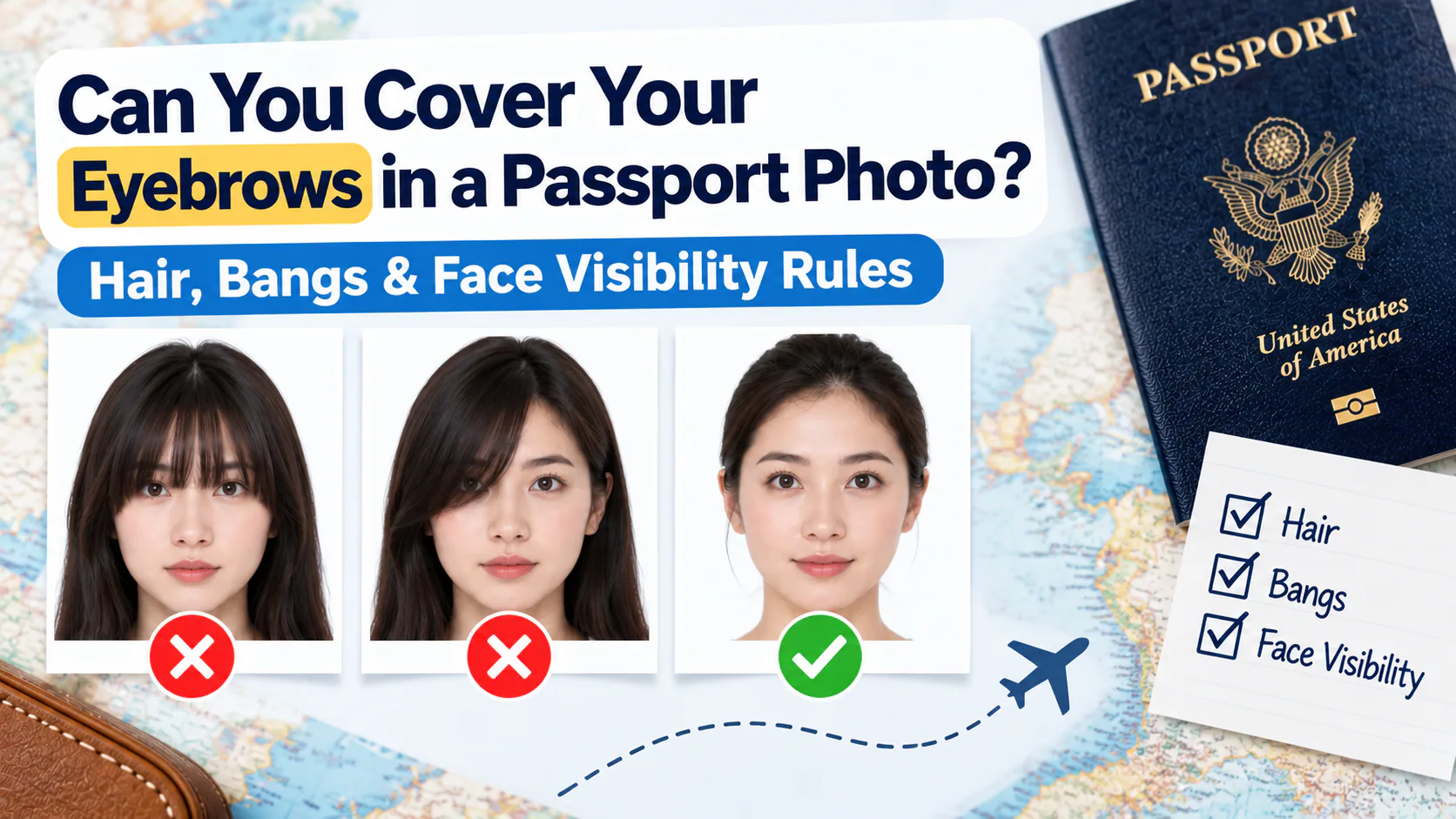
Quick Answer
You can normally wear your hair up or down in a passport photo. The safest rule is to keep both eyes and the outline of your face clearly visible. U.S. and UK passport rules do not specifically say that both eyebrows must be fully visible, but bangs must not cover your eyes or hide your face. Canada is stricter about the facial outline: hair must be off the face so its edges remain visible.
Short bangs above the eyes are usually fine. If your fringe falls over an eye, hides the sides of your face, or creates a shadow, pin or part it back and retake the photo.
| Country | Official hair rule | Must eyebrows show? | Must ears show? |
|---|---|---|---|
| United States | Eyes and full face must be visible; the entire head must be shown | No separate rule requiring both eyebrows to be fully visible | No separate requirement |
| United Kingdom | Eyes must be open and visible; hair cannot be in front of the eyes; nothing may cover the face | No separate requirement | No separate requirement |
| Canada | Hair may be up or down but must stay off the face so its edges are visible | No separate eyebrow rule, but the face and eyes must remain clear | Ears do not have to be exposed, but facial edges must be visible |
Rules vary by document and country. Always follow the instructions for the exact passport, visa or ID application you are submitting.
Do Both Eyebrows Have to Be Visible?
Not necessarily. The official U.S., UK and Canadian passport guidance focuses on visible eyes, an unobstructed face and a clear facial outline. None of those three authorities publishes a general rule saying that every part of both eyebrows must always be visible.
That does not mean heavy bangs are automatically acceptable. Hair becomes a problem when it:
- Covers either eye or makes the eyes difficult to see
- Hides the sides or outline of the face
- Casts shadows across the eyes or face
- Makes it difficult to confirm that the head is facing forward
- Causes part of the head to be cropped out of the image
If a few strands touch an eyebrow but your eyes and full face remain clear, the official rules do not automatically make the photo invalid. For the lowest-risk result, move long or heavy bangs away from the eyes before the photo is taken.
Official Hair Rules by Country
United States
The U.S. Department of State requires applicants to face the camera directly with the full face visible. The eyes must be open and the colored portions of the eyes must not be obstructed by hair. The entire head must also be shown and correctly sized in the photo.
U.S. guidance does not say that ears or both eyebrows must be fully visible. It does say the photo must be an original, unaltered image. Do not use filters or AI to remove hair, rebuild facial features or change your appearance after taking the photo.
Official source: U.S. Department of State passport photo requirements
United Kingdom
UK rules state that you must face forward, look directly at the camera, keep your eyes open and visible, and have no hair in front of your eyes. Nothing may cover your face. For a digital application, the photo must also be unaltered by computer software.
The UK guidance does not separately require visible eyebrows or ears. A fringe is therefore usually acceptable when it stays clear of the eyes and does not hide the face.
Official source: GOV.UK passport photo rules
Canada
Canadian rules explicitly allow hair to be worn up or down, but require it to stay off the face so that the edges of the face are visible. The eyes must be open and clearly visible. The face and shoulders must be centered and square to the camera.
Canada also requires passport photos to be taken in person by a commercial photographer or photo studio. Both printed and digital Canadian passport photos must remain unaltered; Canada specifically prohibits photo-editing software, filters and AI alterations.
Official source: Government of Canada passport photo requirements
Are Bangs Allowed in a Passport Photo?
Yes, bangs or a fringe can be acceptable. What matters is where the hair falls.
| Hairstyle situation | Risk level | What to do |
|---|---|---|
| Short bangs above the eyes | Low | Keep them neat and check for shadows |
| Wispy strands touching an eyebrow | Usually low | Confirm both eyes and the facial outline remain clear |
| Side-swept fringe near one eye | Medium | Pin or part it away from the eye |
| Heavy bangs covering an eye | High | Move the hair before taking the photo |
| Hair hiding the sides of the face | High for Canada; risky elsewhere | Tuck or pin it back enough to show the face outline |
| Hair casting a shadow over the eyes | High | Adjust the hair and lighting, then retake |
Do not digitally erase or reshape hair after the photo is taken. Correct the hairstyle and take a new original photo.
Do Your Ears Need to Be Visible?
For ordinary U.S., UK and Canadian passport photos, there is no universal rule requiring both ears to be exposed. Hair may cover the ears if the eyes, face and required facial outline remain visible.
This is different from some visa, national ID or residence-card applications, which may publish their own ear-visibility instructions. Check the exact document requirements instead of applying one country's passport rule to every application.
Can You Wear Your Hair Up?
Yes. Common acceptable styles include:
- Ponytails
- Low or high buns
- Braids
- Locs
- Natural curls
- Afros
- Hair worn loose
The hairstyle itself is not the deciding factor. Make sure the face is not hidden and the full head fits inside the required frame. Large buns or high-volume styles may require the photographer to stand farther back so the head and hair are not cropped, while still keeping the face at the required size.
Natural texture should not be flattened or digitally changed. The photo should accurately represent how you look.
Hair Clips, Bobby Pins and Headbands
A small, plain bobby pin or clip used to keep hair away from the eyes is generally less risky than a large decorative accessory. However, official passport pages do not publish one universal rule for every type of hair accessory.
For a simple, low-risk photo:
- Use the smallest clip needed to keep hair off the face
- Avoid large bows, flowers or reflective decorations
- Remove wide headbands that may resemble a head covering
- Make sure the accessory does not cast a shadow
- Do not let it hide the hairline or any part of the face
If the application instructions prohibit accessories, follow those instructions even if the face remains visible.
Religious and Medical Head Coverings
The U.S., UK and Canada allow head coverings in qualifying religious or medical circumstances, but the face must remain visible and the covering must not create shadows. Documentation rules differ:
- United States: a signed statement is generally required for a religious head covering, or a signed doctor's statement for a medical covering.
- United Kingdom: religious or medical head coverings are allowed when the face remains visible.
- Canada: head coverings worn daily for religious beliefs or medical reasons are accepted when the full face is visible and there are no facial shadows. Medical cases may require a written explanation.
Always check the application authority's current instructions before taking the photo.
How to Prepare Your Hair
Use this checklist before taking the picture:
- Face the camera directly in even lighting.
- Confirm that both eyes are fully visible.
- Move long bangs or a side fringe away from the eyes.
- For a Canadian passport, keep the hair off the face so both facial edges show.
- Check that no hair creates a shadow across the eyes, nose or cheeks.
- Keep the entire head and hairstyle inside the frame.
- Remove large or reflective accessories.
- Have another person take the photo; do not rely on a close-up selfie.
- Review the original at full size before printing or uploading.
- If something is hidden, fix the hair and retake instead of editing the image.
For the rest of the setup, see how to take a passport photo at home and the complete passport photo requirements guide.
Common Hair-Related Problems
Hair covers part of an eye
Retake the photo. All three countries require clearly visible eyes.
The face looks clear, but the hair casts a shadow
Move farther from the background, adjust the light and retake. Shadows across the face or background can cause problems even when the hair itself is not blocking anything.
A bun or afro is cropped
Reframe the photo so the entire head and hairstyle are visible. Do not shrink the face below the country's required head-size range simply to make the hair fit.
Hair covers the ears
This is normally acceptable for U.S., UK and Canadian passports, provided the eyes and face remain clear and Canada's facial-edge rule is satisfied.
Only part of one eyebrow is covered
There is no general U.S., UK or Canadian rule requiring both eyebrows to be completely exposed. Check whether the hair is also hiding an eye, the facial outline or creating a shadow. If the case looks borderline, moving the hair slightly is safer.
Frequently Asked Questions
Can bangs cover my eyebrows in a passport photo?
They may touch or partly cover an eyebrow if the eyes and face remain clearly visible. The U.S., UK and Canada do not publish a general rule requiring both eyebrows to be fully exposed. Heavy bangs that cover an eye or hide the face should be moved.
Can hair cover my eyes?
No. U.S., UK and Canadian guidance requires the eyes to be open and clearly visible.
Do I have to tuck my hair behind my ears?
Not for a standard U.S., UK or Canadian passport photo. You may leave your ears covered if your face remains clearly visible and you meet the specific country's other rules.
Can I wear a ponytail or bun?
Yes. Keep the full head inside the frame and make sure the hairstyle does not hide the face or create shadows.
Are braids, locs, curls and afros allowed?
Yes. Natural hairstyles and textures are allowed. The relevant requirements are facial visibility, correct framing and an accurate, unaltered appearance.
Can I wear a headband?
A wide or decorative headband is best removed unless it is required for an accepted religious or medical reason. A small, plain clip used to keep hair away from the eyes presents less risk, but the exact document's instructions control.
Can I edit stray hairs after taking the photo?
Do not digitally remove or reshape hair for U.S., UK or Canadian passport photos. These authorities require an original or unaltered photo. Retake it instead.
Are the rules the same for visas and ID cards?
No. Visa, residence-card and national ID rules can differ from passport rules. Check the authority responsible for the exact document.
Final Checklist
- Both eyes are open and fully visible
- Hair does not cover the face
- Facial edges meet the destination country's rules
- No hair shadow crosses the face
- Full head and hairstyle fit in the image
- No large or distracting hair accessory
- Photo remains original and unaltered
If you are preparing a U.S. application, review the U.S. passport photo maker and requirements before downloading or printing.
About the Author
Emma Richardson
Senior ICAO Photo Compliance Expert, PhotoOmni
Emma Richardson has more than 12 years of experience reviewing passport and visa photo requirements. She specializes in biometric photo standards, application-photo quality checks and international document formats.