
Schengen Visa Photo Size & Requirements 2026: Dimensions, Background and Examples
Quick answer: The official Schengen visa photo size is 35 × 45 mm (3.5 × 4.5 cm, or 1.38 × 1.77 inches), with your face height measuring 32–36 mm from chin to crown so it fills roughly 70–80% of the frame.
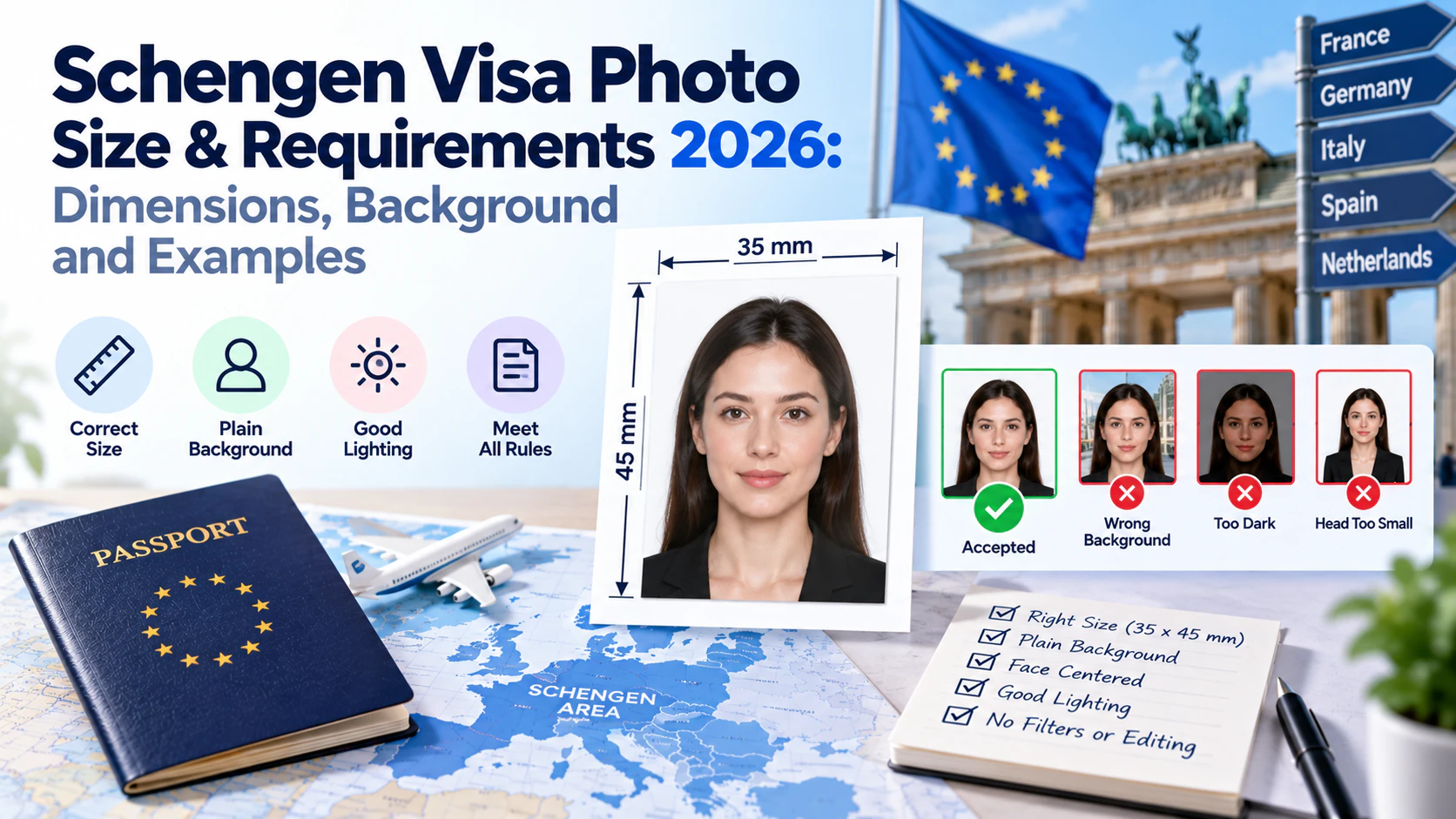
Quick answer: The official Schengen visa photo size is 35 × 45 mm (3.5 × 4.5 cm, or 1.38 × 1.77 inches), with your face height measuring 32–36 mm from chin to crown so it fills roughly 70–80% of the frame. The background must be plain white or light-colored, the photo must be in color and taken within the last 6 months, and this specification is harmonized across all 29 Schengen countries under EU Visa Code Regulation (EC) No 810/2009 and ICAO Document 9303 — so you don't need to check country-by-country.
If you've searched around for this spec, you've probably noticed some sites list different numbers — 35×40mm, or even 35×35mm. Those are errors, not regional variations. The correct, officially harmonized size is 35 × 45 mm, full stop. This guide covers every dimension and requirement you actually need, plus the details most articles skip: pixel specs for digital uploads, baby and child rules, and what actually varies (barely anything) between Schengen countries.
Standard Size: 35 × 45 mm
Your photo must measure exactly:
- 35 mm wide × 45 mm tall (3.5 × 4.5 cm)
- In imperial measurements: 1.38 × 1.77 inches
This is a tall rectangle — noticeably different from the square 2×2 inch format used for US passport photos. If you've had a US passport photo taken recently, it will not work as-is for a Schengen application; the proportions are wrong even before you check anything else.
Pixel Dimensions and Resolution (Digital Uploads)
For online applications, exact pixel requirements vary slightly by the specific portal you're uploading to, but the commonly cited baseline conversions are:
- At 300 DPI: approximately 413 × 531 pixels
- Minimum accepted by some portals: 600 × 750 pixels
- File size: typically at least 50KB and no more than 10MB, depending on the portal
Always check the specific upload instructions for the embassy, consulate, or visa center (VFS Global, TLScontact, or the embassy's own portal) you're applying through, since file size caps and minimum resolution can differ slightly by system even though the physical photo dimensions do not.
Head Size and Face Proportion
- Face height (chin to crown): 32–36 mm
- Face coverage of the frame: approximately 70–80%
- Your head must be centered, facing forward, with enough space around it that the crop doesn't feel tight
This proportion requirement trips up more applicants than the overall photo size does. A photo that's the correct 35×45mm size but has a face that's too small, too large, or off-center will still be rejected — the outer dimensions are only half of the specification.
Background Requirements
- Color: plain white or very light-colored (light grey is also commonly accepted)
- No patterns, textures, or shadows on the background
- Clear contrast between your face/hair and the background — this matters especially if you have light-colored or gray hair against a white backdrop
- No other objects or people visible in the frame
Expression, Pose and Attire
- Facing forward, looking directly at the camera
- Neutral expression, mouth closed, no smiling
- Eyes open and clearly visible, not obscured by hair
- No head coverings, except for religious or medical reasons — and even then, your face from chin to forehead must remain fully visible
- No shadows on the face or on the background behind you
- Simple, plain clothing is recommended; avoid clothing that matches the background color
Glasses: What's Allowed and What Isn't
- Glasses are only acceptable if you wear them as a consistent part of daily life — removing them is the safer default if you're unsure
- Thin frames only — frames must not obscure your eyes or eyebrows
- No tinted or sunglasses lenses
- No glare or reflections on the lenses; if your photo shows any reflection, it needs to be retaken
Digital vs. Printed Photos: What's Different
| Printed | Digital | |
|---|---|---|
| Size | 35 × 45 mm exactly | Same ratio, in pixels |
| Paper | Matte or glossy, professional photo paper | N/A |
| Background | Plain white/light, no border | Plain white/light |
| Editing | Must be unaltered | Must be unaltered |
| Where used | In-person applications, physical submission | Online application portals |
Both versions must meet identical proportions and background standards — a digital file is simply the same specification measured in pixels instead of millimeters. Neither format allows filters, digital retouching, or beautification edits of any kind; the photo must reflect your natural, unedited appearance.
Common Reasons Photos Get Rejected
- Face too close (chin or forehead cropped) or too far away (face smaller than the 70-80% requirement)
- Head not centered, or tilted at an angle
- Shadows visible on the face or background
- Photo older than 6 months
- Smiling, or mouth visibly open
- Glasses causing glare, or tinted lenses
- Head covering that isn't for religious/medical reasons, or one that obscures part of the face
- Background with visible texture, pattern, or a color that isn't plain white/light
Baby and Children's Photo Rules
Every applicant needs their own compliant photo — including infants. This is one of the more commonly missed requirements, since parents sometimes assume a young child can be included in the parent's photo or skip the requirement entirely.
For children:
- Same core specification as adults — centered, forward-facing, neutral expression as much as possible
- Simple, non-flashy clothing
- No toys, pacifiers, or other objects visible in the frame
For infants and babies:
- Photographing the baby lying on a plain white sheet is a commonly used technique, since infants can't sit upright with adult-level control
- The parent or caregiver cannot appear in the photo, and cannot be holding the child in the frame
- For children under roughly 3 years old, a slightly open mouth is generally acceptable, since a fully neutral, closed-mouth expression isn't realistic at that age
- Eyes must be open — a photo taken mid-blink or with eyes closed will be rejected
- Avoid photos taken while the baby is crying or with an exaggerated expression
Is the Requirement the Same for All 29 Schengen Countries?
Yes, for the core specification. The 35×45mm size, face proportion, and neutral-expression requirement are harmonized across all Schengen member states under the EU Visa Code and ICAO 9303 standards — you do not need to look up country-specific dimensions. The minor variation that does exist is mostly cosmetic: some consulates express a preference for light grey over pure white backgrounds, and glasses policy enforcement can be marginally stricter at some visa centers than others. When in doubt, follow the exact instructions listed on the specific embassy, consulate, or VFS/TLScontact portal you're applying through, since they'll flag anything beyond the universal core spec.
Get It Right the First Time
Getting all of these requirements correct in a single photo — the exact crop, the correct face proportion, a genuinely plain background, no shadows — is harder to do with a phone camera and a white wall than it sounds. PhotoOmni takes a photo you upload and automatically formats it to the exact 35 × 45 mm Schengen specification: correct crop, correct head size, background cleaned to plain white, and output ready for both digital upload and print, without altering your actual facial features. It's built specifically around the requirements covered in this guide, so you're not left guessing whether your crop or background will pass.
FAQ
Can I use a photo I already have, like a US passport photo? No — the proportions are different. US passport photos are a 2×2 inch square format, while Schengen visa photos are a 35×45mm tall rectangle with a different face-to-frame ratio. You'll need a new photo taken or reformatted specifically to the Schengen specification.
Do I need a printed photo, a digital upload, or both? It depends on how you're applying. Paper-based applications typically require two identical printed photos; some online application portals accept a single digital upload instead. Check the specific instructions for the embassy, consulate, or visa center handling your application.
Can I wear my everyday glasses in the photo? Yes, if you wear them consistently — but the frames must be thin enough not to obscure your eyes or eyebrows, the lenses must be clear (no tint), and there must be no glare or reflection. If you're unsure, removing glasses is the safer choice.
What if my child won't sit still or keep a neutral expression? For children, aim for as neutral an expression as realistically possible, but for infants under about 3 years old, a slightly open mouth is generally accepted since a fully closed, neutral expression isn't realistic at that age. Eyes must be open regardless of age.
How old can the photo be? No older than 6 months at the time of application. Even if you feel your appearance hasn't changed, using an older photo is a common and avoidable reason for rejection.
Do all 29 Schengen countries really use the exact same photo size? Yes — the core specification (35×45mm, face proportion, neutral expression, plain background) is harmonized under EU and ICAO standards across all member states. Minor preferences (like background shade) can vary slightly by consulate, but the fundamental size and proportion requirements do not change by country.
Bottom Line
The Schengen visa photo spec is precise but consistent: 35 × 45 mm, face height 32–36 mm, plain light background, neutral expression, taken within 6 months — the same everywhere in the Schengen area. Most rejections come from getting the face proportion or background wrong, not the outer photo size, so double-check those details specifically before you submit.