
Can You Smile in a Passport Photo?
Learn when a natural smile is allowed in passport photos, how country rules differ and why a relaxed neutral expression is usually the safest choice.
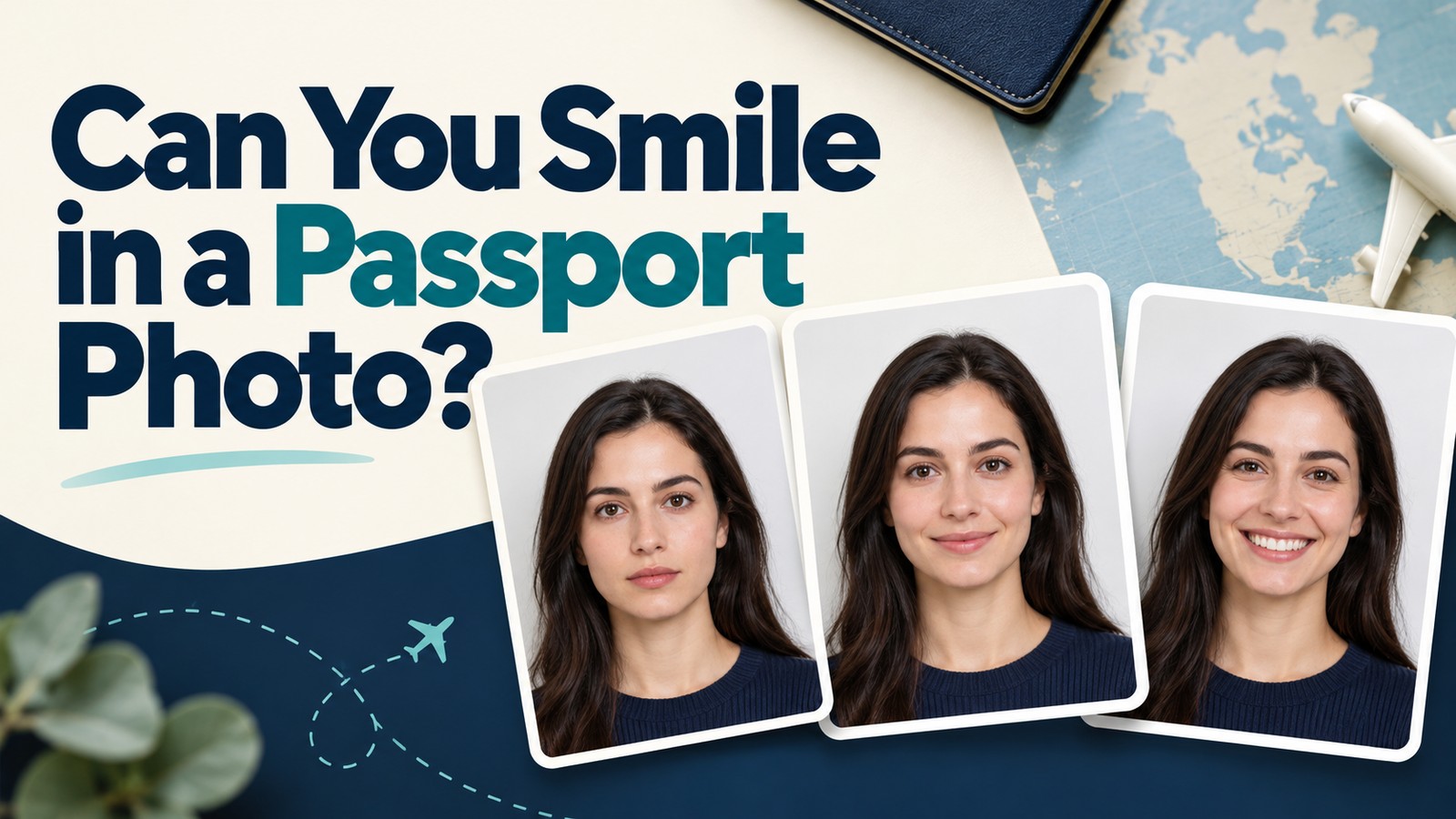
Quick Answer: It depends on the country. For a US passport, the State Department says you can smile, but it must be a natural, unexaggerated smile, with both eyes open. The UK, Canada and Australia ask for a neutral expression with the mouth closed. A broad, toothy smile is the riskiest choice everywhere, so the safest photo is a relaxed, neutral face with lips together. If you want to be sure, check your country's official page, and check your photo before you print or upload it. Check your passport photo with PhotoOmni →
Smile Rules by Country
| Country | Smile allowed? | What to do |
|---|---|---|
| United States | Yes, if natural and unexaggerated | Keep both eyes open. A neutral expression is the lowest-risk option |
| United Kingdom | No. Neutral expression, mouth closed | Relax your face, lips together |
| Canada | No. Neutral expression, mouth closed, eyes open | Same |
| Australia | No. Neutral expression, mouth closed | Same |
| India | Neutral expression | Indian consulate instructions specify a neutral expression. Follow the instructions for your application route |
Confirm each rule on the issuing authority's current page before you take the photo. Official guidance: United States, United Kingdom, Canada, Australia.
The US Rule: "Can" Isn't "Should"
A fact check of a viral claim that Americans can't smile in passport photos found it false. The State Department's passport photo FAQ answers "Can I smile?" with yes, but it must be a natural, unexaggerated smile. A State Department customer representative also confirmed that a natural smile is allowed. The same fact check notes that the department had made no announcement of a policy change.
An older formulation of the guidelines, attributed to a State Department spokesperson, says the most neutral face is the most desirable standard for identification, and that a smile with a closed jaw is allowed but not preferred. That's a useful way to read the rule: a smile is permitted, but neutral is the standard.
Two practical points:
- Eyes open and mouth closed. The expression guidance repeatedly pairs a natural smile with open eyes and a closed mouth.
- Teeth are risky. Guides generally advise not showing your teeth. The State Department’s online-renewal photo guidance explicitly advises avoiding visible teeth. A photo can be rejected for an exaggerated expression.
Why Passport Photos Prefer a Neutral Face
A smile shifts the position of facial points, which can make it harder for face-matching software to determine that the face in your photo matches the face in the document. That's why many countries ask for a neutral expression: it gives the most consistent reference for border checks and comparisons over the years your passport is valid.
Toothy Smile vs Closed-Mouth Smile vs Neutral
| Expression | Risk | Notes |
|---|---|---|
| Toothy or broad smile | High | Likely to be rejected in most countries |
| Gentle closed-mouth smile | Medium | Allowed in the US as a natural smile, not accepted in countries that require a neutral face |
| Neutral, lips together | Low | Accepted everywhere, but look relaxed, not tense |
Babies and Children
Rules for infants are more relaxed. The US guidance, as summarized by a travel writer, says an infant's eyes can be closed or only partially open, while older children must have their eyes open. Expression exemptions depend on the country and age: the UK does not require under-6s to have a neutral expression, while Canada allows some variation for newborns. Do not assume one country’s exception applies everywhere. Check the country's current child rules before you take the photo.
What Other Guides Get Wrong
When you read several guides, you'll see contradictions:
- Some flatly say "no, you can't smile," including for US passports. That's incorrect for the US, according to the State Department's FAQ.
- Some pages state that US rules require a neutral expression and, a few lines later, that smiling is okay.
- Some guides conflict about India; use the official instructions for your application route.
- Few guides explain how to pose a neutral face that still looks natural.
How to Take the Photo (Step by Step)
- Decide your country's rule first. If it requires a neutral face, don't try a smile.
- Relax your face. Breathe out, drop your shoulders and let your cheeks relax.
- Keep your lips gently together, not pressed or pursed.
- Look straight at the camera with both eyes open. Don't squint, and don't raise your eyebrows.
- Hold your head level, with no tilt.
- Take several shots and pick the most neutral one.
- Check the photo against the official rules, including background, head size and lighting. Check it with PhotoOmni →
Practicing a neutral expression in a mirror helps. One tip from guides is to think of a calm thought, not a smile.
Common Mistakes
- Showing teeth or grinning.
- Squinting or raised cheeks from a "forced" smile.
- Pursed lips or a tense jaw.
- Raised eyebrows or a surprised look.
- Looking away or tilting the head.
- Assuming US rules apply to every country.
- Not checking the photo before submitting it.
Checklist
- I know my issuing country's expression rule
- Neutral face with lips together, or a natural closed-mouth smile if the US allows it
- No teeth showing
- Both eyes open, no squinting
- Head level, looking straight ahead
- Photo checked against the full requirements
Get It Checked With PhotoOmni
Expression is one of several things a reviewer looks at, alongside background, lighting and head size. PhotoOmni combines AI formatting with a human review, and that review includes checking your expression, so a smile that's too broad, a squint or a tense mouth can be flagged before you print or submit. PhotoOmni's public listings also describe a free check before you buy and an acceptance guarantee for eligible photos. See the 30-day refund policy for photo-related rejection caused by PhotoOmni; final acceptance rests with the issuing authority. Upload your photo for a free check →
A review can flag an expression problem, but it can't change what your country allows. Decide your country's rule first, then use the review to confirm the photo meets it.
FAQ
Can you smile in a passport photo? In the US, yes, if it's a natural, unexaggerated smile with your eyes open. In the UK, Canada and Australia, the expression should be neutral with the mouth closed.
Can you show teeth in a passport photo? It's risky. Guides advise against it, and an exaggerated expression can get your photo rejected.
Can you smile in a US passport photo? Yes, if it's natural and unexaggerated. A neutral face is the lowest-risk choice.
Can you smile in a UK passport photo? No. The UK asks for a neutral expression with the mouth closed.
Can babies smile in passport photos? Some countries allow expression variations for infants or young children. Check the relevant country’s age-specific rules.
Why can't you smile in passport photos? Smiling changes your facial features, which can make face-matching less reliable.
Does PhotoOmni check my expression? Yes. PhotoOmni's human review includes an expression check, along with the other photo requirements.
Does a visa photo follow the same rule? Not always. Check the visa authority's instructions.
Bottom Line
You may be allowed a natural smile for a US passport, but a neutral expression with a closed mouth is the safest everywhere. Check your country's rule, take several shots and check your photo before you submit it. Check your passport photo with PhotoOmni →
Official sources: US State Department passport photos · GOV.UK passport photo rules · Canada passport photo specifications · Australian passport photo guide · Indian consulate passport photo instructions