
PhotoOmni Insights · 2026 report
2026 Airline Baggage Fees & Carry-On Rules Report
We analyzed baggage policies across 30 major airlines. Only 62% of the airlines we could clearly classify include a standard overhead carry-on in their lowest or reference economy fare.
Airline baggage rules have become one of the most fragmented parts of flying.
A fare that looks cheaper at first glance may include only a seat and a small under-seat bag, while another airline may include a personal item, an overhead carry-on and even checked baggage in the ticket price.
To understand how large those differences have become, we analyzed the published 2026 baggage policies of 30 major airlines across the United States, Europe, Asia-Pacific and the Middle East.
The results show a clear divide.
Among the 29 airlines whose lowest or reference economy fare could be clearly classified, 18 include a standard overhead carry-on at no additional charge. Eleven do not.
That means only:
62%
of the airlines analyzed with a clearly classifiable policy include a standard overhead carry-on in the reference fare.
The differences become even larger when low-cost airlines, full-service carriers and regions are compared.
Key Findings
Our analysis of 30 major airlines found:
62% include a free overhead carry-on
Among the 29 airlines that could be clearly classified, 18 include a standard overhead-bin carry-on, while 11 require passengers on the reference fare to pay for it separately.
One airline was excluded from this percentage because its Economy hand-baggage allowance varies by fare.
Only 33% of low-cost airlines analyzed include a free overhead carry-on
Of the 12 low-cost, ultra-low-cost and hybrid airlines in our sample, only 4 include a standard overhead carry-on in the reference fare.
The remaining eight either charge separately for overhead cabin baggage or restrict the lowest fare to a smaller personal item.
78% of full-service airlines analyzed include a standard carry-on
Among the 18 full-service airlines in the study, 14 include an overhead carry-on in the reference fare.
However, even full-service status no longer guarantees that cabin baggage is included.
Several traditional carriers now offer stripped-down Economy Basic fares that exclude a standard overhead bag.
U.S. airlines are split 50/50
Among the 10 U.S. airlines analyzed:
5 include a standard overhead carry-on in the reference fare.
5 do not.
This means two tickets sold as an airline's lowest economy option can provide very different baggage allowances before checked baggage is even considered.
Only 3 of 9 clearly classified European airlines include a free overhead carry-on
Europe shows one of the strongest examples of baggage unbundling.
Of the nine European airlines in our sample that could be clearly classified, only three include a standard overhead carry-on in the reference fare.
Six do not.
One additional European carrier was treated as fare-dependent and excluded from the percentage.
All 10 Asia-Pacific and Middle Eastern airlines in our sample include a standard carry-on
The regional contrast is striking.
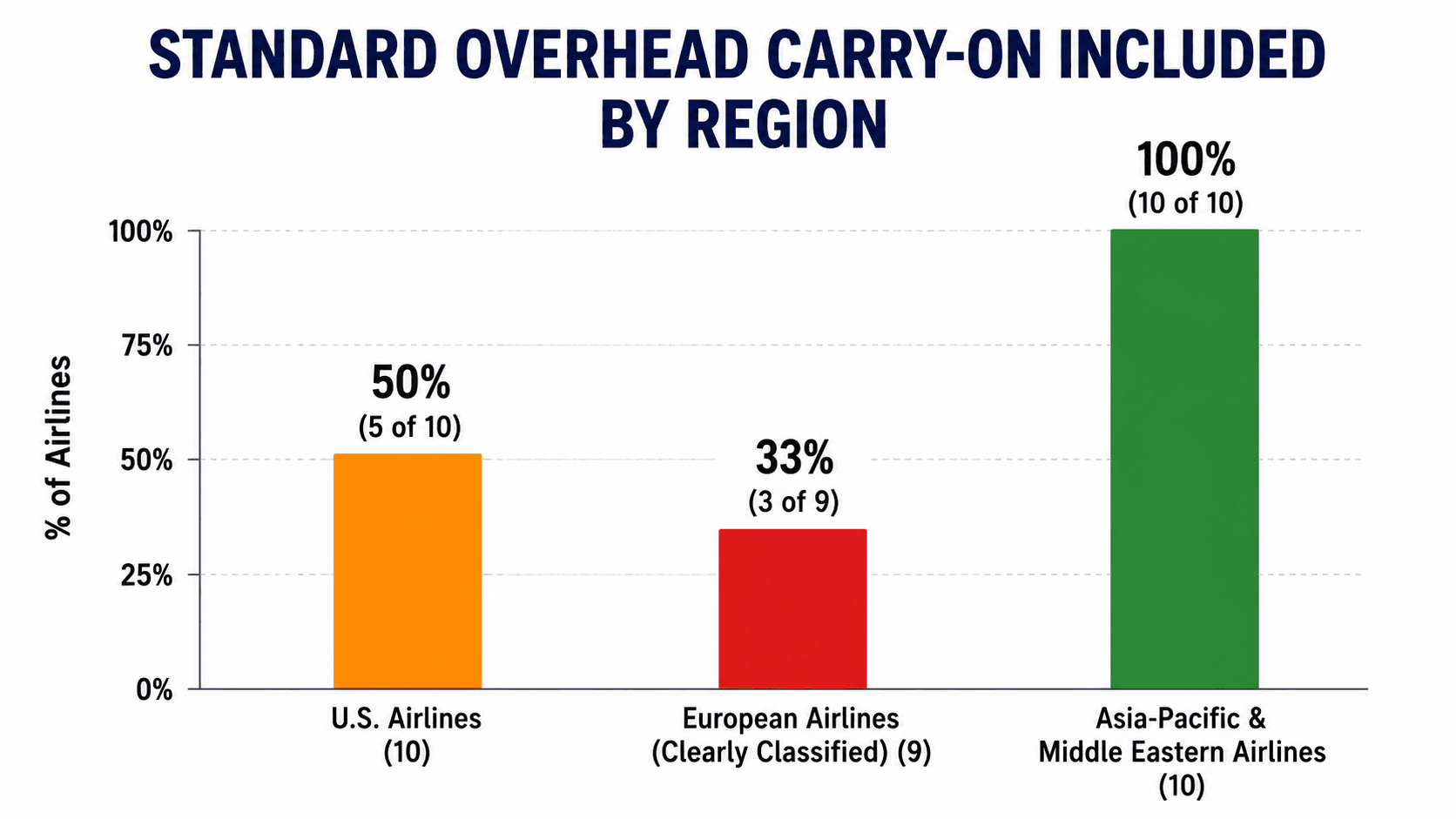
All 10 Asia-Pacific and Middle Eastern airlines included in our sample allow a standard cabin bag in the reference economy fare we analyzed.
That is:
100%
compared with:
50% among the U.S. airlines analyzed
and
33% among clearly classified European airlines.
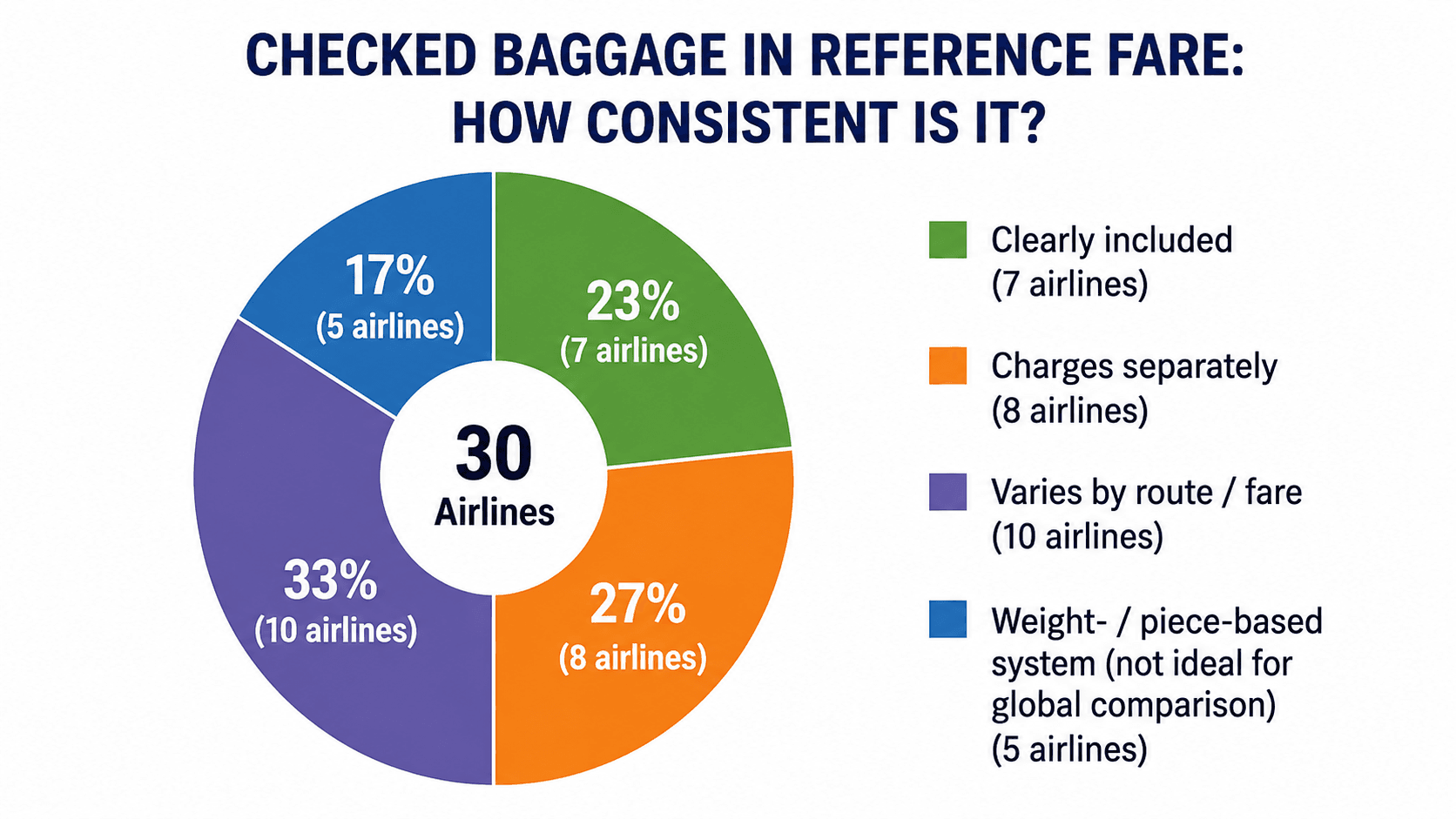
Only 7 of the 30 reference fares clearly include checked baggage
Checked baggage is even less consistent.
Only 7 of the 30 airlines in our dataset were classified as clearly including checked baggage in the specific lowest/reference fare used for the study.
Others charge separately, vary the allowance by route or fare, or use weight- and piece-based systems that make a single global fee comparison misleading.
Methodology
We reviewed the published baggage policies of 30 major passenger airlines in August 2026.
The sample consists of:
- 10 U.S. airlines
- 10 European airlines
- 10 Asia-Pacific and Middle Eastern airlines
The airlines analyzed include a mix of traditional full-service carriers, low-cost airlines, ultra-low-cost carriers and hybrid airline models.
For each airline, we recorded the baggage allowance associated with its lowest broadly marketed economy or comparable reference fare where that fare could be identified from the airline's published information.
We collected:
- Personal-item allowance
- Personal-item dimensions where published
- Standard carry-on inclusion
- Carry-on dimensions
- Carry-on weight limits
- Checked-bag inclusion
- First checked-bag fee where a stable reference price was available
- Second checked-bag fee where available
- Standard checked-bag weight allowance
- Fare and route restrictions
- Official airline source
A “free overhead carry-on” in this report means a standard cabin bag that can be stored in an overhead compartment without purchasing an additional baggage product.
A free handbag, backpack or other small item that must fit under the seat does not count as a standard overhead carry-on.
Where baggage policies or prices vary substantially by route, date, fare or booking method, we classify them as variable rather than forcing them into a single price.
All policies were checked against airline-published information.
1. A Free Carry-On Is No Longer Standard
38% of clearly classified airlines charge separately for an overhead carry-on
Of the 29 airlines with a clearly classifiable reference fare:
18 — 62% — include an overhead carry-on.
11 — 38% — do not.
This distinction is important because almost every airline in our sample allows some form of personal item.
But a personal item is not necessarily the suitcase travelers traditionally think of when they hear “carry-on.”
On many unbundled fares, the free allowance may be limited to a backpack, handbag or laptop bag that fits underneath the seat.
A passenger wanting to use the overhead bin may have to purchase another baggage option.
The result is a growing difference between:
“Cabin baggage is allowed”
and
“An overhead carry-on is included in the fare.”
2. Low-Cost Passengers Are Much More Likely to Pay for Carry-On
Only 1 in 3 low-cost airlines analyzed includes an overhead carry-on
The difference becomes much clearer when airlines are divided by business model.
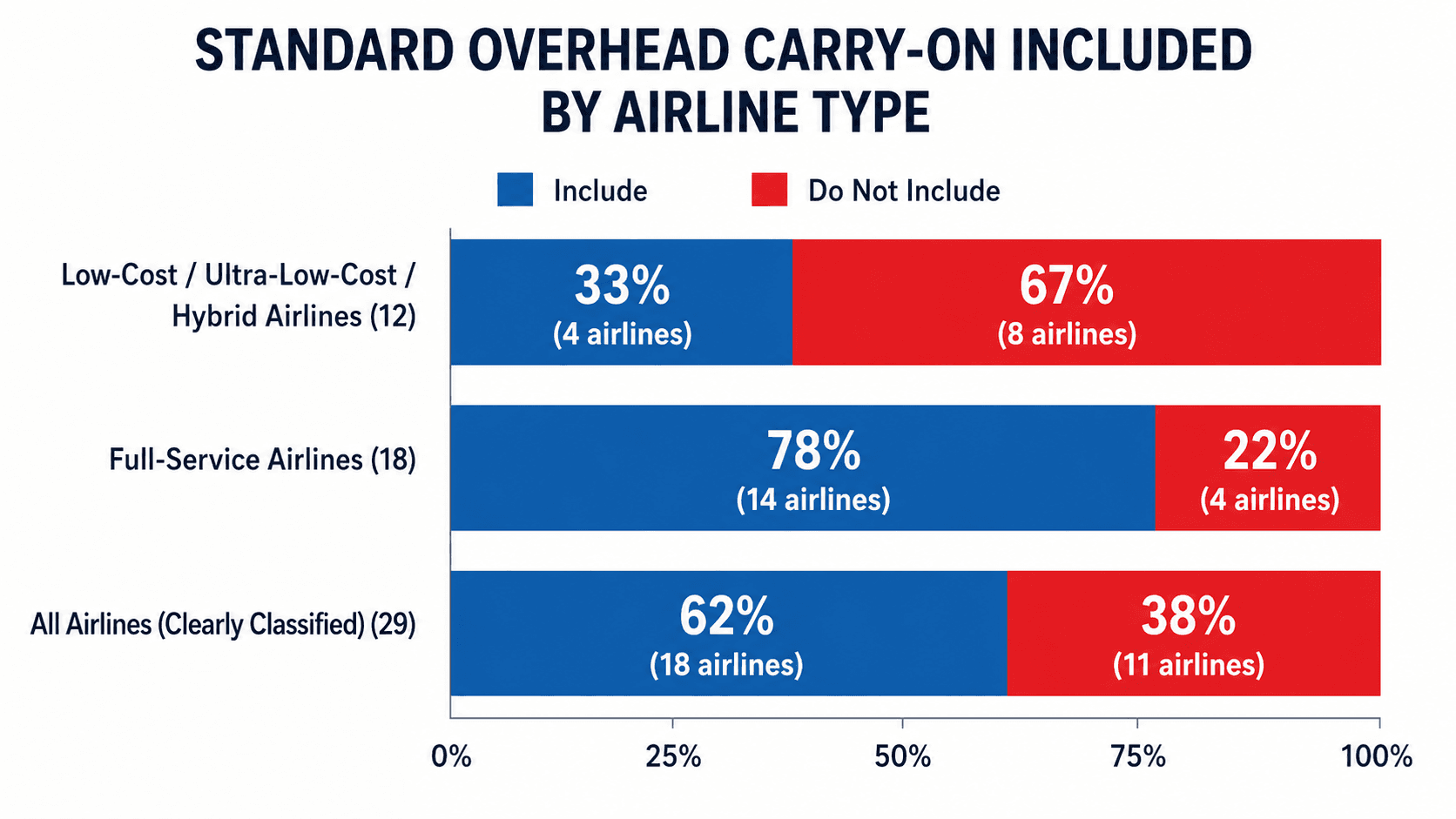
Among the 12 low-cost, ultra-low-cost and hybrid airlines analyzed:
4 of 12
include a standard overhead carry-on in the reference fare.
That's approximately:
33%
Among the 18 full-service airlines:
14 of 18
include one.
That's approximately:
78%
In other words, a standard carry-on was more than twice as likely to be included among the full-service airlines in our sample as among the low-cost group.
This is one reason headline airfare alone can be misleading when comparing low-cost and traditional airlines.
A passenger planning to travel with an overhead cabin bag needs to compare the price after baggage is added, rather than simply comparing the first fare displayed.
3. Europe Shows the Strongest Carry-On Unbundling
Two-thirds of clearly classified European airlines in our sample exclude a standard overhead bag from the reference fare
Among the European airlines analyzed, Ryanair, easyJet and Wizz Air illustrate how the definition of “free cabin baggage” has changed.
Ryanair's standard free allowance is a 40 × 30 × 20 cm small personal bag.
A larger trolley bag requires Priority or another eligible baggage option.
Wizz Air follows a similar model: its free cabin bag measures 40 × 30 × 20 cm, while a 55 × 40 × 23 cm trolley bag requires WIZZ Priority.
easyJet allows a somewhat larger free under-seat cabin bag measuring 45 × 36 × 20 cm, but a larger overhead cabin bag depends on the seat or baggage option purchased.
The overall result in our European sample is:
3 of 9 clearly classified airlines include an overhead carry-on.
6 of 9 do not.
One additional European airline was classified as fare-dependent.
That means approximately:
67%
of the clearly classified European airlines in our study exclude a standard overhead carry-on from the reference fare.
4. Full-Service Airlines Are Starting to Unbundle Carry-On Too
Low-cost airlines are not the only carriers separating cabin baggage from the lowest fare.
Our dataset found examples among traditional full-service airlines as well.
Lufthansa's Economy Basic product on applicable European routes includes a small personal item measuring 40 × 30 × 15 cm, while a standard 55 × 40 × 23 cm carry-on can be purchased separately.
KLM's Economy Basic allowance similarly includes a 40 × 30 × 15 cm small bag, while the larger standard hand-baggage allowance is not automatically included in that Basic product.
United's Basic Economy baggage rules also demonstrate how baggage inclusion can depend on market, fare and passenger status.
This suggests an important shift:
“Full-service airline” no longer automatically means “full baggage allowance.”
The fare itself matters increasingly as much as the airline.
5. The U.S. Market Is Split Down the Middle
5 of 10 U.S. airlines include a free overhead carry-on. Five do not.
Our U.S. sample produced an exact 50/50 split.
The airlines in the dataset that include a standard overhead carry-on on the reference fare are:
- Delta Air Lines
- American Airlines
- Southwest Airlines
- JetBlue
- Alaska Airlines
The other five reference fares analyzed do not include a standard overhead carry-on or require an additional baggage purchase under the conditions studied.
This is a major difference for travelers comparing low headline fares.
A traveler choosing between two airlines may see only a small difference in the initial ticket price, but the relative value can change once an overhead bag is added.
6. Checked Bags Can Add $90 or More to a U.S. Round Trip
Carry-on baggage is only part of the story.
Checked-bag fees have also become a meaningful component of the final ticket price.
For example, several U.S. airlines in our dataset have a first checked-bag reference price around $45 each way under the conditions studied.
At $45 per direction:
One checked bag
$45 outbound
- $45 return
= $90 round trip
A family or traveler checking multiple bags can therefore add hundreds of dollars to the initial airfare.
Second checked bags can cost even more.
This is why the lowest advertised ticket price increasingly represents only one part of the real cost of flying.
7. Southwest Now Charges for Checked Bags — But Keeps Carry-On Free
Southwest represents an interesting example of how baggage economics are changing.
For the U.S. Mainland reference conditions in our dataset, Southwest's first checked bag is $45, while the second is $55.
That means two checked bags can add:
$100 each way
or:
$200 round trip
before considering other optional services.
However, Southwest still includes a standard carry-on and personal item in the fare analyzed.
This demonstrates why airlines cannot be categorized simply as “cheap” or “expensive” based on one baggage fee.
One airline may charge for checked baggage while including cabin baggage; another may advertise a lower fare but charge separately for the overhead bag.
8. Carry-On Weight Limits Vary Dramatically
Dimensions are not the only restriction travelers need to consider.
Weight limits vary considerably as well.
Among airlines in our dataset that publish explicit cabin-bag weight restrictions, common allowances include:
7 kg
8 kg
10 kg
and, in some cases, substantially higher limits.
Examples in our dataset include 7 kg economy allowances at several Asia-Pacific and Middle Eastern carriers, 8 kg limits at some European airlines and 10 kg allowances at carriers including Turkish Airlines and several Asian airlines.
easyJet publishes a substantially higher maximum cabin-bag weight than many of these carriers, although passengers must still be able to lift and carry their own baggage safely.
Meanwhile, several U.S. airlines do not publish the same kind of fixed standard carry-on weight limit.
This creates another problem for connecting travelers:
A carry-on that is acceptable on the first airline may be overweight on the second.
9. Asia-Pacific and Middle Eastern Carriers Stand Out
Perhaps the strongest regional result in the entire dataset is found in Asia-Pacific and the Middle East.
All 10 airlines in this portion of our sample include a standard cabin bag in the reference economy fare.
That compares with:
| Region | Airlines With Free Overhead Carry-On |
|---|---|
| Asia-Pacific / Middle East | 10 of 10 — 100% |
| United States | 5 of 10 — 50% |
| Europe | 3 of 9 clearly classified — 33% |
The difference does not stop at cabin baggage.
Several major Asia-Pacific and Middle Eastern full-service airlines in our dataset also include checked baggage in their reference economy product.
For example, the dataset records included checked baggage under the reference conditions for carriers such as Emirates, Qatar Airways, Singapore Airlines, Qantas, ANA, Japan Airlines and Cathay Pacific.
However, allowances vary significantly by route.
Some airlines use a piece concept, such as one or two bags of up to 23 kg each.
Others use a weight concept, where the passenger receives a total kilogram allowance.
For this reason, we did not calculate a single global “average checked-bag fee.”
Doing so would combine fundamentally different baggage systems and create a misleading statistic.
10. The Same “Free Bag” Can Be Very Different Between Airlines
Another issue is that the phrase “personal item” has no universal global size.
For example, several European low-cost airlines in our dataset allow an under-seat bag around:
40 × 30 × 20 cm
easyJet's free small cabin bag is:
45 × 36 × 20 cm
Some U.S. carriers use different dimensional standards again.
The difference becomes important when passengers build itineraries using several airlines.
A backpack purchased specifically to meet one airline's free-baggage limit may not satisfy another airline's restrictions.
Travelers therefore need to check the most restrictive airline in their itinerary — not just the first flight.
11. The Real Cost of a “Cheap” Flight
Consider two hypothetical flights.
Airline A
Ticket:
$120
Overhead carry-on:
Included
Checked bag:
$45
Airline B
Ticket:
$95
Overhead carry-on:
$35
Checked bag:
$50
At first glance, Airline B appears:
$25 cheaper.
But a traveler carrying both an overhead bag and a checked suitcase would actually pay:
Airline A
$120 + $45 = $165
Airline B
$95 + $35 + $50 = $180
The flight that initially appeared $25 cheaper becomes:
$15 more expensive.
This example is hypothetical, but it illustrates the problem revealed by the airline policies in our dataset.
Baggage inclusion needs to be part of the airfare comparison itself.
12. 2026 Airline Carry-On Comparison
| Airline | Region | Free Overhead Carry-On on Reference Fare |
|---|---|---|
| Delta Air Lines | U.S. | Yes |
| American Airlines | U.S. | Yes |
| United Airlines | U.S. | No* |
| Southwest Airlines | U.S. | Yes |
| JetBlue | U.S. | Yes |
| Alaska Airlines | U.S. | Yes |
| Frontier Airlines | U.S. | No |
| Allegiant Air | U.S. | No |
| Sun Country Airlines | U.S. | No |
| Breeze Airways | U.S. | No |
| Ryanair | Europe | No |
| easyJet | Europe | No |
| Wizz Air | Europe | No |
| British Airways | Europe | Yes |
| Lufthansa | Europe | No* |
| Air France | Europe | Fare-dependent |
| KLM | Europe | No* |
| Iberia | Europe | Yes |
| Turkish Airlines | Europe | Yes |
| Norwegian | Europe | No |
| Emirates | Asia-Pacific / Middle East | Yes |
| Qatar Airways | Asia-Pacific / Middle East | Yes |
| Singapore Airlines | Asia-Pacific / Middle East | Yes |
| Qantas | Asia-Pacific / Middle East | Yes |
| Air New Zealand | Asia-Pacific / Middle East | Yes |
| ANA | Asia-Pacific / Middle East | Yes |
| Japan Airlines | Asia-Pacific / Middle East | Yes |
| Cathay Pacific | Asia-Pacific / Middle East | Yes |
| AirAsia | Asia-Pacific / Middle East | Yes |
| Jetstar | Asia-Pacific / Middle East | Yes |
- Based on the lowest/reference fare and conditions used in this study. Different fares, routes, status levels or purchased add-ons may include additional baggage.
The 2026 Baggage Divide
The airline industry increasingly operates under two different definitions of an economy ticket.
On one side are fares that still include:
personal item + overhead carry-on
and, in some markets:
checked baggage.
On the other are increasingly unbundled fares that may include little more than:
seat + small under-seat bag.
Our analysis found that 38% of clearly classified airlines do not include a standard overhead carry-on in the reference fare.
Among low-cost airlines, that rises to approximately:
67%
But geography matters almost as much as airline type.
Every Asia-Pacific and Middle Eastern airline in our 10-carrier sample includes an overhead cabin bag.
Only half of the U.S. airlines do.
Among the clearly classified European airlines analyzed, only one-third do.
For travelers, this creates a simple but increasingly important rule:
The cheapest airfare is not necessarily the cheapest flight.
A meaningful price comparison should include not only the seat, but also the baggage the passenger actually intends to bring.
Data Summary
30
Major airlines analyzed
29
Airlines with clearly classifiable carry-on inclusion
62%
Include a free standard overhead carry-on
38%
Do not include a free standard overhead carry-on
33%
Low-cost airlines analyzed that include a free overhead carry-on
78%
Full-service airlines analyzed that include a free overhead carry-on
50%
U.S. airlines analyzed that include one
33%
Clearly classified European airlines analyzed that include one
100%
Asia-Pacific / Middle Eastern airlines analyzed that include one
7 of 30
Reference fares clearly classified as including checked baggage
Sources & Data Notes
The dataset was compiled from official airline baggage, fare and fee information available in August 2026.
Airlines included:
United States: Delta Air Lines, American Airlines, United Airlines, Southwest Airlines, JetBlue, Alaska Airlines, Frontier Airlines, Allegiant Air, Sun Country Airlines and Breeze Airways.
Europe: Ryanair, easyJet, Wizz Air, British Airways, Lufthansa, Air France, KLM, Iberia, Turkish Airlines and Norwegian.
Asia-Pacific / Middle East: Emirates, Qatar Airways, Singapore Airlines, Qantas, Air New Zealand, ANA, Japan Airlines, Cathay Pacific, AirAsia and Jetstar.
Research definitions
Personal item: A smaller item generally required to fit under the seat.
Overhead carry-on: A standard cabin bag intended for an overhead compartment.
Included / Free: Available under the reference fare without purchasing an additional baggage product.
Reference fare: The lowest broadly marketed economy/base fare identifiable for the comparison. Because airline fare structures differ, it should not be interpreted as an identical product across all 30 airlines.
Low-cost group: Airlines categorized in this study as low-cost, ultra-low-cost or hybrid carriers. This is a research classification used for comparison and is not an official industry designation.