
PhotoOmni Insights · 2026 report

2026 Visa Fee Increase & Travel Impact Report
Which Destinations Raised Entry Costs — and Did Travelers Actually Stay Away?
International travel became more expensive for millions of travelers in 2026.
Japan implemented one of the sharpest visa fee increases in decades. The United Kingdom raised both visitor visa and Electronic Travel Authorisation fees. The United States nearly doubled the cost of ESTA compared with its previous $21 price.
But did higher entry costs actually cause travelers to stay home?
This report compares confirmed tourist visa, eVisa and electronic travel authorization fee increases with available visitor and visa-volume data.
The early evidence suggests a more complicated answer:
higher visa fees do not automatically translate into fewer travelers.
In several markets, visitor numbers continued to grow even after travel-related government charges increased. In other cases, the 2026 increases are simply too recent for any credible tourism impact to be measured.
Top Stats
- Japan increased its standard single-entry visa fee from approximately ¥3,000 to ¥15,000 in July 2026 — a 400% increase.
- Japan's multiple-entry visa fee increased from approximately ¥6,000 to ¥30,000 — also +400%.
- The U.S. ESTA authorization now costs $40.27, compared with $21 before the legislative increase — roughly 92% more.
- The UK ETA increased from £16 to £20 in April 2026 — a 25% increase.
- The UK's six-month Standard Visitor Visa increased from £127 to £135 — approximately 6.3%.
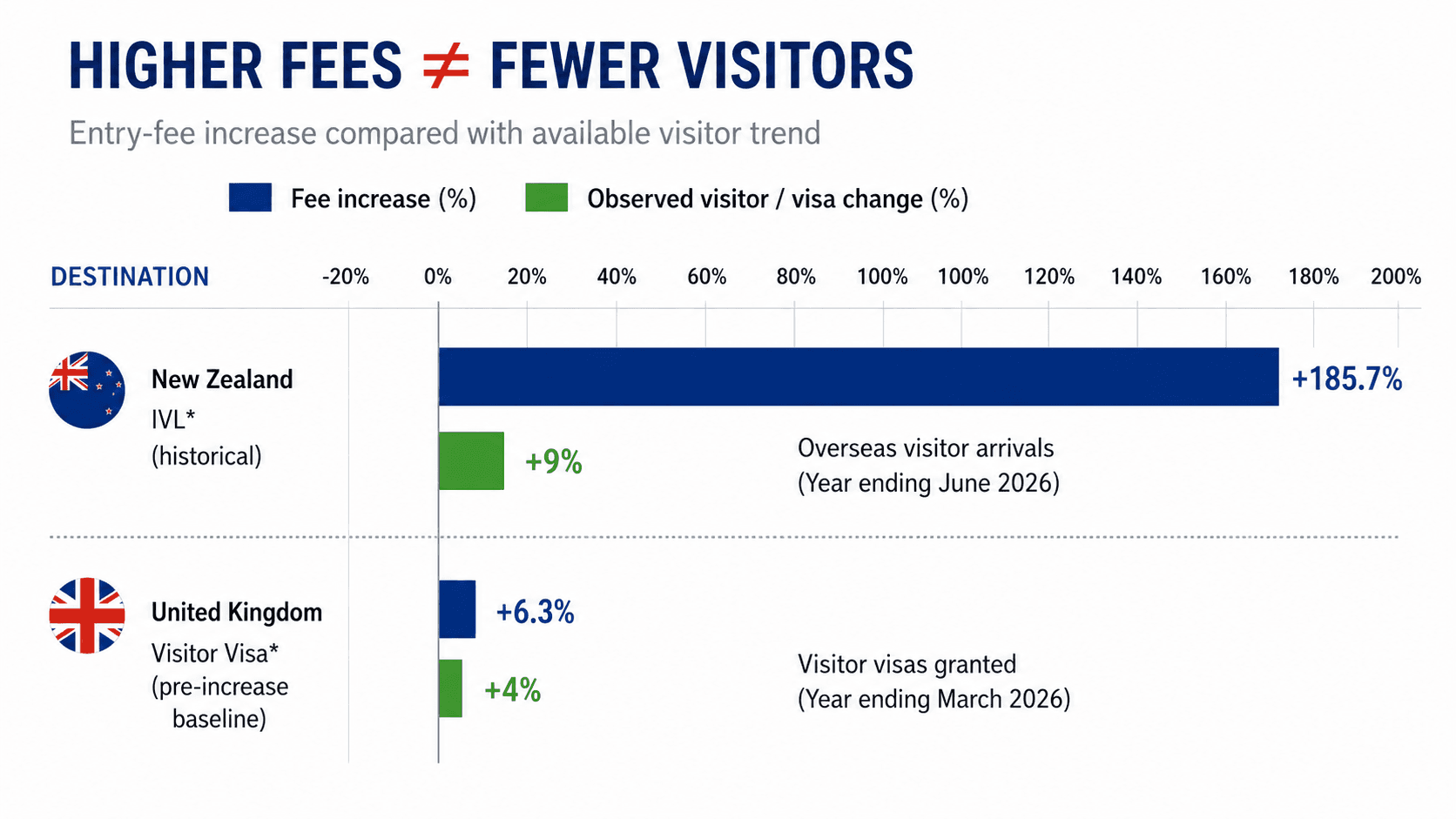
- Despite previous increases in UK visitor-entry costs, 2.2 million Visitor visas were granted in the year ending March 2026, 4% more than a year earlier.
- New Zealand provides an important historical comparison: despite increasing its International Visitor Conservation and Tourism Levy from NZ$35 to NZ$100 in October 2024, overseas visitor arrivals reached 3.67 million in the year ending June 2026, up 9% year over year.
- For several of the largest 2026 fee increases — particularly Japan — there is not yet enough post-increase data to determine whether the higher fee affected demand.
1. Biggest Tourist Entry Fee Increases
Confirmed 2026 Changes
| Rank | Destination | Entry Document | Previous Fee | 2026 Fee | Increase | % Increase |
|---|---|---|---|---|---|---|
| 1 | Japan | Multiple-entry visa | ~¥6,000 | ~¥30,000 | +¥24,000 | +400% |
| 1 | Japan | Single-entry visa | ~¥3,000 | ~¥15,000 | +¥12,000 | +400% |
| 2 | United States | ESTA | $21 | $40.27 | +$19.27 | +91.8% |
| 3 | United Kingdom | ETA | £16 | £20 | +£4 | +25.0% |
| 4 | United Kingdom | 2-year Visitor Visa | £475 | £506 | +£31 | +6.5% |
| 5 | United Kingdom | 6-month Visitor Visa | £127 | £135 | +£8 | +6.3% |
| 6 | United Kingdom | 5-year Visitor Visa | £848 | £903 | +£55 | +6.5% |
| 7 | United Kingdom | 10-year Visitor Visa | £1,059 | £1,128 | +£69 | +6.5% |
Japan's Ministry of Foreign Affairs confirmed that its amended consular fee rules took effect on July 1, 2026, setting the reference fee at approximately ¥15,000 for single-entry visas and ¥30,000 for multiple-entry visas.
The UK Home Office implemented its new rates on April 8, 2026. The six-month visitor visa rose from £127 to £135, while the ETA increased from £16 to £20.
For the United States, the official federal rule states that ESTA had previously cost $21 before legislation raised the authorization fee substantially. CBP's current official charge is $40.27.
2. Japan: The Largest Confirmed Increase
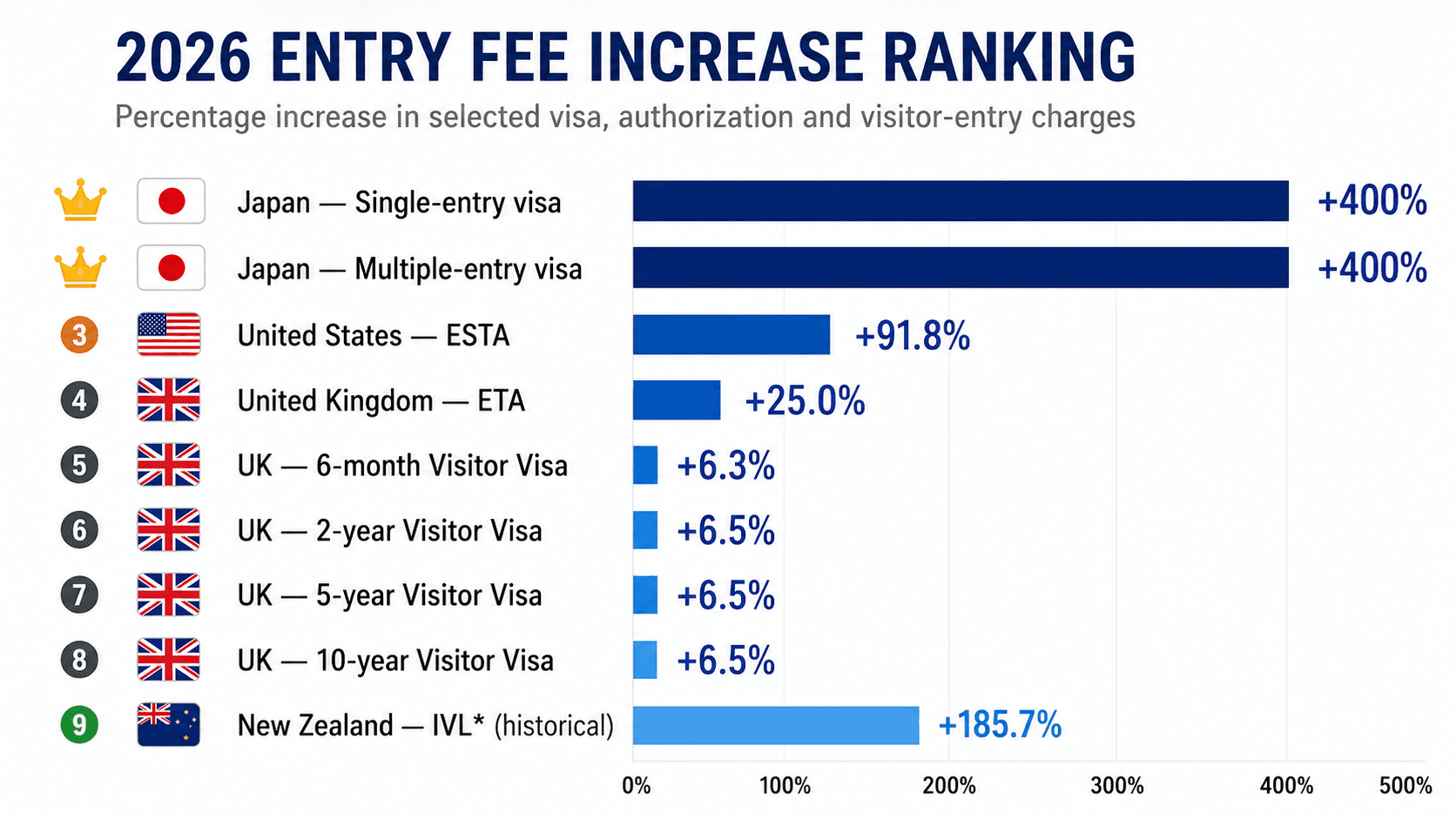
Japan stands out by a substantial margin.
For decades, Japan's standard reference visa fees had remained approximately:
Single-entry: ¥3,000
Double/multiple-entry: ¥6,000
Japan's Ministry of Foreign Affairs published those previous reference prices before the new rules took effect.
From July 1, 2026:
Single-entry: ~¥15,000
Multiple-entry: ~¥30,000
That means both increased approximately fivefold.
Percentage change
Single-entry:
(¥15,000 − ¥3,000) ÷ ¥3,000 = 400% increase
Multiple-entry:
(¥30,000 − ¥6,000) ÷ ¥6,000 = 400% increase
This makes Japan the clearest extreme case in the current dataset.
Did Japan Lose Tourists?
It is too early to say.
The higher visa fee began on July 1, 2026. At the time of this report, Japan does not yet have a sufficiently long post-change period for a meaningful before-and-after tourism analysis.
JNTO reported 3,148,600 visitor arrivals in June 2026, but June was still before the new fee took effect.
Therefore:
Japan should rank #1 for fee increase, but it should not yet receive a "tourism impact" score.
3. United States: ESTA Nearly Doubles
For Visa Waiver Program travelers, the most visible U.S. entry-cost change is ESTA.
The previous ESTA authorization charge was:
$21
The current official application charge is:
$40.27
That represents:
+$19.27 per traveler
or approximately:
+91.8%
The U.S. Federal Register confirms the previous $21 charge and the legislative increase in the ESTA fee structure, while CBP currently lists the payable fee as $40.27.
For a family of four:
Previous cost
$21 × 4 = $84
Current cost
$40.27 × 4 = $161.08
Additional cost
$77.08
This illustrates an important feature of electronic travel authorization increases:
A relatively modest per-person increase becomes considerably more visible for families.
Has U.S. Tourism Fallen Because of ESTA?
There is not yet sufficient evidence to isolate an ESTA-price effect.
The U.S. National Travel and Tourism Office tracks visitor arrivals through its I-94 arrivals system, but changes in U.S. inbound travel during 2026 are affected by many other variables, including exchange rates, airline capacity, geopolitical conditions, border policy and the 2026 FIFA World Cup.
It would therefore be misleading to attribute changes in total U.S. arrivals directly to ESTA pricing.
4. United Kingdom: Smaller Increase, Much Larger Volume
The UK's increases are less dramatic in percentage terms but affect a large pool of international travelers.
UK ETA
2025/early 2026:
£16
From April 8, 2026:
£20
Increase:
£4 / +25%
The UK government was still advertising the £16 ETA in February 2026 and officially increased the charge to £20 from April 8.
Six-Month Standard Visitor Visa
Previous:
£127
2026:
£135
Increase:
£8 / +6.3%
Long-Term Visitor Visas
| Visa | Previous | 2026 | Increase |
|---|---|---|---|
| 2 years | £475 | £506 | +£31 |
| 5 years | £848 | £903 | +£55 |
| 10 years | £1,059 | £1,128 | +£69 |
All of these prices became effective on April 8, 2026.
5. Did Higher UK Visa Costs Reduce Demand?
This is where the data becomes particularly interesting.
In the year ending March 2026, the United Kingdom granted approximately:
2.2 million Visitor visas
That was:
4% higher than the previous year.
The UK also issued approximately 25.1 million ETAs in the year ending March 2026 as the system expanded globally.
However, these numbers cannot be used to claim that the April 2026 price increase caused visitor demand to grow.
Most of the measurement period predates the April 8 increase.
Instead, the data provides a useful baseline.
Future 2026 and 2027 application statistics can be compared with this period to determine whether demand changed after the increase.
6. Higher Travel Fees Do Not Always Mean Fewer Visitors
New Zealand provides one of the strongest historical comparisons.
Its International Visitor Conservation and Tourism Levy increased from:
NZ$35 → NZ$100
on October 1, 2024.
That represents an increase of approximately:
186%
Yet tourism did not subsequently collapse.
Statistics New Zealand reported 3.67 million overseas visitor arrivals in the year ending June 2026, compared with 3.38 million a year earlier.
That's approximately:
+9% year over year
Monthly figures also remained positive. April 2026 recorded 288,500 visitor arrivals, 21,300 more than April 2025.
This does not prove the higher levy had no impact.
It does demonstrate something important:
A substantial increase in a government travel charge can coexist with rising international visitor numbers.
Demand may still have been lower than it would have been without the increase — something raw arrival numbers cannot determine.
7. Fee Increase vs Visitor Change
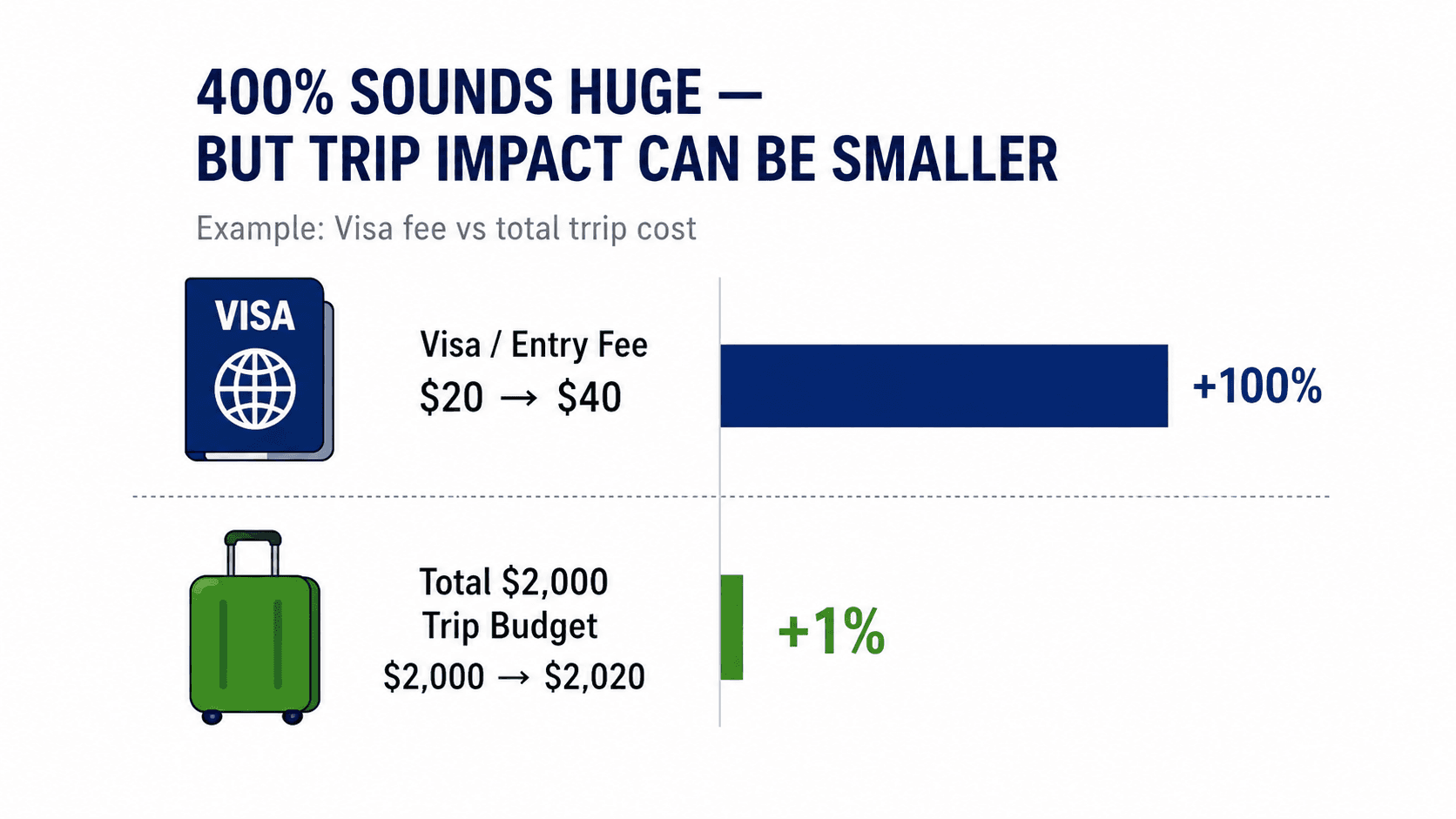
The available cases can therefore be classified differently.
| Destination | Fee Increase | Observed Visitor/Application Trend | Can Fee Impact Be Determined? |
|---|---|---|---|
| Japan | +400% visa fee | Insufficient post-July data | Too early |
| United States | ~+92% ESTA vs previous $21 | 2026 data affected by multiple major factors | Not isolated |
| UK ETA | +25% | Insufficient post-April observation window | Too early |
| UK Visitor Visa | ~+6% in 2026 | Pre-increase baseline: visitor visa grants +4% YoY | Too early for 2026 increase |
| New Zealand IVL* | +186% | Visitor arrivals +9% YoY by June 2026 | No simple negative correlation |
- New Zealand's change took effect in October 2024 and is included as a longer-term comparison rather than a 2026 visa-fee increase.
8. The Most Important Finding
At first glance, it seems logical:
Higher visa fee → more expensive trip → fewer tourists
Real-world tourism data does not behave that cleanly.
For most international trips, the visa or electronic authorization represents only part of the total travel budget.
A traveler may spend:
- hundreds or thousands of dollars on airfare
- hundreds or thousands on accommodation
- food and transport
- insurance
- attractions
- local taxes
Against that total, an additional £4 ETA charge may have very little influence on the final decision to travel.
A several-hundred-percent visa increase, however, could matter more in price-sensitive markets — particularly for families and repeat travelers.
9. Families Feel Fee Increases More
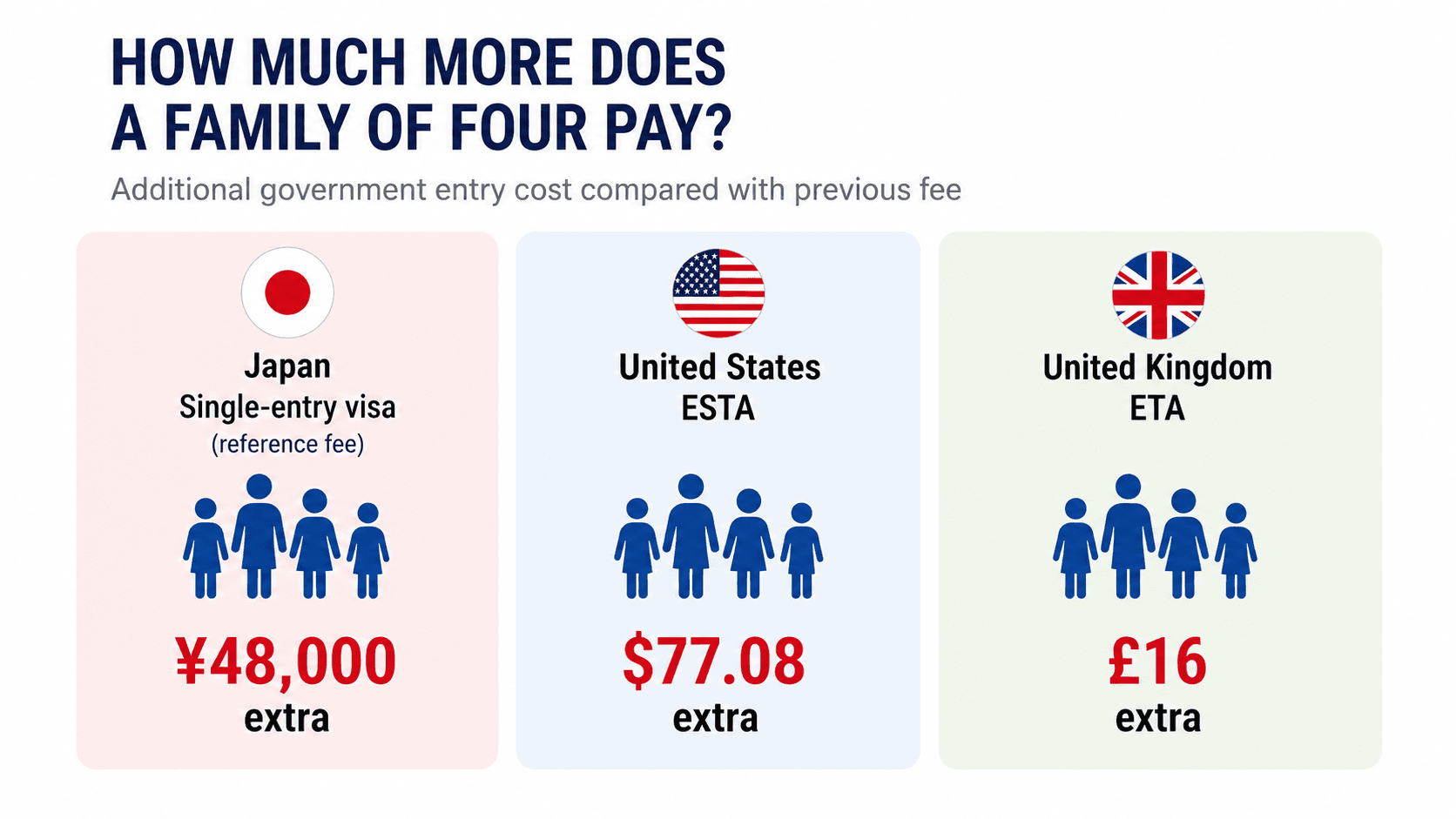
Per-person pricing can make small headline increases substantially larger at the household level.
U.S. ESTA — Family of Four
Previous:
4 × $21 = $84
2026:
4 × $40.27 = $161.08
Difference:
+$77.08
UK ETA — Family of Four
Previous:
4 × £16 = £64
2026:
4 × £20 = £80
Difference:
+£16
Japan Single-Entry Visa — Family of Four
Previous reference fee:
4 × ¥3,000 = ¥12,000
2026 reference fee:
4 × ¥15,000 = ¥60,000
Difference:
+¥48,000
For families, Japan's increase is consequently much more significant than the percentage figure alone may suggest.
10. Not Every 2026 Change Is a Price Increase
A credible fee report also needs to track destinations moving in the opposite direction.
Sri Lanka, for example, made tourist ETA applications free for nationals of 40 countries from May 25, 2026 under its current scheme.
New Zealand also temporarily reduced visitor visa costs for certain Pacific nationals from NZ$216 to NZ$161 from June 2026.
These reductions can eventually provide an interesting counter-test:
If increasing entry costs suppress demand, do fee reductions measurably increase arrivals?
That requires nationality-level visitor data and a longer post-policy observation period.
11. An Important Upcoming Change: ETIAS
Europe's ETIAS should not be included in the main 2025-vs-2026 paid-fee ranking because travelers were not paying a €7 ETIAS fee in 2025.
The system was not operational.
However, the planned application charge was raised from:
€7 → €20
a planned-price increase of approximately:
+186%
The European Commission confirmed the €20 fee, while the official ETIAS portal states that the authorization system was scheduled to begin operations later in the implementation cycle.
ETIAS should therefore appear under:
Upcoming Entry Cost Changes
rather than:
2026 Visa Fees That Increased
This distinction prevents a common statistical mistake: treating a change in a planned future price as if travelers had previously paid the lower amount.
12. Other Visa-Related Costs Rising in 2026
Not all increases occur in the government visa application fee itself.
New Zealand announced that Visa Application Centre service fees would increase in a large number of markets from January 1, 2026 because of higher operating costs.
Affected application locations include Australia, Bangladesh, Hong Kong, India, Indonesia, Japan, Singapore, South Korea, Thailand, the UK, the U.S., Vietnam and others.
These costs are excluded from the main ranking because they are:
service fees rather than the underlying visa fee.
Keeping them separate makes cross-country comparisons cleaner.
13. New Fees Can Matter as Much as Fee Increases
The United States introduced another interesting 2026 example.
A temporary expedited B1/B2 interview pilot allows eligible applicants at participating locations to pay:
$750
for access to an expedited appointment within 10 business days, subject to availability.
This fee is optional and sits on top of the standard $185 B1/B2 application fee.
It should therefore not be described as a "$185 → $935 visa fee increase."
It is better categorized as:
New Optional Visa Processing Fees
This distinction is important for media reporting.
14. Three Types of Rising Travel-Entry Costs
The 2026 market can be divided into three categories.
1. Existing fees that increased
Examples:
Japan Visa
UK Visitor Visa
UK ETA
U.S. ESTA
These belong in the main ranking.
2. New or optional charges
Example:
U.S. $750 expedited B1/B2 interview fee
These should be analyzed separately.
3. Future systems whose planned price increased
Example:
ETIAS €7 → €20
These belong in an upcoming-changes section.
Mixing these three categories would exaggerate the number of countries that actually increased tourist visa prices during 2026.
15. Does a 100% Visa Increase Mean Tourism Falls 100%?
No.
The two measurements describe completely different things.
A visa increasing from $20 to $40 is:
+100%
But if the total trip costs $2,000, the increase represents only:
1% of the total trip budget.
That is one reason extremely large percentage changes in entry fees may produce much smaller changes in travel demand.
Price sensitivity will also differ by:
- traveler income
- country of origin
- trip length
- airfare
- destination uniqueness
- family size
- exchange rates
- availability of alternative destinations
16. What the Available Evidence Says
The current evidence does not support a simple claim that:
"Higher visa fees cause tourist numbers to fall."
Instead, three patterns are emerging.
Pattern 1 — Fees rise and tourism can still grow
New Zealand is the clearest comparison in this report.
Its visitor levy nearly tripled, yet annual visitor arrivals subsequently increased.
Pattern 2 — The increase is too recent to evaluate
This currently applies to Japan and the UK's April 2026 increases.
Pattern 3 — Other variables overwhelm the fee effect
The United States is a particularly strong example.
Changes in air capacity, exchange rates, major sporting events, border policy and broader economic conditions make isolating the effect of a roughly $19 ESTA increase extremely difficult.
17. The Data Journalists Should Watch Next
The most useful follow-up metrics will be:
Japan
Visa applications by nationality before and after July 1, 2026.
United Kingdom
ETA applications and Visitor Visa applications for comparable months before and after April 8, 2026.
United States
Arrivals from Visa Waiver Program countries following the ESTA increase.
New Zealand
Visitor arrivals from visa-required markets versus visa-waiver markets following higher entry costs.
These comparisons will be more informative than simply looking at total tourism arrivals.
Key Takeaways
Japan recorded the largest confirmed visa-fee increase in this study.
Its standard reference visa fees increased approximately 400% in July 2026.
ESTA became considerably more expensive.
The U.S. authorization currently costs $40.27, compared with the previous $21 charge.
UK increases were smaller.
The ETA rose 25%, while major Visitor Visa categories increased roughly 6%–7% in April 2026.
Families face a much larger absolute increase.
A family of four applying for Japanese single-entry visas could face approximately ¥48,000 more in reference visa fees than under the previous rate.
Higher fees do not automatically mean fewer tourists.
New Zealand visitor arrivals increased 9% year over year even after its visitor levy had increased from NZ$35 to NZ$100.
But correlation is not causation.
Tourist arrivals alone cannot reveal how many travelers would have visited under a lower visa price.
The largest 2026 changes need more time.
For Japan, the UK and the United States, sufficiently clean post-increase data is not yet available to make strong causal claims.
Sources
Japan Ministry of Foreign Affairs
Visa Fees; revised visa fee rules effective July 1, 2026.
UK Home Office / UK Visas and Immigration
Home Office immigration and nationality fees effective April 8, 2026; Electronic Travel Authorisation guidance.
U.S. Customs and Border Protection / Federal Register
ESTA fee rules and current ESTA application charge.
UK Home Office Immigration Statistics
Visitor Visa and ETA volumes, year ending March 2026.
Statistics New Zealand
International visitor arrival statistics through June 2026.
Immigration New Zealand / MBIE
International Visitor Conservation and Tourism Levy and visa application service fee changes.
European Commission
ETIAS pricing and implementation information.
Sri Lanka Department of Immigration and Emigration
2026 tourist ETA fee-waiver program.
U.S. Department of State
2026 expedited B1/B2 appointment pilot.