
German Passport Photo Requirements 2026: Size, Format and Biometric Rules
German passport photo size, biometric framing and the digital-only submission process used inside Germany since May 2025.
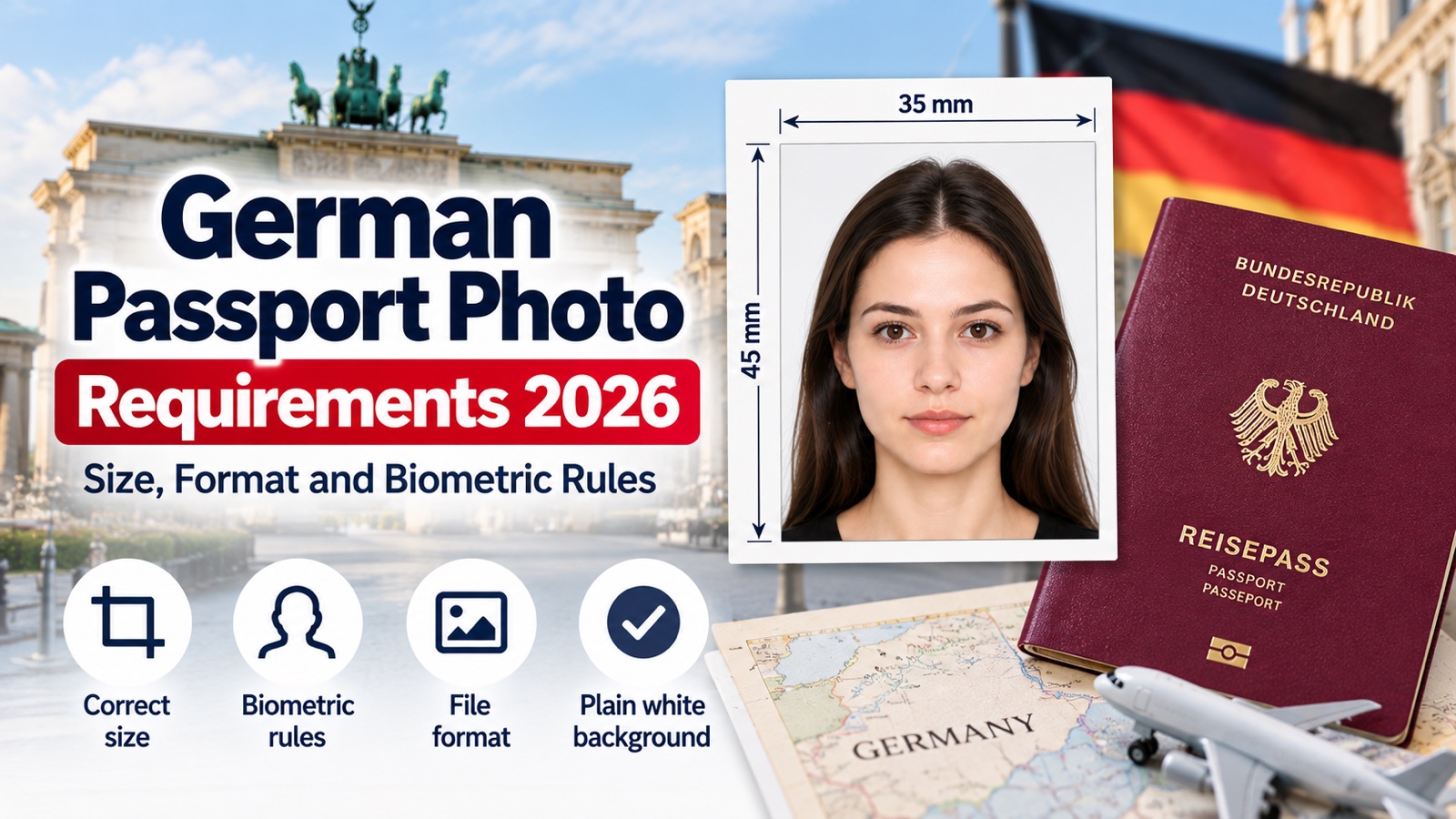
Quick answer: A German passport photo (Passbild) must be 35×45 mm, with the face occupying 70–80% of the frame and a chin-to-crown height of 32–36 mm. Use a neutral expression, closed mouth, and a plain, light, neutral background with good contrast. Since May 1, 2025, self-taken and printed photos are no longer accepted for passports, ID cards and most residence permits — instead, you either have your photo taken on-site at the Bürgeramt, or get it from a certified provider who uploads it and gives you a QR/Data-Matrix code to bring to your appointment.
Germany has some of the strictest biometric photo rules in Europe, enforced by automated facial-recognition checks. Small errors — a slight smile, the wrong background shade, a photo that's a few months too old — are common reasons applications get sent back.
Size and Framing
- Dimensions: 35 mm wide × 45 mm tall (not the US 2×2 inch format)
- Face height: 32–36 mm from chin to crown for adults
- Face coverage: roughly 70–80% of the frame
- Head position: straight, eyes level with the camera, eyes clearly visible
Background and Lighting
The background should be plain and light — most current guidance points to light grey rather than pure white, though light grey/white is generally accepted. No shadows, no reflections, even lighting across the face.
Expression and Appearance
- Neutral expression, closed mouth — no smiling with visible teeth
- Glasses are permitted only when the eyes remain fully visible, with no reflections, tinted lenses or frames covering the eyes
- Eyes fully visible; tinted lenses or reflections aren't allowed
- Should reflect your current appearance, generally within the last 6 months
How the Digital-Only Submission Actually Works
This is the part most guides skip over. Since May 1, 2025 (with a short transition allowing some paper photos until July 31, 2025 in certain offices), there are exactly two accepted routes for a German passport, ID card, or most residence permits:
- On-site terminal: The Bürgeramt photographs you directly, either at the counter or on a self-service terminal, usually for a small fee (around €6).
- Certified provider upload: A certified photo studio, or a participating drugstore counter (dm, Rossmann, and similar), takes the biometric photo and uploads it to the secure government system. You receive a QR or Data-Matrix code, valid for about 6 months, which you bring to your appointment. Staff scan the code to retrieve your photo — there's no option to email a file or bring a USB drive.
A printed photo alone, even if it meets every size and background rule, will generally be rejected at the counter for these documents. The rules can vary slightly by office, so it's worth confirming with your specific Bürgeramt or Ausländerbehörde.
FAQ
What size photo does Germany require for a passport?
35×45 mm, with the face filling 70–80% of the frame and a chin-to-crown height of 32–36 mm.
Can I wear glasses in a German passport photo?
Yes, provided the eyes are fully visible, the lenses do not reflect light, and neither the lenses nor frames cover the eyes. Tinted glasses and sunglasses are not accepted.
Can I just bring a printed photo to the Bürgeramt?
Generally no, since May 1, 2025. You need either an on-site photo at the terminal or a QR/Data-Matrix code from a certified provider.
How much does a digital biometric photo cost?
Roughly €6 at the authority's own terminal, and typically €6–10 at a certified drugstore or studio, though providers set their own prices.
How long is the QR code valid?
Around 6 months, and it can generally be reused for related document applications during that time.
Check Your Photo Before You Apply
PhotoOmni can help check the 35×45 mm crop, background and image quality. For passport or ID applications made inside Germany, you must still complete the required secure capture and transmission through the authority or a certified provider.