
35×45mm Passport Photo: Size in Pixels, Ratio, Countries, and Printing Guide
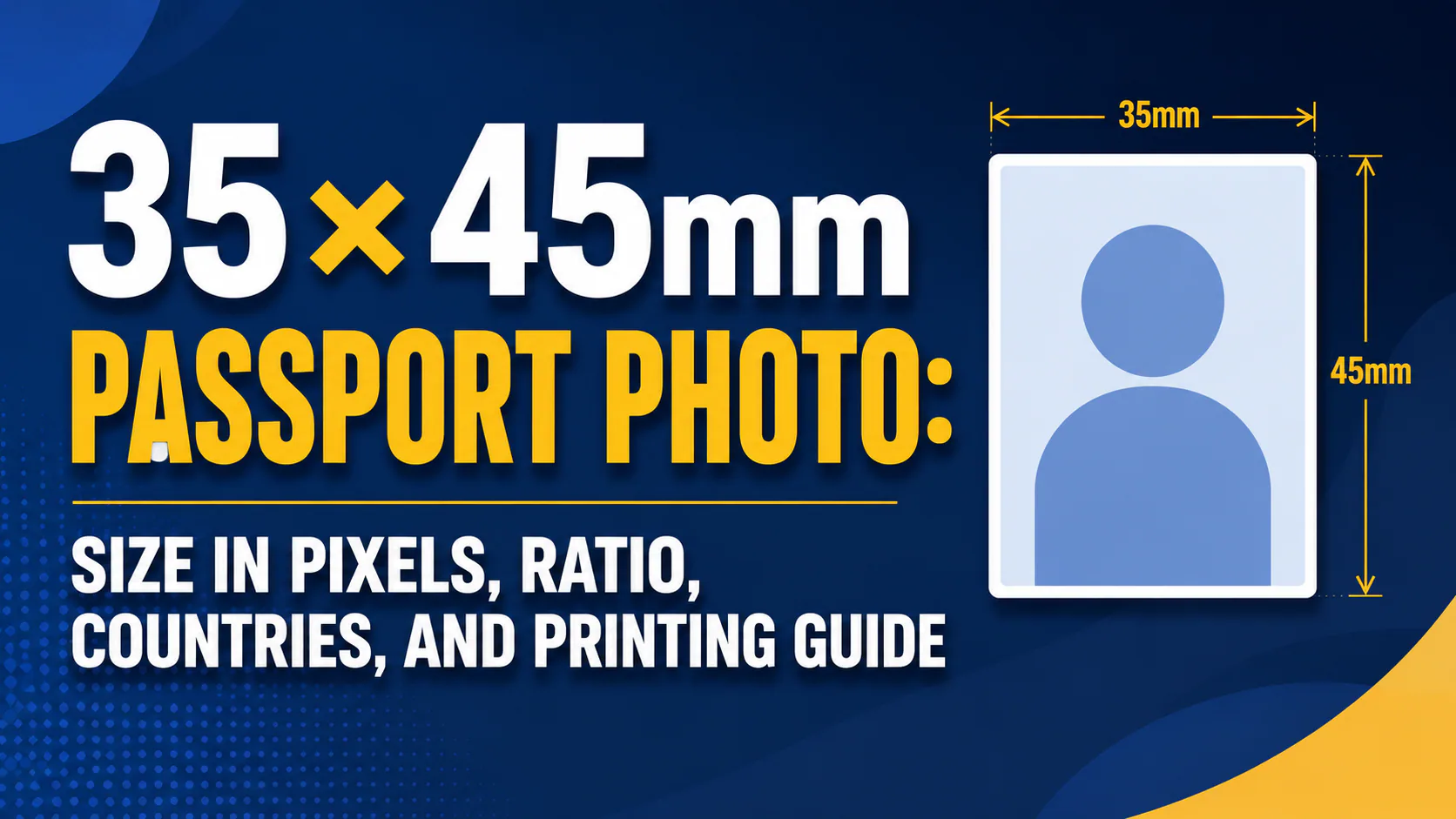
35×45mm is the passport and visa photo size used across the UK, all of Schengen Europe, India, and most of Asia and Africa — making it the single most common format worldwide, well ahead of the US's 2×2 inch standard. At 300 DPI, that converts to roughly 413×531 pixels, though several countries' dig
Dimensions, printing guidance and product links checked: September 28, 2026
35×45mm Passport Photo: Size in Pixels, Ratio, Countries, and Printing Guide
If you prefer to prepare the file online, the US passport photo maker can help check the crop, background, and passport-photo format before submission.
The world's most common passport photo size, reduced to one clean number nobody states out loud: it's a 7:9 rectangle.
Quick answer: 35×45mm is the passport and visa photo size used across the UK, all of Schengen Europe, India, and most of Asia and Africa — making it the single most common format worldwide, well ahead of the US's 2×2 inch standard. At 300 DPI, that converts to roughly 413×531 pixels, though several countries' digital portals actually require more resolution than that — the UK's minimum is 600×750 pixels, noticeably higher than a straightforward 300 DPI conversion of the mm size would produce. The photo's aspect ratio is 35:45, which simplifies to 7:9 — a number worth knowing if you ever need to crop or verify a photo without a calculator.
A US passport photo maker can apply these dimensions and formatting checks to the uploaded photo.
Many countries use a 35×45 mm outer size, but their head-position, background and digital-file rules still differ. Select the destination and document before creating the final image.
The ratio nobody states plainly
Every size guide lists "35mm × 45mm." Almost none point out that this reduces to a clean 7:9 ratio. That's a useful thing to actually know: if you're ever checking whether a crop is roughly correct by eye — cropping a photo yourself, or verifying an ID photo app's output before you commit to printing it — a rectangle where the height is 9/7ths (about 1.29×) the width is in the right proportion. It won't replace an actual measurement, but it's a fast sanity check that most guides never mention because they're built around a fill-in-the-blank crop tool, not around helping you understand what the numbers mean.
Pixel conversion at different DPIs
Pixels = millimeters ÷ 25.4 × DPI. Here's what 35×45mm actually converts to at the DPI values you'll actually encounter:
| DPI | Width (px) | Height (px) | Typical use |
|---|---|---|---|
| 72 | 99 | 128 | Screen preview only — too low-resolution for printing or most portal uploads |
| 150 | 207 | 266 | Below most portals' minimums |
| 300 | 413 | 531 | Standard print resolution — the number most guides quote |
| 354 (UK's actual minimum) | 488 | 627 | Closer to what UK digital portals actually enforce |
That last row is the one worth sitting with. The UK's official minimum for a digital driving licence or passport photo upload is 600×750 pixels — not 413×531. If you back-calculate what DPI that implies at 35×45mm, it's roughly 435 DPI, well above the "standard" 300 DPI that most size charts quote as the target. India's Passport Seva portal is a second, independent example of the same pattern: it requires 630×810 pixels, again well above the 413×531 that a plain 300 DPI conversion produces. Two unrelated countries both setting their actual digital minimum meaningfully above the "standard" conversion suggests this isn't a rare edge case — it's common enough that assuming 300 DPI math will clear any portal is a real risk, not just a UK quirk. In practice, this means: if you export a photo at exactly 413×531 pixels because a guide told you that's "35×45mm at 300 DPI," both a UK and an Indian portal may reject it for being under-resolution — even though the millimeter math is textbook-correct. Always check the specific pixel minimum your destination portal states, rather than assuming a generic 300 DPI conversion will clear every system.
One more wrinkle: even the "standard" 300 DPI figure isn't consistently quoted the same way across tools. Some sources round 35×45mm at 300 DPI to 413×531 pixels (the mathematically precise conversion). Others quote 420×540 — a rounder set of numbers that isn't the exact conversion, but functions as a slightly-oversized safe buffer. Neither is wrong exactly; they're different rounding conventions, but it means two "300 DPI, 35×45mm" tools can hand you files that are a few pixels apart. If a portal enforces an exact pixel match rather than a minimum, that small gap can matter — worth checking whether your destination wants an exact figure or just a floor.
Which countries actually use 35×45mm
This is the size used by, among others:
- United Kingdom — passport and driving licence, strictly enforced at exactly 35×45mm
- All Schengen Area countries — France, Germany, Spain, Italy, Netherlands, and the rest of the bloc use a harmonized biometric photo standard at this size
- India — passport photos, but only since September 2025, when India switched from its previous 51×51mm square format (the US-style size) to 35×45mm under the ICAO Doc 9303 international standard. If you're reusing an older Indian passport photo or going by an older guide, double-check which format applies to your specific application — the square 51×51mm size isn't simply outdated advice, it was genuinely correct before the switch.
- Australia — but not as a fixed exact size. Australia accepts a range: 35–40mm width by 45–50mm height, which is meaningfully more forgiving than the UK's exact requirement. Treating Australia and the UK as "the same 35×45mm size" — as many comparison charts do — overstates how strict Australia's tolerance actually is.
- Russia — for certain visa and travel document types
- Nigeria and South Africa — among other African nations using a shared biometric convention
- Most of Asia, outside of countries with a unique size of their own — China's 33×48mm being the clearest exception
If your destination isn't on this list, don't assume 35×45mm applies — check the specific document type, since even within one size family, digital pixel minimums, background rules, and exact-vs-range tolerances vary country to country.
Printing layout: fitting multiple copies on one sheet
A single 35×45mm photo is small enough that printing one at a time wastes most of a sheet of photo paper — most services and DIY setups fit several copies onto a standard print size:
- 4×6 inch print (101.6×152.4mm): typically fits 4 copies with reasonable margins, sometimes 6 with tighter spacing
- 5×7 inch print: generally fits 6 copies
- A4 sheet (210×297mm): commonly fits 8, depending on the margin and spacing template used
Exact counts depend on the specific layout template a print service or app uses — some add cutting guides and wider margins, which reduces the count; some tile tightly with almost no gap. If you're printing at home or asking a pharmacy to print a supplied digital file, request the specific layout (how many copies per sheet) before paying, since "one photo, six prints" and "one photo, four prints with room to cut cleanly" cost the same but deliver a different number of usable copies.
Getting the pixel target right the first time
Because the gap between "300 DPI math" and "what a specific portal actually requires" is exactly where 35×45mm submissions get rejected, the more reliable approach is generating the file at the exact pixel target your destination country's portal states — not deriving it yourself from a generic mm-to-DPI formula. PhotoOmni's country-specific presets export directly at each country's actual required pixel dimensions, which sidesteps the UK-style under-resolution trap rather than requiring you to track down each portal's specific minimum yourself.
Official Reference for U.S. Passport Printing
The U.S. Department of State specifies a 2×2-inch print on matte or glossy photo-quality paper. Other documents and countries can use different dimensions and rules: U.S. passport photo guidance.
FAQ
What is the aspect ratio of a 35×45mm passport photo? 35:45, which simplifies to 7:9 — meaning the height is about 1.29 times the width.
Is 35×45mm the same as 413×531 pixels? Only at exactly 300 DPI. Several countries' digital portals — the UK included — require higher pixel minimums than a straightforward 300 DPI conversion produces, so always check the specific portal's stated pixel requirement rather than assuming 413×531 covers every use case.
Which countries use 35×45mm passport photos? The UK, all Schengen European countries, India (for passports, since September 2025), Russia, and much of Asia and Africa use this size. It's the most common passport photo format worldwide — more common than the US's 2×2 inch standard. Note that Australia accepts a range (35–40mm × 45–50mm) rather than the exact fixed size the UK and Schengen countries require.
Did India always use 35×45mm passport photos? No — India switched from a 51×51mm square format (the same size the US uses) to 35×45mm in September 2025, adopting the ICAO Doc 9303 international standard. If you're going by an older photo or an outdated guide, confirm which size applies to your specific application.
How many 35×45mm photos fit on one printed sheet? Typically 4–6 on a 4×6 inch print, 6 on a 5×7, and around 8 on an A4 sheet — though the exact count depends on the margin and spacing template used, so confirm with whoever is printing it.
Why did my photo get rejected even though it matched the 35×45mm size? Most likely a resolution shortfall — the physical size can be correct while the pixel count falls short of a specific portal's actual minimum, which is sometimes higher than the standard 300 DPI conversion implies.
Country-specific pixel and file requirements are set by individual portals and can change — always confirm current specs with the issuing authority before submitting.
35×45mm photos for UK driving licences
For UK driving licence applications, 35×45mm describes the printed photo, not the physical size of a digital upload. The UK driving licence photo requirements guide explains the separate DVLA and Northern Ireland DVA routes.
About the Author
PhotoOmni Editorial Team
The PhotoOmni Editorial Team researches official passport, visa, immigration, and identity-photo requirements. Every guide is reviewed for practical accuracy and updated when application rules, upload specifications, or government guidance change.