
Japan Visa Photo Requirements 2026: Size, File Format, and the 45mm Myth
Japan visa photo requirements 2026: size (35×45 mm, not 45×45 mm), file formats (JPG, PNG, HEIC), pure white background, ear visibility rules, and digital upload limits.
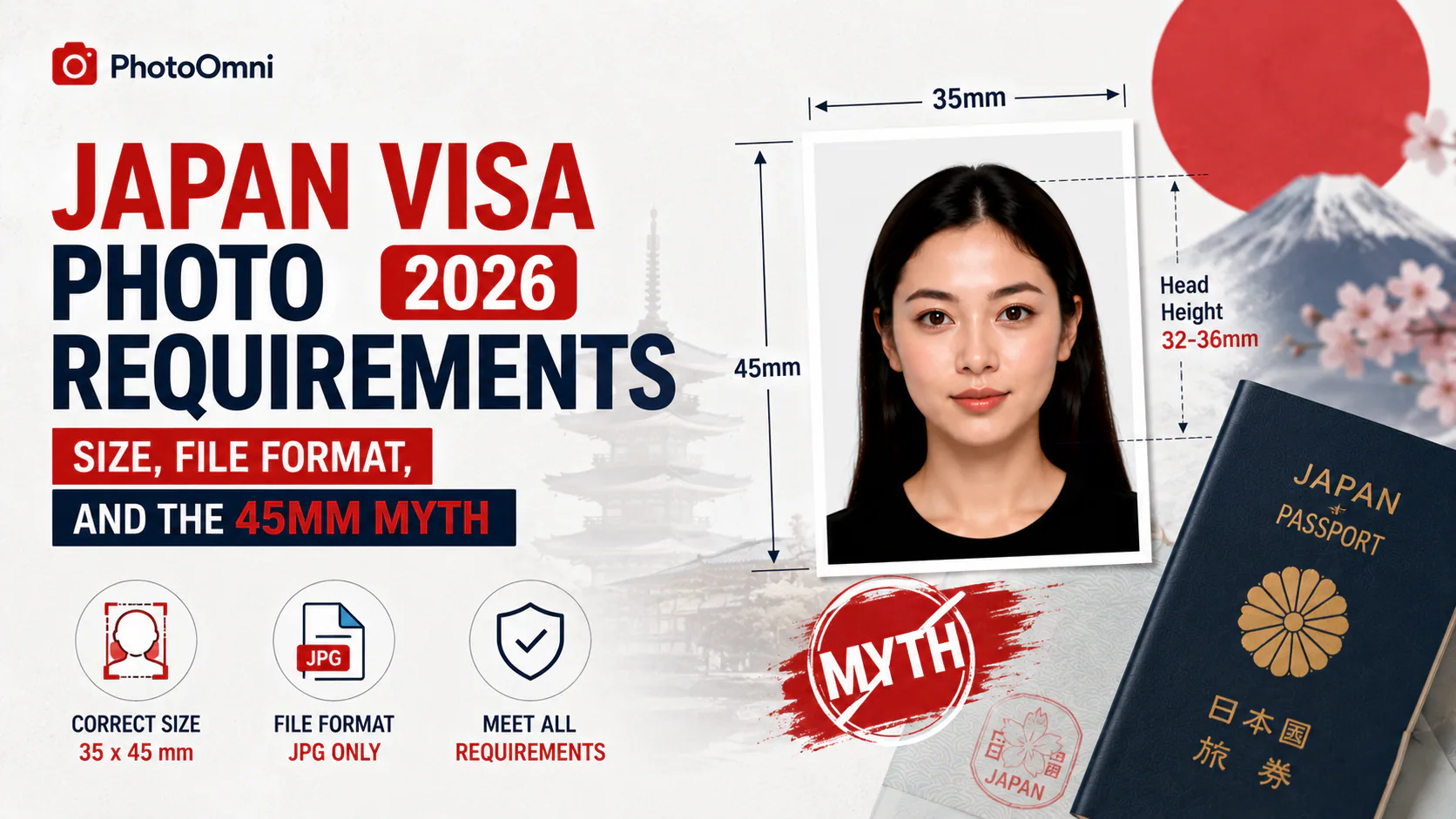
Japan's visa photo requirements carry a genuine point of confusion: some guides say 45×45 mm square, others say 35×45 mm rectangular. This isn't a debate — it's an outdated figure that's been copied from guide to guide without fact-checking. Here's the correct spec, plus the file-format question that trips up just as many applicants.
Quick Answer
A Japan visa photo must be 35 × 45 mm — identical to a Japan passport photo, not the 45×45 mm square number still circulating on older guides. The background must be pure white (never off-white or cream), both ears fully visible, a neutral expression, and the photo taken within the last 6 months. For printed submissions, use high-quality photo paper and bring two identical copies. For digital/e-Visa uploads (evisa.mofa.go.jp), accepted formats typically include JPG, PNG, GIF, BMP, and HEIC, with a common file size cap around 240 KB — always confirm the exact limit on your specific portal, since it can vary by jurisdiction.
Is a Japan Visa Photo the Same Size as a Passport Photo?
Yes. This is worth stating plainly because search results for this exact question are genuinely inconsistent. A Japan visa photo and a Japan passport photo both use the same 35 × 45 mm format — matching the ICAO-standard biometric portrait size.
The 45 × 45 mm square figure you'll see on a number of guides is outdated or misattributed — one photo-tool provider even corrected their own site after listing the square dimension in error. It likely traces back to older application forms or jurisdiction-specific historical exceptions, since a small number of embassies have, at various points, listed alternate sizes (50×50 mm, 40×30 mm) for older paper processes. But for the current MOFA-aligned specification that applies to most applicants in 2026, 35×45 mm rectangular — identical to the passport photo — is correct.
If your specific embassy or VFS Global checklist states a different figure, that instruction takes priority over any general guide, including this one — but don't assume 45×45 mm is the default without checking.
What File Format Should a Japan Visa Photo Be?
The answer depends on whether you're submitting a printed application or applying through the e-Visa digital portal:
| Submission type | Format requirements |
|---|---|
| Printed application | High-quality photo paper (glossy is the safest default; a small number of sources cite matte — check your consulate's instructions), two identical copies |
| e-Visa digital upload (evisa.mofa.go.jp) | JPG, PNG, GIF, BMP, or HEIC accepted; file size commonly capped around 240 KB; minimum resolution generally 300–600 DPI depending on the portal |
If you're printing, write your full name and date of birth lightly in pencil on the back of each photo before attaching it to your application — several Japan-specific guides flag this as an easy-to-miss step, and pressing too hard can leave indentations visible on the front.
Full Photo Specification
| Spec | Requirement |
|---|---|
| Size | 35 mm wide × 45 mm tall (same for visa and passport) |
| Head height | Approximately 32–36 mm chin-to-crown for passport; visa guidance varies slightly by source — check your specific form |
| Background | Pure white — not off-white, cream, or light grey |
| Ears | Both ears must be fully visible — Japan enforces this more strictly than most countries |
| Expression | Neutral, mouth closed, eyes open, looking directly at the camera |
| Glasses | Permitted if there's no glare and eyes are clearly visible; sunglasses and tinted lenses never accepted |
| Head coverings | Not permitted except for religious reasons — face must remain fully visible from forehead to chin |
| Photo age | Taken within the last 6 months |
| Editing | No digital retouching or modification of any kind |
| Copies | Two identical photos for most paper visa applications |
For children and babies
Japan's visa and passport photo requirements are generally the same for toddlers and babies as for adults — same size, same background, child must be alone in the frame with no parent visible or holding them.
Common Mistakes to Avoid
- Assuming 45×45 mm square is correct — as covered above, this is an outdated figure for most current applications
- Using an off-white or cream background — Japan specifically wants pure white, unlike several other countries that prefer a softer tone
- Hair or head covering obscuring the ears — Japan checks for full ear visibility more strictly than most countries' passport rules
- Reusing an old passport photo for a visa application — some embassies will return it even if the dimensions technically match, since the photo must be current
- Uploading the wrong file format or exceeding the file size cap for e-Visa applications — check the specific portal's limit before submitting, since it's tighter than many other countries' digital uploads
Preparing a Compliant Photo With PhotoOmni
- Set up a plain, pure white background — a white wall or a hung white sheet works, evenly lit with no shadows.
- Have someone else take the photo (or use a tripod), keeping your ears fully visible — pull hair back if needed.
- Remove sunglasses or tinted lenses; regular glasses are fine as long as there's no glare.
- Upload it to PhotoOmni's free AI check. It verifies the 35×45 mm proportions, background whiteness, ear visibility, and expression against the current Japan specification — without applying any retouching or digital alteration.
- Fix anything flagged and re-check — there's no cost to try again.
- Download the compliant file once it passes — the only paid step — sized correctly for either a printed application or e-Visa digital upload.
FAQ
Is a Japan visa photo the same size as a Japan passport photo? Yes — both use 35 × 45 mm. A commonly cited 45×45 mm square figure circulating on some guides is outdated or misattributed for the current standard specification.
What file format does the Japan e-Visa portal accept? Commonly JPG, PNG, GIF, BMP, and HEIC, with a file size cap often around 240 KB — always verify the exact limit on the specific portal at the time you apply, since it can vary.
Does the background need to be pure white? Yes — Japan specifically requires pure white, not off-white, cream, or light grey, which several other countries use instead.
Do my ears need to be visible in a Japan visa photo? Yes — Japan enforces full ear visibility more strictly than most countries. Make sure hair or head coverings don't obscure either ear.
Can I wear glasses in a Japan visa photo? Yes, as long as there's no glare and your eyes are clearly visible. Sunglasses and tinted lenses are never accepted.
Is PhotoOmni's compliance check free? Yes — checking your photo against the current Japan visa/passport specification is free. You only pay if you choose to download the final compliant file.
Create Your Passport Photo Now
About the Author
Emma Richardson Senior ICAO Photo Compliance Expert, PhotoOmni
Emma Richardson is the Senior ICAO Photo Compliance Expert at PhotoOmni. With 12+ years of experience in passport and visa photo verification, she has helped applicants achieve 820,000+ successful photo approvals across 100+ countries and territories. She specializes in global passport photo requirements, ICAO-compliant photo standards, and biometric image verification.
Related Articles
- How to Take a Passport Photo at Home (2026 Guide)
- Passport Photo Requirements: The Complete 2026 Guide
- Why Was My Passport Photo Rejected? 15 Common Reasons & Fixes
Data sources: Ministry of Foreign Affairs of Japan (MOFA) visa and passport photo guidance; ICAO Document 9303 biometric photo standard. This guide is independent and not affiliated with or endorsed by MOFA or the Japanese government. US Department of State passport processing (FY2024), UK Home Office annual report (2023), NIST FRVT Part 3: Demographic Effects (March 2024), ICAO Doc 9303 photo specifications. Pricing based on publicly listed rates as of July 2026.