
US Passport Photo Requirements for Infants & Babies (2026)
Complete guide to U.S. passport photos for infants and babies: size, background, at-home methods, checklist, and common rejection reasons. Eyes may be closed — everything else must be perfect.
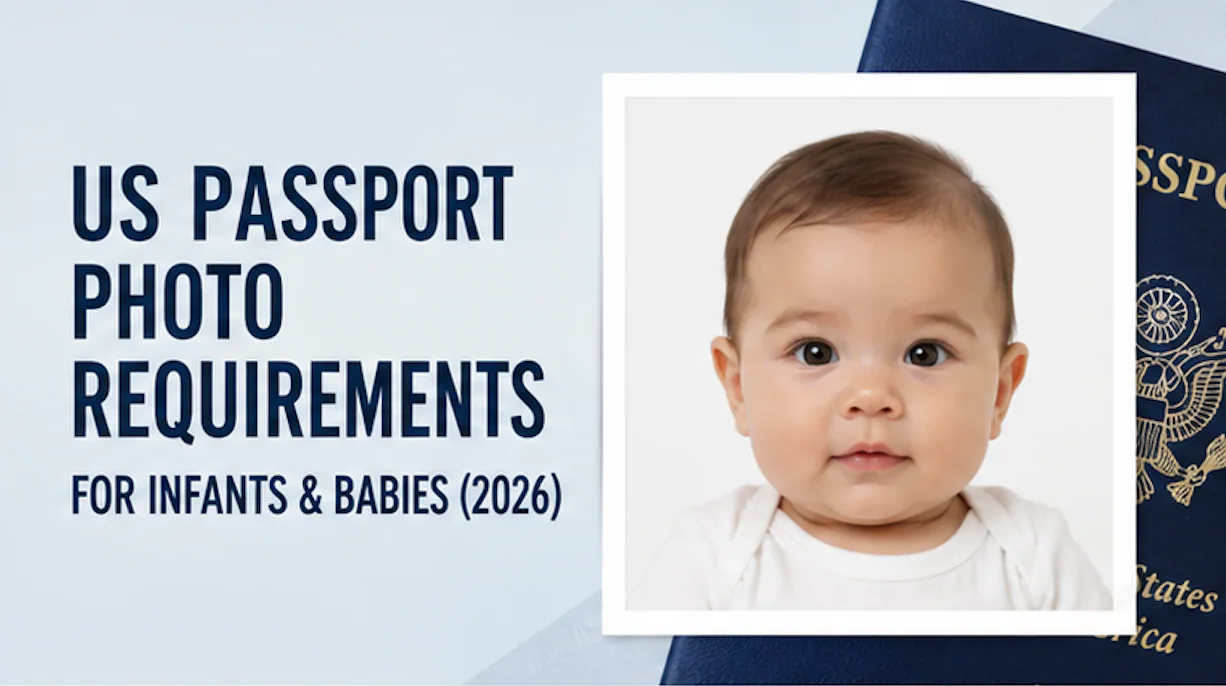
Quick answer: A U.S. passport photo for an infant or baby must be one recent color photo, taken within the last six months and printed at 2 × 2 inches (51 × 51 mm). Use a plain white or off-white background, show the baby's full face facing the camera, and keep parents, hands, toys, pacifiers, and shadows out of the frame. A baby's eyes do not need to be entirely open.
Taking a passport photo for a newborn or baby is harder than taking one for an adult — but the U.S. Department of State gives parents two practical at-home setups. This guide explains the current requirements, the measurements that matter, and the checks to make before you apply.
Baby passport photo requirements at a glance
| Requirement | Current U.S. requirement |
|---|---|
| Photos to provide with a child's application | 1 |
| Photo recency | Taken within the last 6 months |
| Printed photo size | 2 × 2 inches |
| Metric size | 51 × 51 mm |
| Head height | 1–1⅜ inches |
| Head height in metric units | 25–35 mm |
| Background | Plain white or off-white, with no shadows, texture, lines, or objects |
| Baby's eyes | They do not need to be entirely open |
| Other children's eyes | Open and visible |
| Child passport validity under age 16 | 5 years |
These photo rules apply to paper passport applications. Children under 16 apply in person and must provide one photo. Do not attach or staple the photo to the form — the acceptance agent or passport employee does that.
What is different about an infant or baby passport photo?
Most U.S. passport photo requirements are the same for every applicant: a recent color photo, a full face facing the camera, correct size and position, and a plain white or off-white background. The important baby-specific allowance is simple: a baby's eyes do not need to be entirely open. All other children should have their eyes open.
There is no invented age cutoff such as six or twelve months. The State Department's public guidance describes the exception for a baby, not a particular month-by-month rule.
Aim for a calm, natural expression with the baby's full face visible. Avoid exaggerated expressions, a turned or tilted head, or anything covering part of the face. The baby must be the only person in the photo.
Baby passport photo size and position
A U.S. baby passport photo is the same printed size as an adult passport photo: 2 × 2 inches (51 × 51 mm). Measure from the bottom of the chin to the top of the head: the head must be 1 to 1⅜ inches (25–35 mm) high.
Before taking the photo, leave enough plain background around the baby's head and shoulders. This gives you room to prepare the correct composition without stretching, compressing, filtering, or otherwise altering the original image.
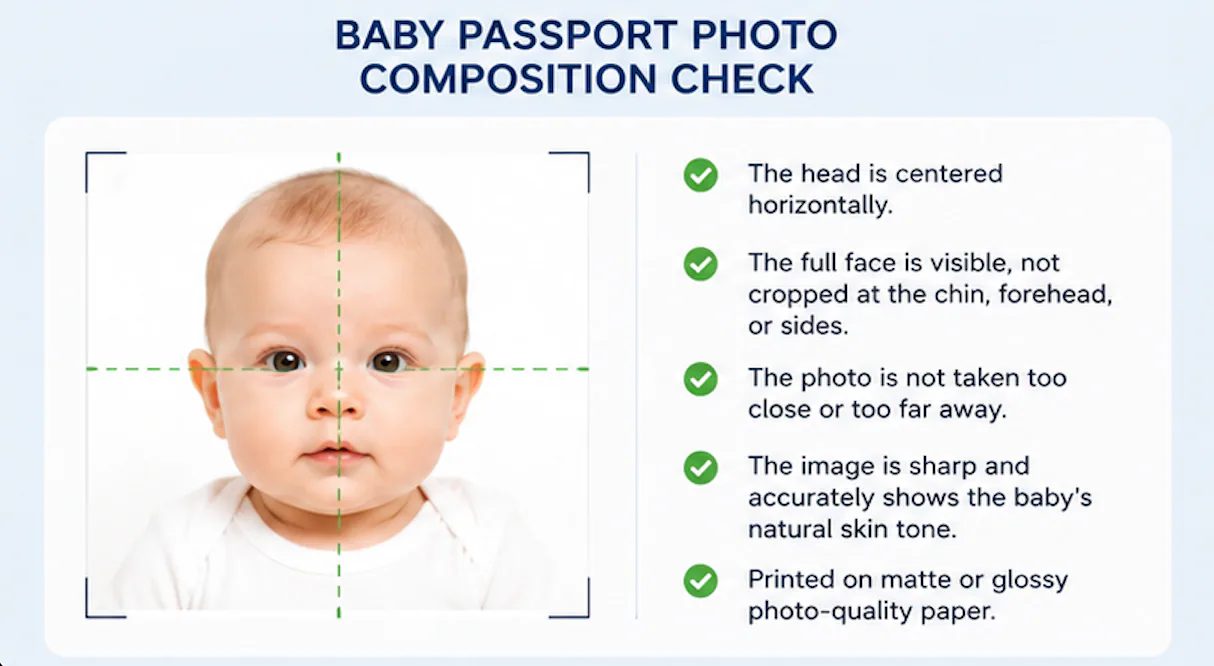
Quick composition check
- The head is centered horizontally.
- The full face is visible, not cropped at the chin, forehead, or sides.
- The photo is not taken too close or too far away.
- The image is sharp and accurately shows the baby's natural skin tone.
- The printed copy is on matte or glossy photo-quality paper, not ordinary paper or a photocopy.
How to take a baby passport photo at home
The State Department suggests two at-home methods. Choose the one that lets your baby stay safely supported while keeping everyone else out of the frame.
Method 1: Lay your baby on a white or off-white sheet
- Place a clean, plain white or off-white sheet on a safe flat surface.
- Lay your baby on their back with their head supported by the surface.
- Use soft, even light. Check that neither the baby nor the photographer casts a shadow on the face.
- Hold the camera directly above the baby and take several photos.
- Select the sharpest image with the full face visible and the baby facing the camera.
This setup is especially useful when a baby cannot yet support their own head. Do not place toys, a pacifier, a bottle, or a hand inside the frame to get the baby's attention.
Method 2: Cover a car seat with a white or off-white sheet
- Cover the car seat with a plain white or off-white sheet.
- Position the baby safely in the seat and make sure the background around the head is plain.
- Check the face for shadows before taking photos.
- Photograph the baby alone, facing the camera, with the full face visible.
This is an official alternative to the sheet-on-the-floor method. The goal is to create a clean, compliant background and even lighting before you take the photo — not to hide a poor original with editing later.
Clothing, hats, and accessories
Choose ordinary, comfortable clothing that does not cover the baby's face. Remove hats, hoods, glasses, sunglasses, pacifiers, bottles, headphones, and toys before the photo. A religious or medical head covering has limited exceptions, but the full face must remain visible and the application needs the required signed statement.
Avoid clothing that blends completely into the background around the face. A simple, non-uniform top that contrasts gently with the white or off-white background usually makes the face easier to see.
12 issues to check before submitting a baby passport photo
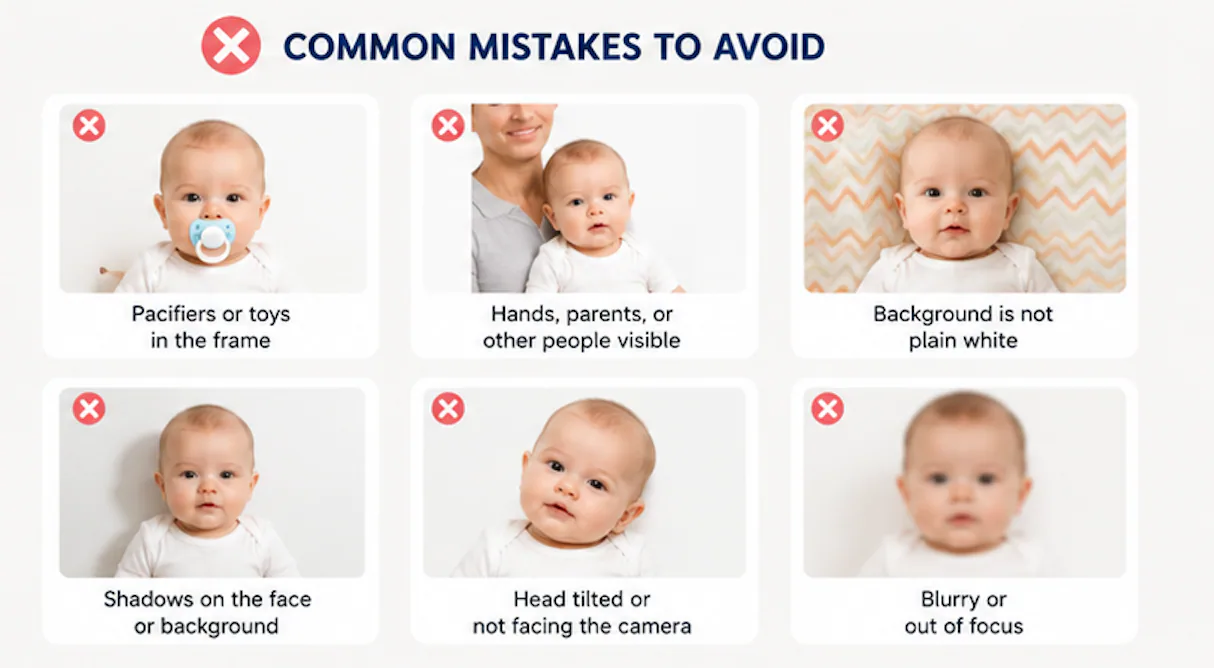
The list below is a practical pre-submission checklist, not a list of official rejection statistics. If any of these are present, take a new original photo rather than trying to repair it digitally.
| Check | Why it is a problem | What to do |
|---|---|---|
| A parent's hand, arm, face, or shadow is visible | The baby must be the only person in the photo | Retake with the baby supported by a sheet or covered car seat |
| A pacifier, bottle, toy, or food is visible | It can obscure the face or introduce an object into the photo | Remove it and retake |
| The baby is turned sideways or looking down | The full face must face the camera | Retake from directly above or directly in front |
| The head is tilted | The head should not be tilted | Wait for a straighter pose and take another frame |
| The face or background has a shadow | The background must be plain and shadow-free | Change the light and retake |
| The background is patterned, colored, or textured | The background must be plain white or off-white | Use a clean plain sheet and retake |
| The photo is blurry, grainy, or pixelated | The printed image must be high resolution and clear | Use the sharpest original frame or retake in better light |
| Flash causes red-eye or overexposure | Red-eye and washed-out features are not acceptable | Turn off flash and use even ambient light |
| The photo is older than six months | It must reflect the baby's current appearance | Take a new photo |
| The head is too large, too small, or off-center | The image will not meet the required composition | Reframe a clean original without distorting it |
| A hat or clothing covers the face | The full face must be visible | Remove the covering and retake |
| The image uses a filter, retouching, AI enhancement, or background replacement | The State Department requires an original, unchanged photo | Retake against a compliant background |
Retake, reframe, or submit?
Use this short decision guide before you upload or print.
| If you see this issue | Best next step |
|---|---|
| Blur, a visible hand, a pacifier, a shadow, a turned face, or an unsuitable background | Retake the original photo |
| A clean original photo with the baby centered but not at the final printed composition | Check the framing and use PhotoOmni's baby passport photo tool to prepare the print layout without altering the baby or background |
| A clean original image with correct size, position, background, and visibility | Prepare and submit one print-ready photo |
The rule is simple: framing a compliant original is different from changing it. Do not use editing tools, filters, AI, or background replacement to make a non-compliant original appear compliant.
How many passport photos does a baby need?
For a child's U.S. passport application, provide one color passport photo. The State Department processes over 20 million passport applications annually, with photo rejection rates of 20-25%, meaning millions of photos get sent back each year. The photo must meet the size, background, quality, and recency rules in this guide.
Do not attach or staple the photo to the child's application yourself. Bring it with the application; the acceptance agent or passport employee will review and staple it for you.
A 60-second baby passport photo checklist
Before printing, confirm all ten answers are "yes":
- Was the photo taken within the last six months?
- Is it a clear, high-resolution color image?
- Is the final printed size 2 × 2 inches (51 × 51 mm)?
- Is the baby's head 1–1⅜ inches (25–35 mm) high in the print?
- Is the head centered and the full face visible?
- Is the background plain white or off-white, with no shadow, pattern, texture, or object?
- Is the baby the only person in the frame?
- Are hands, pacifiers, toys, bottles, and face coverings out of the photo?
- Is the baby facing the camera? If the applicant is no longer a baby, are both eyes open and visible?
- Is this the original, unfiltered, unedited image?
If you can answer "yes" to every question, prepare one 2 × 2-inch print-ready photo for the application.
Frequently asked questions
Can a baby's eyes be closed in a passport photo?
It is acceptable if a baby's eyes are not entirely open. For all other children, the eyes should be open and visible. Try to take a clear forward-facing photo either way.
Can I hold my baby for a passport photo?
No. No other person should appear in the photo. Use a plain white or off-white sheet under the baby, or cover a car seat with one, so the baby can be safely supported without a parent appearing in the frame.
What size is a U.S. baby passport photo?
The printed photo must be 2 × 2 inches (51 × 51 mm). The baby's head must measure 1–1⅜ inches (25–35 mm) from the bottom of the chin to the top of the head.
Can I take a newborn passport photo at home?
Yes. The Department of State suggests placing your baby on a plain white or off-white sheet, or covering a car seat with one. Use even lighting, keep the baby alone in the frame, and take several photos to find a sharp, forward-facing image.
Can my baby wear a hat, headband, or pacifier?
Remove hats, headbands that cover the face, and pacifiers before taking the photo. The full face must be visible. Religious or medical head coverings have limited exceptions and may require a signed statement.
Why was my infant passport photo rejected?
Common photo problems include a visible parent or hand, shadows, a patterned background, blur, a turned head, an object covering the face, incorrect size, or digital editing. Check each item in the pre-submission checklist and retake the original photo if needed.
How long is an infant passport valid?
U.S. passports for children under age 16 are valid for 5 years. This affects the passport, not the photo: the photo submitted with the application still needs to be recent and taken within the previous six months.
Create Your Passport Photo Now
About the Author
Emma Richardson Senior ICAO Photo Compliance Expert, PhotoOmni
Emma Richardson is the Senior ICAO Photo Compliance Expert at PhotoOmni. With 12+ years of experience in passport and visa photo verification, she has helped applicants achieve 820,000+ successful photo approvals across 100+ countries and territories. She specializes in global passport photo requirements, ICAO-compliant photo standards, and biometric image verification.
Related Articles
- How to Take a Passport Photo at Home (2026 Guide)
- Passport Photo Requirements: The Complete 2026 Guide
- Why Was My Passport Photo Rejected? 15 Common Reasons & Fixes
Data sources: US Department of State passport processing (FY2024), UK Home Office annual report (2023), NIST FRVT Part 3: Demographic Effects (March 2024), ICAO Doc 9303 photo specifications. Pricing based on publicly listed rates as of July 2026.