
Do Your Ears Need to Show in a Passport Photo? Hair Rules for Women and Men
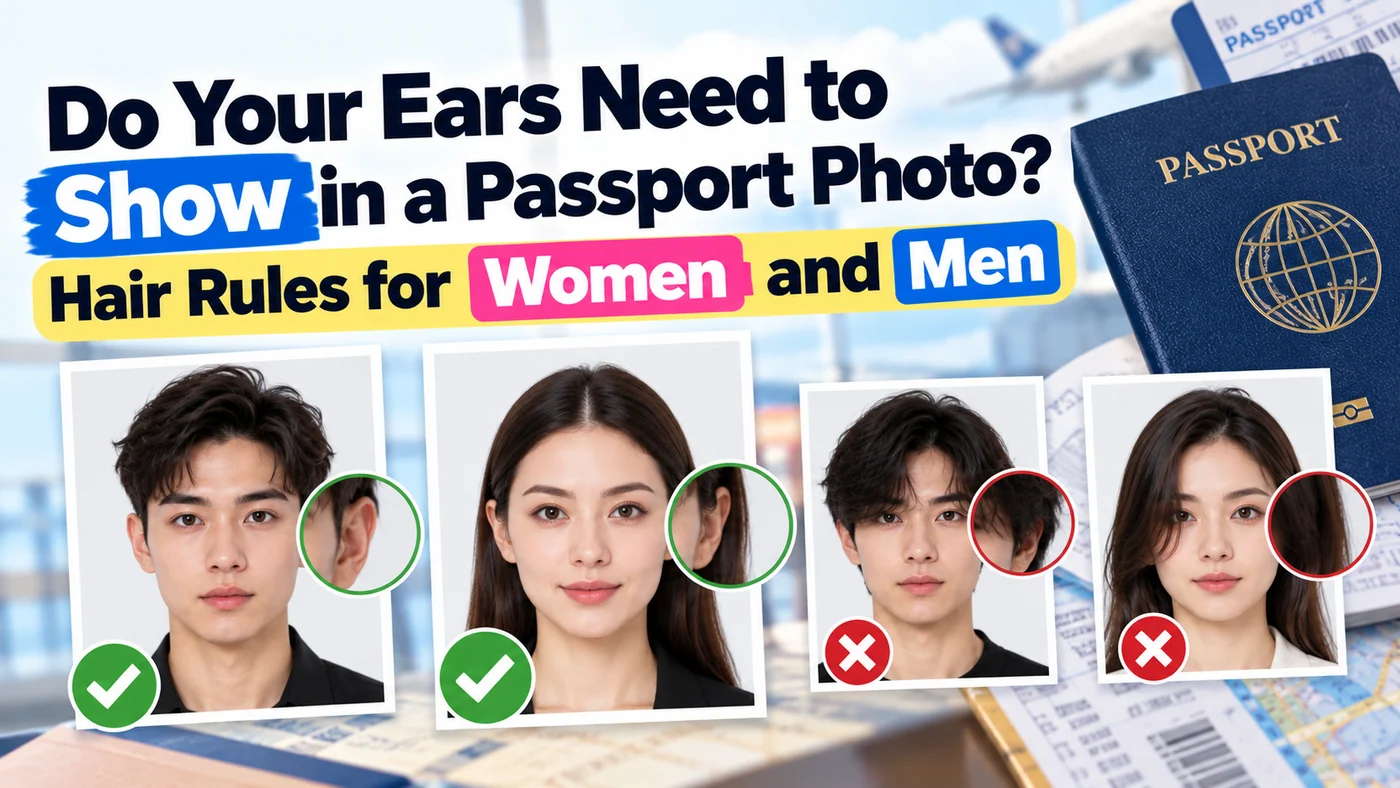
Your ears do not need to show in a U.S. passport photo, but your full face, eyes and facial outline must remain clear and free of shadows.
Last updated: September 2026
Quick answer: No. For a U.S. passport photo, your ears do not have to show, so you don't have to put your hair behind your ears. What matters is that your full face is clearly visible: hair must not cover your eyes, cast shadows on your face, or hang over the edges of your face. Tucking hair behind your ears is an easy, low-risk way to meet that, but it's a choice, not a rule.
This guide covers the U.S. rules in plain language, using the State Department's own wording, and explains where common advice goes beyond what the rules say. If you're applying for a passport from another country, jump to passports from other countries.
In this guide
- Do ears have to show in a U.S. passport photo?
- Should women put their hair behind their ears?
- Can hair cover your ears?
- Can bangs cover your eyebrows?
- Hair accessories: what's actually allowed
- Hair rules for men
- How head size is measured with hair, buns and beards
- Other ear rules: earrings, hearing aids, headphones
- If a photo shop tells you to tuck your hair
- Applying for a passport from another country
- FAQ
Do Ears Have to Show in a U.S. Passport Photo?
No. The State Department's internal passport photo policy (8 FAM 402.1) describes the photo as a clear, close-up view of the head and neck, and states that the ears do not have to be visible. The public passport photo page says the same thing in simpler terms: your full face must be visible.
So where does the "ears must show" idea come from? A few likely sources:
- Photo shops and booths that tuck hair back by habit, because it avoids retakes.
- Other countries' guidance, or advice written for them, that is more cautious about hair.
- Cautious blog advice that rounds "safest option" up to "rule."
The safest reading is this: the rules care about your face, not your ears. Ears can be covered as long as nothing important is hidden.
Should Women Put Their Hair Behind Their Ears?
You don't have to. The question to ask isn't "are my ears showing?" but "is any part of my face hidden or shadowed?"
| Your hair | Likely fine? | What to do |
|---|---|---|
| Long, down, covering ears, clear of eyes, cheeks and jawline | Yes | Nothing needed, though tucking is also fine |
| Long, down, falling forward over cheeks, jawline or eyes | Risky | Tuck it behind your ears or pin it back so the edges of your face are clear |
| Ponytail, bun or braid | Yes | Keep it neat; see head size for tall buns |
| Hair partly covering one eye | No | Pin or tuck it; the manual says no hair obscuring the eyes |
| Heavy, voluminous, or textured hair | Yes, if face is clear | Keep it from casting shadows or hiding face edges; hair may extend past the photo's edge as long as the whole head is shown at the right size |
Why tucking is still a smart choice. It's the simplest way to guarantee nothing falls across your face when the shutter clicks, and it keeps shadows off your cheeks. If you tuck, do it evenly on both sides so your head doesn't look tilted.
Why you shouldn't feel forced to. If you always wear your hair down, a passport photo that looks like you is exactly what the rules ask for. The regulation standard is a good likeness that identifies you.
Can Hair Cover Your Ears in a Passport Photo?
Yes, hair can cover your ears in a U.S. passport photo, as long as it does not hide your eyes or any part of your face or create shadows on your face. The line to watch is where the hair falls:
- Over the ears only: fine.
- Across the cheeks or jawline: this hides the outline of your face and is where photos run into trouble.
- In front of the eyes: the manual is explicit that hair must not obscure the eyes.
One practical reason photographers step back from the camera: at very close distances, wide-angle distortion (the manual calls it fish-eye distortion) exaggerates the center of the face and makes features at the edges, like ears, smaller and less clear. Taking the photo from a proper distance reduces this.
Can Bangs Cover Eyebrows in a Passport Photo?
Here it helps to separate what's written from what's advised.
- Written rule: the State Department manual says there must be no hair obscuring the eyes, and the public page says your full face must be visible.
- Not written: the manual excerpt I reviewed does not mention eyebrows by name.
- Safe practice: because "full face" includes the forehead and brow area, and shadows from bangs can hide features, the safest choice is to keep bangs clear of your eyebrows. Short bangs above the brows are typically fine. Curtain bangs or long fringe are easier to pin back or sweep aside.
If your bangs sit right on your eyebrows and you'd like to leave them, that's a judgment call. Pinning them back for the few seconds it takes to photograph is a small price for avoiding a retake.
Hair Accessories: What's Actually Allowed
This is where much of the advice you'll find online disagrees with the official text.
| Item | What the State Department manual says |
|---|---|
| Hair clips and bobby pins | Acceptable if they lie flat and don't obscure any part of the face, hairline, or composition |
| Thin headbands | Acceptable if they lie flat and don't obscure the face, hairline, or composition |
| Wide headbands, scarves, bows | Treated as head coverings and prohibited, unless worn for religious or medical reasons |
| Hats and other head coverings | Prohibited, except religious or medical (a signed statement may be requested when it's not obvious) |
Some sites say all headbands are banned or that only bobby pins are allowed. The manual is more specific: the test is whether the accessory lies flat and leaves your face, hairline and the overall photo clean. In practice, plain, hair-colored pins and thin ties are the lowest-risk choices; bright, bulky or decorative items draw attention and are easy to avoid.
Passport Photo Hair Rules for Men
Most hair guides are written for women, but the same principle applies to men: full face visible, no hair over the eyes, no shadows across the face.
- Long hair or a man bun: allowed. If it's down, make sure it isn't over your eyes or the edges of your face. A tall bun can affect how your head fits the frame.
- Beards and mustaches: nothing in the manual bans them, and the photo should be a good likeness of you. If you have a beard, keep it as you normally wear it. The manual also notes that a change in hairstyle or facial hair compared with your ID is acceptable as long as the photo still looks like you.
- Receding hairline or baldness: no special rule. Head size is measured to the top of the head, not the hairline.
- Wigs and hairpieces: the manual allows a wig if it doesn't partly or completely obscure the face.
- Hair loss from medical treatment: a head covering may be acceptable for medical reasons, and a signed statement from a medical professional may be requested in unclear cases.
- Hats, caps and beanies: not allowed, except for religious or medical reasons.
How Head Size Is Measured With Hair, Buns and Beards
This is the technical detail that trips people up, and few guides explain it. U.S. passport photos are 2 x 2 inches, and your head must measure between 1 and 1 3/8 inches (25 to 35 mm). According to the manual, that measurement runs from the top of the head (not the hairline or the hair) to the bottom of the chin (not including facial hair).
What that means in practice:
- Tall buns and voluminous hair don't count as the "top of your head," so a big hairstyle can make your face look smaller in the frame if you aren't careful. Your hair may extend past the edge of the photo as long as your entire head is shown at the correct size.
- Beards don't count toward chin position. Your chin, not the end of your beard, is the bottom reference point.
- Best practice: if you aren't sure, compare your photo against the official template on the State Department's photo page, and keep tall buns or big styles slightly flatter than usual for the photo.
Other Ear Rules: Earrings, Hearing Aids, Headphones
The only rules that mention ears directly are about what you wear on them:
- Headphones, earbuds, Bluetooth and hands-free devices must not be worn in the photo.
- Earrings and piercing jewelry: allowed if they don't hide your face. Small studs are a safe choice; large dangling earrings can create shadows or block the jawline.
- Hearing aids: the manual says a hearing device may be worn if it does not partly or completely obscure the face.
If a Photo Shop Tells You to Tuck Your Hair
This happens often, and people are sometimes told it's a requirement. If your hair is clear of your face, you can politely ask them to point to the rule. A calm way to say it:
"The State Department says the full face must be visible, and its manual says ears don't have to show. My hair isn't covering my face, so I'd like to keep it as it is. If you'd like, I'm happy to pin it back a little on the sides."
Tucking is a completely legitimate choice; it just isn't mandatory. The reason to be careful is what happens if a photo is rejected. When a photo doesn't meet the requirements, the State Department asks for a new one, which delays your application. According to the department's internal manual, if the applicant doesn't respond within 90 days, the application is denied and fees aren't refunded. That internal guidance may be worded differently in what applicants receive, but it shows why it's worth getting the photo right before submitting.
Don't Fix Your Hair With Software
If your hair blocks part of your face, retake the photo instead of editing it. The State Department states that digital manipulation and retouching of the facial image is not acceptable, and that beauty filters and social media photo tools are also not acceptable. Software that simply crops your photo to the correct size is a different thing from software that changes how you look. Change the hair in real life, not in an editing app.
Applying for a Passport From Another Country
Ear and hair rules aren't identical everywhere, and online sources sometimes contradict each other. For example, Canada's official passport photo page says your hair must be off your face so the edges of your face are visible, and it accepts photos with hair up or down. Some third-party sites say Canada requires both ears to show; others say ears may be covered. Always check the official page for the country you're applying to.
Passport Photo Hair Checklist
- Your full face is visible, from forehead to chin and the edges of your face.
- No hair over your eyes; bangs are pinned or swept aside if needed.
- No shadows on your face from hair.
- Any clips or pins are plain and lie flat; no wide headbands, bows, or scarves (unless religious or medical).
- No headphones, earbuds or Bluetooth devices.
- Head fits the correct size range and is centered.
- No filters, retouching or AI editing.
- Photo taken within the last six months.
FAQ
Do ears have to show in a passport photo? Not for a U.S. passport. The State Department's photo policy says the ears do not have to be visible. What must be visible is your full face.
Can hair cover your ears in a passport photo? Yes, as long as it doesn't hide your eyes or the edges of your face and doesn't cast shadows on your face.
Should I put my hair behind my ears for a passport photo? It's optional. Tucking your hair is a simple way to keep your face clear, but wearing it down is fine if nothing covers your face.
Are there passport photo hair rules for women that differ from men? No. The same rules apply to everyone: full face visible, no hair over the eyes, no shadows on the face. Men also need to consider beards and hairlines, but there are no special rules for them.
Can bangs cover eyebrows in a passport photo? The official rule says hair must not obscure the eyes and your full face must be visible. Keeping eyebrows clear is the safest approach; short bangs above the brows are typically fine.
Can I wear a headband or hair clip in a passport photo? Flat clips, bobby pins and thin headbands are acceptable if they don't hide any part of your face or hairline. Wide headbands, bows and scarves are not allowed unless worn for religious or medical reasons.
Can I wear my hair up or down? Either. Up is the simplest way to keep your face clear; down works if it doesn't cover your face.
Can I wear a wig or hearing aid? Yes. The manual allows a wig or hearing device as long as it doesn't partly or completely obscure the face.
What if a photo shop insists I tuck my hair? You can ask them to show the rule. If they can't, you can decline politely, though pinning your hair back slightly is a safe, easy choice.
Do other countries require ears to show? It depends on the country, and sources don't always agree. Check the official passport photo page for the country you're applying to.
Sources
- U.S. Department of State, Passport Photos: travel.state.gov/en/passports/apply/help/photos.html
- U.S. Department of State, 8 FAM 402.1 Passport Photographs: fam.state.gov/fam/08fam/08fam040201.html
- Immigration, Refugees and Citizenship Canada, Passport photo requirements: canada.ca/en/immigration-refugees-citizenship/services/canadian-passports/photos.html
About the Author
Emma Richardson
Senior ICAO Photo Compliance Expert, PhotoOmni
Emma Richardson is the Senior ICAO Photo Compliance Expert at PhotoOmni. With 12+ years of experience in passport and visa photo verification, she has helped applicants achieve 820,000+ successful photo approvals across 100+ countries and territories. She specializes in global passport photo requirements, ICAO-compliant photo standards, and biometric image verification.