
Passport Photo Rules for Women 2026
Passport photo rules are the same for everyone, but women often need to pay particular attention to hair, makeup, jewelry and necklines.
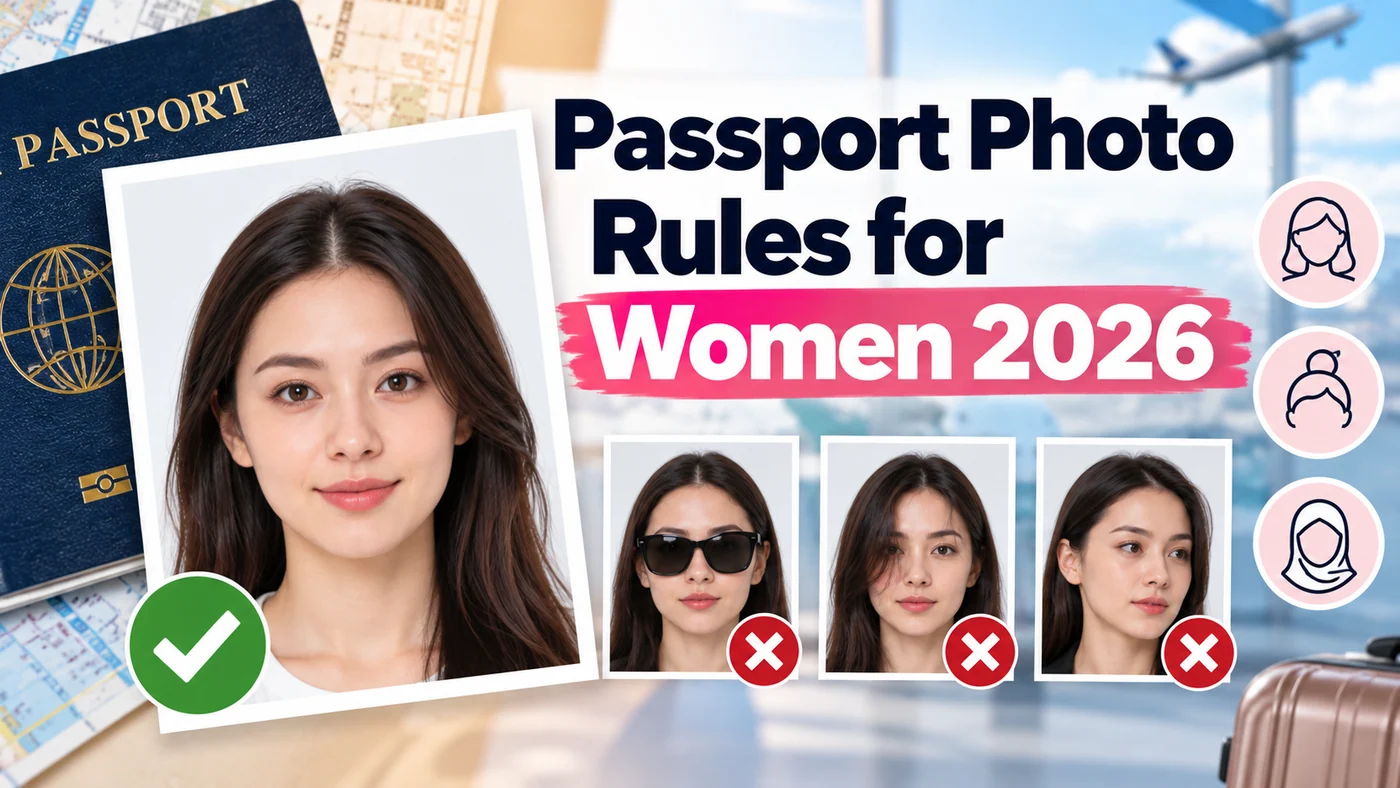
Last updated: September 2026
Quick answer: There is no separate legal standard for women's passport photos — the U.S. State Department applies the same rules to everyone. What changes is which rules trip women up most often: hair covering the face, jewelry, makeup that changes your everyday look, and necklines that don't survive the crop. This guide walks through each one using the State Department's own wording, then covers where U.S. rules diverge from other countries.
In this guide
- Is there a different rule set for women?
- Hair: what's required vs. what's just safe
- Makeup: how much is too much
- Jewelry and piercings
- Clothing and necklines
- Religious and medical head coverings
- Special circumstances: pregnancy, postpartum, hair loss
- Passport photos for women in other countries
- Checklist
- FAQ
Is There a Different Rule Set for Women?
No. The public passport photo page and the internal manual (8 FAM 402.1) describe one standard that applies to every applicant: full face visible, neutral expression, no head covering except for religious or medical reasons, no glasses (with a medical exception), and a recent photo that looks like you. Guidance written specifically "for women" is almost always about the parts of that standard women run into most — hair, makeup, jewelry, and necklines — not a separate legal bar.
Hair: What's Required vs. What's Just Safe
A common claim online is that a passport photo must show both ears. It doesn't. The manual states the ears do not have to be visible; what has to be visible is your full face. Hair can fall over your ears as long as it doesn't cover your eyes, hide the edges of your face, or cast shadows.
| Hairstyle | Fine as-is? | Notes |
|---|---|---|
| Down, clear of eyes and cheeks | Yes | No action needed |
| Down, falling across cheeks or jaw | Risky | Tuck or pin back |
| Up (bun, ponytail, braid) | Yes | Watch head-size measurement for tall buns |
| Bangs on the eyebrows | Judgment call | No written rule bans it, but shadows/obscured eyes are a real rejection reason |
Head size is measured from the top of the head — not the top of your hair — to the bottom of the chin, so voluminous styles won't inflate your measured head size, but they can make your face look small in the frame if the bun sits high.
Makeup: How Much Is Too Much
This is one of the least-documented areas in official guidance, and most existing articles just say "keep it natural" without saying why. The reasoning follows directly from the identity-document standard: the photo has to be a recognizable likeness of how you normally look. Two practical takeaways:
- Skip dramatic changes you don't wear day to day — heavy contouring, false lashes, or a lip color you'd never wear to work — not because a specific product is banned, but because it works against the "accurate likeness" standard the same way costume makeup or a wig that obscures the face would.
- Regular, everyday makeup is not restricted in any way; there's no rule capping foundation coverage or requiring bare skin.
Jewelry and Piercings
Jewelry is allowed if it doesn't hide your face, create glare, or cast a shadow. In practice:
- Studs and small earrings: low risk.
- Large hoops or dangling earrings: can shadow the jawline — not banned, but worth checking under your photo's lighting.
- Facial piercings: allowed under the same standard — visible and not casting a shadow over facial features.
- Reflective pieces (metallic chokers, sequin-trimmed collars): avoid, since glare is treated the same way whether it comes from glasses or jewelry.
Clothing and Necklines
The State Department doesn't regulate necklines directly, but two practical issues come up specifically for women's photos:
- White or very light tops can blend into the white/off-white background used for U.S. passport photos.
- Low or off-shoulder necklines can look bare once the image is cropped tight to head and shoulders — not a rule violation, but a common reason people ask for a retake.
Religious and Medical Head Coverings
Head coverings are prohibited except for religious or medical reasons, and a signed statement may be requested if the reason isn't obvious from the photo alone. The face must still be fully visible from chin to forehead — a hijab, for example, is permitted, but it can't shadow or cover any part of the face. This is also where U.S. rules diverge sharply from some other countries (see below).
Special Circumstances
Areas most existing guides skip entirely:
- Pregnancy: no rule differences; standard clothing and background guidance applies.
- Postpartum hair shedding or a temporary hairstyle change: fine — the manual explicitly allows a hairstyle that differs from your ID photo, as long as the new photo is still a good likeness of you.
- Hair loss from medical treatment: a head covering may be acceptable for medical reasons, generally with a signed statement from a medical professional in unclear cases.
Passport Photos for Women in Other Countries
Rules diverge more than most sites acknowledge:
| Country | Head covering | Glasses | Notes |
|---|---|---|---|
| United States | Religious/medical only, face fully visible | Not allowed except with signed medical statement | 2x2 in., head 1–1 3/8 in. |
| United Kingdom | Religious/medical only, face fully visible | Not allowed except medical exception | Similar standard to U.S. |
| Saudi Arabia (national ID) | Hijab required for women | Glasses/contacts not permitted | Different framework — a mandatory covering rather than an exception |
Because sources on non-U.S. rules frequently contradict each other, always confirm against the destination country's official passport authority page before your photo session.
Passport Photo Checklist for Women
- Full face visible from forehead to chin and both face edges
- No hair over the eyes; shadows cleared
- Everyday makeup, no dramatic departure from your usual look
- Jewelry doesn't hide your face or create glare
- Top color contrasts with a white/off-white background
- Neckline holds up once cropped to head and shoulders
- Head covering only for religious/medical reasons, face fully visible
- No glasses unless a signed medical statement is on file
- Photo taken within the last six months, no filters or retouching
FAQ
Are passport photo rules different for women than men? No — one standard applies to everyone. Guidance aimed at women usually just covers the areas — hair, makeup, jewelry, necklines — that come up most for women applicants.
Do I have to wear my hair up or tucked behind my ears? No. Hair can be up or down; the only requirement is that your full face stays visible and unshadowed.
Can I wear my normal makeup? Yes. There's no restriction on everyday makeup — the standard is that the photo should be a recognizable likeness of how you normally look.
Can I wear a hijab or other religious head covering? Yes, as long as your face is fully visible from chin to forehead with no covering or shadow over any facial feature. A signed statement may be requested.
Do other countries have the same rules for women? No — some countries, like Saudi Arabia, require a head covering for women's ID photos rather than treating it as a religious exception. Always check the destination country's official page.
Sources
- U.S. Department of State, Passport Photos: travel.state.gov/en/passports/apply/help/photos.html
- U.S. Department of State, 8 FAM 402.1 Passport Photographs: fam.state.gov/fam/08fam/08fam040201.html
About the Author
Emma Richardson
Senior ICAO Photo Compliance Expert, PhotoOmni
Emma Richardson is the Senior ICAO Photo Compliance Expert at PhotoOmni. With 12+ years of experience in passport and visa photo verification, she has helped applicants achieve 820,000+ successful photo approvals across 100+ countries and territories. She specializes in global passport photo requirements, ICAO-compliant photo standards, and biometric image verification.