
Good vs Bad Passport Photo Examples: What Gets Accepted or Rejected
Compare the most common accepted and rejected passport photo patterns, including expression, shadows, head position, glasses and framing.
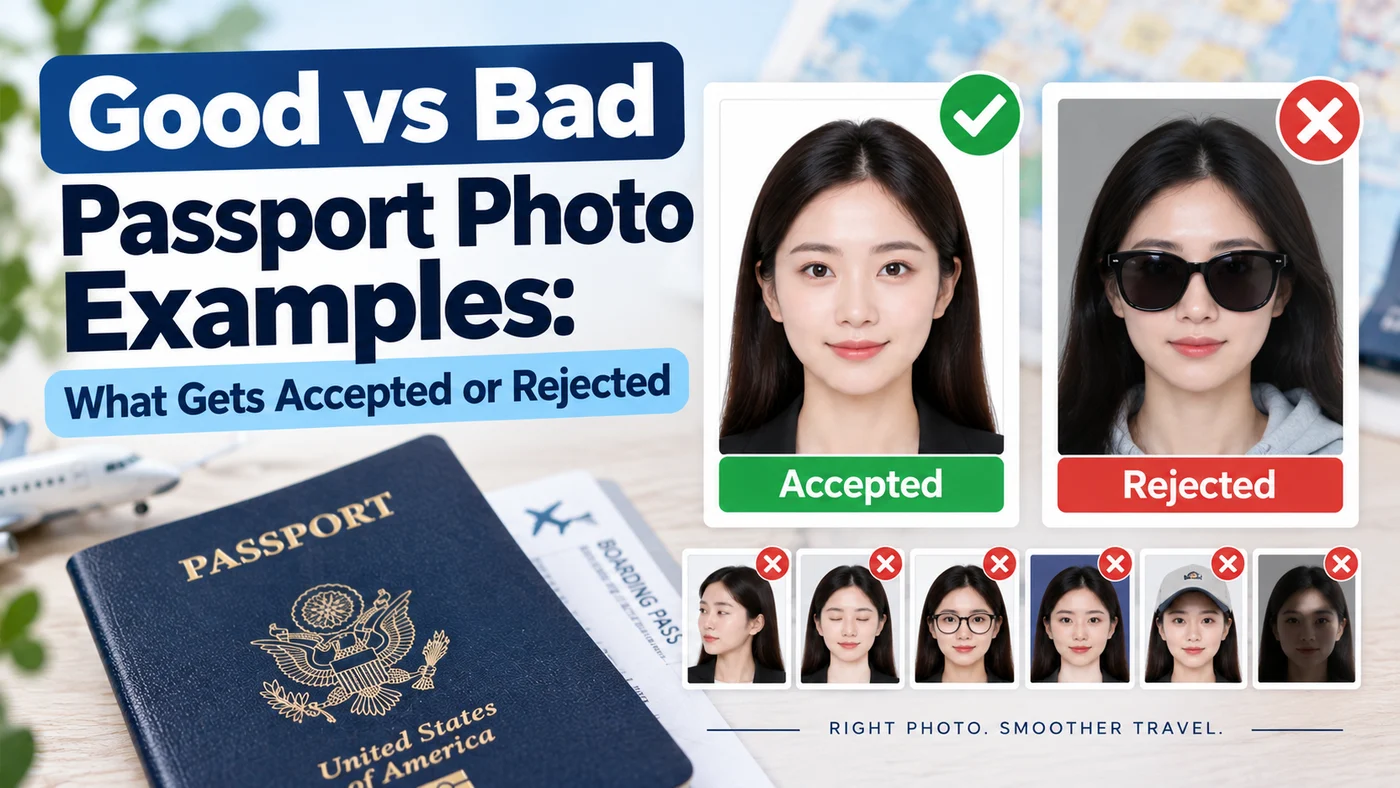
Quick answer: An accepted passport photo has a plain white background, a neutral expression with mouth closed and eyes open, direct forward-facing framing with both edges of the face visible, even lighting with no shadows or glare, and nothing covering the face — no glasses, no hat, no hair across the forehead or eyes. A rejected photo typically fails for one of a small, predictable set of reasons: smiling or an open mouth, a tilted head, a background that isn't a plain neutral color, shadows across the face, glare on glasses, or a head size outside the required proportion of the frame. Most rejections come down to just a few of these repeat offenders — not unusual or unpredictable mistakes.
Why "Examples" Are More Useful Than a Rules List
A checklist of rules ("neutral expression," "plain background") is accurate but abstract — most people don't know what "too much shadow" or "slightly tilted" actually looks like until they see it. This is why side-by-side good/bad comparisons are searched for so often: people want to pattern-match their own photo against a known-good and known-bad example, not re-read a spec sheet.
What a Good Passport Photo Looks Like
- Background: Plain white or off-white, evenly lit, with no shadow gradient behind the head or shoulders
- Expression: Neutral — mouth closed, no smile, both eyes open and looking directly at the camera
- Head position: Facing forward, not tilted left, right, up, or down; both ears don't need to be visible, but both edges of the face do
- Framing: Head takes up roughly 50–69% of the image height (varies slightly by country), with even space above the head and below the chin
- Lighting: Even across the whole face — no harsh shadow under the chin, no glare on the forehead, no dark half-face from a single light source
- Clothing: Everyday clothing, no uniforms (except daily religious attire), and ideally not white or very light-colored, since it can blend into the background
Common Rejection Patterns, Explained
Smiling or an open mouth. This is one of the most common rejection reasons cited across every country's guidance. A relaxed, closed-mouth neutral expression is required — not a big smile, but also not an exaggeratedly serious frown. "Neutral" is a narrower target than people expect.
Shadows on the face or background. Single-source lighting (one lamp, an overhead light, direct sun from one side) tends to create a visible shadow on one side of the face or a shadow gradient on the background behind the head. Even, diffused lighting — a window with soft daylight, or two light sources at even angles — avoids this.
Head tilted or turned. Even a slight tilt of the head or a turn toward one shoulder is a common, easy-to-miss rejection cause. The face needs to be squared directly to the camera, not angled.
Glare on glasses. Rather than risk glare, most current guidance simply recommends removing glasses entirely for the photo — several countries no longer permit glasses in passport photos at all, and others require a glare-free result that's genuinely difficult to guarantee without professional lighting.
Hair across the face. Bangs, loose hair, or a hood covering part of the forehead, eyebrows, or eyes are a frequent rejection cause. Both edges of the face need to be visible — hair can be worn up or down, but it can't obscure the face itself.
Background that isn't truly plain. A textured wall, a patterned curtain, an outdoor background, or even a slightly off-white wall with visible texture can all fail the "plain background" requirement, even when it looks acceptable to the naked eye on a phone screen.
Incorrect head size. A photo where the head is too small (too much background visible) or too large (cropped too tight) relative to the frame doesn't meet the size ratio requirement, even if everything else about the photo is otherwise fine.
A Photo Can Look Fine to You and Still Fail
This is the core reason "good vs bad examples" content exists: several rejection causes — a shadow gradient on the background, a slightly tilted head, hair just barely crossing an eyebrow — are genuinely hard to self-assess by eye, especially on a small phone screen. A photo that looks perfectly normal to the person in it can still fail one of these checks when reviewed against the actual spec.
Checking Your Own Photo Against These Patterns
Rather than guessing whether your photo falls into the "good" or "bad" category, running it through an actual compliance check catches these issues before submission rather than after a rejection. PhotoOmni evaluates an uploaded photo against the destination document's specific requirements — flagging shadow, tilt, expression, and framing issues — and corrects background and cropping automatically, combining an automated check with human review before the final file is delivered.
FAQ
Is a slight smile with a closed mouth acceptable? Generally no — most guidance specifies a fully neutral expression, and even a slight closed-mouth smile can be flagged during review. A relaxed, non-smiling expression is the safest choice.
Can I wear makeup in a passport photo? Yes, in most countries — normal, everyday makeup is permitted as long as it doesn't alter your natural appearance or obscure facial features.
Does the background have to be pure white, or is off-white acceptable? Off-white and very light neutral tones are generally accepted, but the background must be plain and evenly lit either way — a slightly warm or cool white is usually fine, but visible texture, shadow, or color variation is not.
Why did my photo get rejected when it looks identical to an accepted example? Small, hard-to-see issues — a faint shadow, a fraction-of-an-inch head tilt, hair just touching an eyebrow — are the most common reason a photo that looks fine actually fails. A dedicated compliance check is more reliable than a visual comparison alone.
Bottom Line
The gap between an accepted and a rejected passport photo usually comes down to a short, repeatable list of issues — expression, shadow, tilt, background, and framing — rather than anything unpredictable. Comparing your own photo against these specific patterns, or running it through a compliance tool like PhotoOmni that checks for them directly, catches the kind of small, easy-to-miss problems that cause most real-world rejections.