
Passport Book vs Passport Card: Which One Do You Actually Need?
Compare U.S. passport books and cards by travel use, cost, validity, and photo rules.
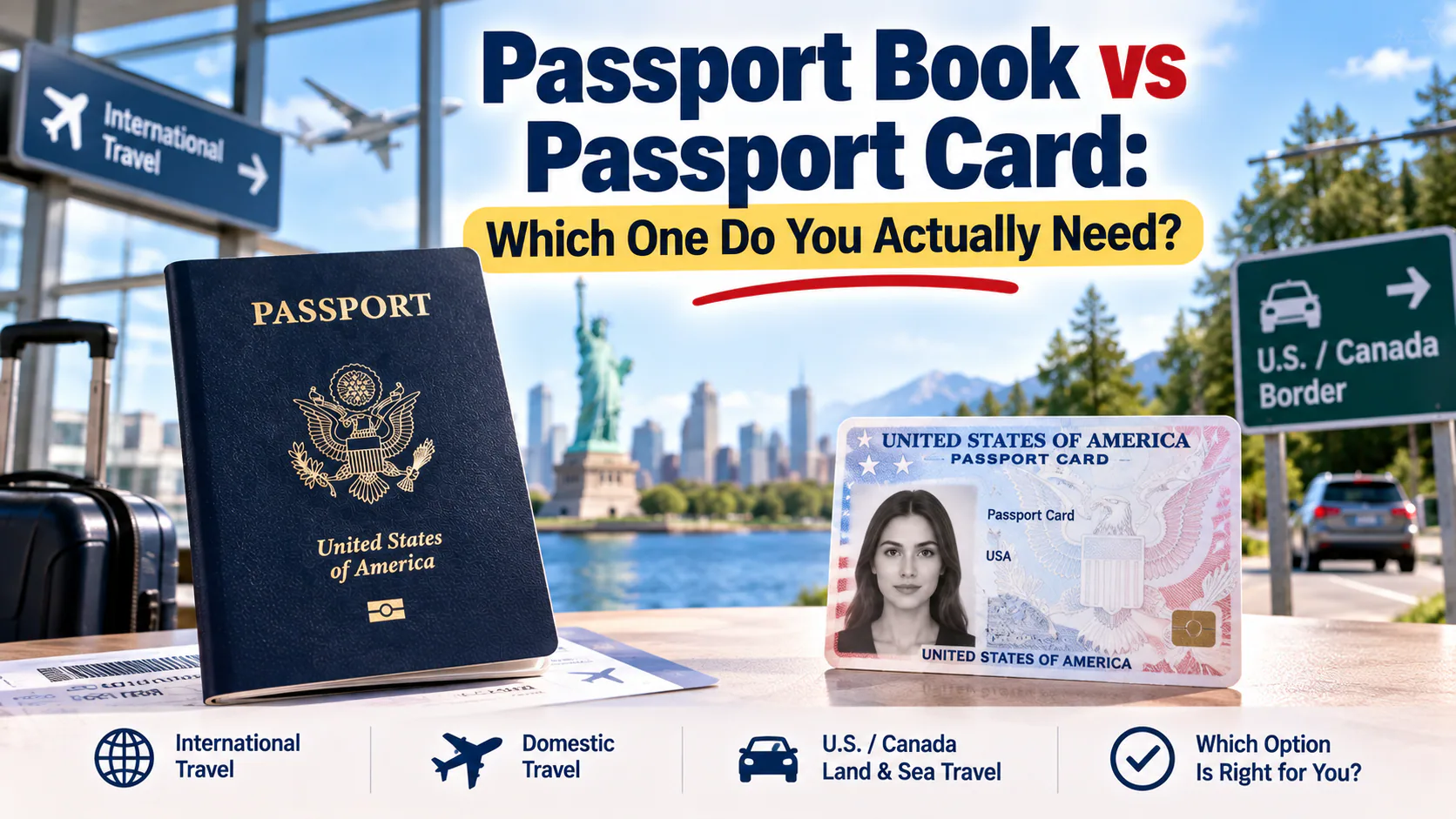
If you've started a U.S. passport application, you've probably noticed the form asks whether you want a passport book, a passport card, or both. For a lot of first-time applicants, this is the point where the process stalls out — the State Department's own explanation is accurate but not exactly built for quick decision-making. Here's a plain breakdown of what each document actually does, what it costs in 2026, and which one fits your situation.
The Short Version
- Passport book: Valid for international air, land, and sea travel to any country in the world.
- Passport card: A cheaper, wallet-sized ID valid only for land and sea travel between the U.S. and Canada, Mexico, Bermuda, and the Caribbean. It cannot be used for international flights.
If you plan to fly internationally at any point, you need a passport book. The card is a supplement, not a substitute.
Passport Book: The Full Rundown
The passport book is the document most people picture when they hear "passport" — the navy blue booklet with your photo, personal details, and blank pages for visa stamps. It's accepted for entry into virtually every country and is required for all international air travel, including to Canada and Mexico.
2026 cost: A first-time adult passport book runs $165 total ($130 application fee + $35 execution fee paid at an acceptance facility). Renewing an existing adult book by mail costs $130, since no execution fee applies. A minor's first passport book (under 16) costs $135 total.
Validity: 10 years for adults, 5 years for minors under 16.
Passport Card: The Full Rundown
The passport card was introduced as a cheaper, more convenient option for people who cross land borders often — commuters near the Canadian or Mexican border, frequent Caribbean cruisers, or families who drive to Mexico for vacation. It's the size of a credit card, fits in a wallet, and uses RFID technology for faster processing at land and sea checkpoints.
The catch is right there in the name of the restriction: it is not valid for air travel outside the U.S., not even to Canada or Mexico. If you try to board an international flight with only a passport card, you will be turned away at the gate.
2026 cost: A first-time adult passport card costs $65 total ($30 application fee + $35 execution fee). A minor's card costs $50 total. If you're getting both a book and a card together, the combined adult application fee is $160 (plus one $35 execution fee), which is cheaper than paying for each separately.
Validity: 10 years for adults, 5 years for minors — same as the book.
Side-by-Side Comparison
| Passport Book | Passport Card | |
|---|---|---|
| International air travel | ✅ Yes, anywhere | ❌ No |
| Land/sea travel to Canada, Mexico, Bermuda, Caribbean | ✅ Yes | ✅ Yes |
| Domestic U.S. flights (as REAL ID alternative) | ✅ Yes | ✅ Yes |
| Cost (first-time adult) | $165 | $65 |
| Size | Booklet | Wallet-sized card |
| Validity | 10 years | 10 years |
Who Should Get Which One
Get a passport book if:
- You have any plans, even loosely, to fly internationally — including short trips to Canada, Mexico, or the Caribbean.
- You want one document that works everywhere, with no restrictions to remember.
Get a passport card if:
- You live near the northern or southern U.S. border and regularly drive across.
- You take cruises that depart from and return to the same U.S. port (closed-loop cruises to the Caribbean, for example) and don't need to fly.
- You want a compact backup ID for domestic flights that also happens to work for occasional land-border trips.
Get both if:
- You want the flexibility of a book for flying, plus a card as a lighter, harder-to-lose option for local border crossings or as a spare ID. Applying for both together is cheaper than applying for each on its own, since you only pay one execution fee.
What Doesn't Change Between the Two
Regardless of which one (or both) you apply for, the application process itself is largely the same:
- Same form (DS-11 for first-time applicants, or the online DS-82 renewal for eligible adults renewing a book).
- Same proof-of-citizenship and ID documents.
- Same photo requirements — a 2x2 inch photo with a plain white or off-white background, neutral expression, and no glasses, taken within the last 6 months.
That last point trips people up more than any other part of the process. Photo issues are one of the most common reasons applications get delayed, whether you're applying for a book, a card, or both — the same photo is used for either document, so there's no shortcut there. If you're preparing your application at home rather than getting photos done in person, it's worth running your photo through a compliance check before you submit — a tool like PhotoOmni checks your photo against the exact U.S. passport specification (and works for both book and card applications, since the photo requirement is identical) with an AI review backed by a human check, so you're not finding out about a lighting or cropping issue after the State Department already has your application.
Bottom Line
For most travelers, the passport book is the non-negotiable one — it's what actually lets you leave the country by air. The card is a low-cost add-on that makes sense specifically for frequent land-border crossers and closed-loop cruisers, not a cheaper replacement for the book. When in doubt, ask yourself one question: will I ever need to fly out of the country? If the answer is yes, or even "probably," the book is the one to prioritize.