
Do Passport Photos Have to Be in Color? Black-and-White and Printing Rules
U.S. passport photos must be in color, while rules differ elsewhere. Learn the color, filter, lighting and printing requirements.
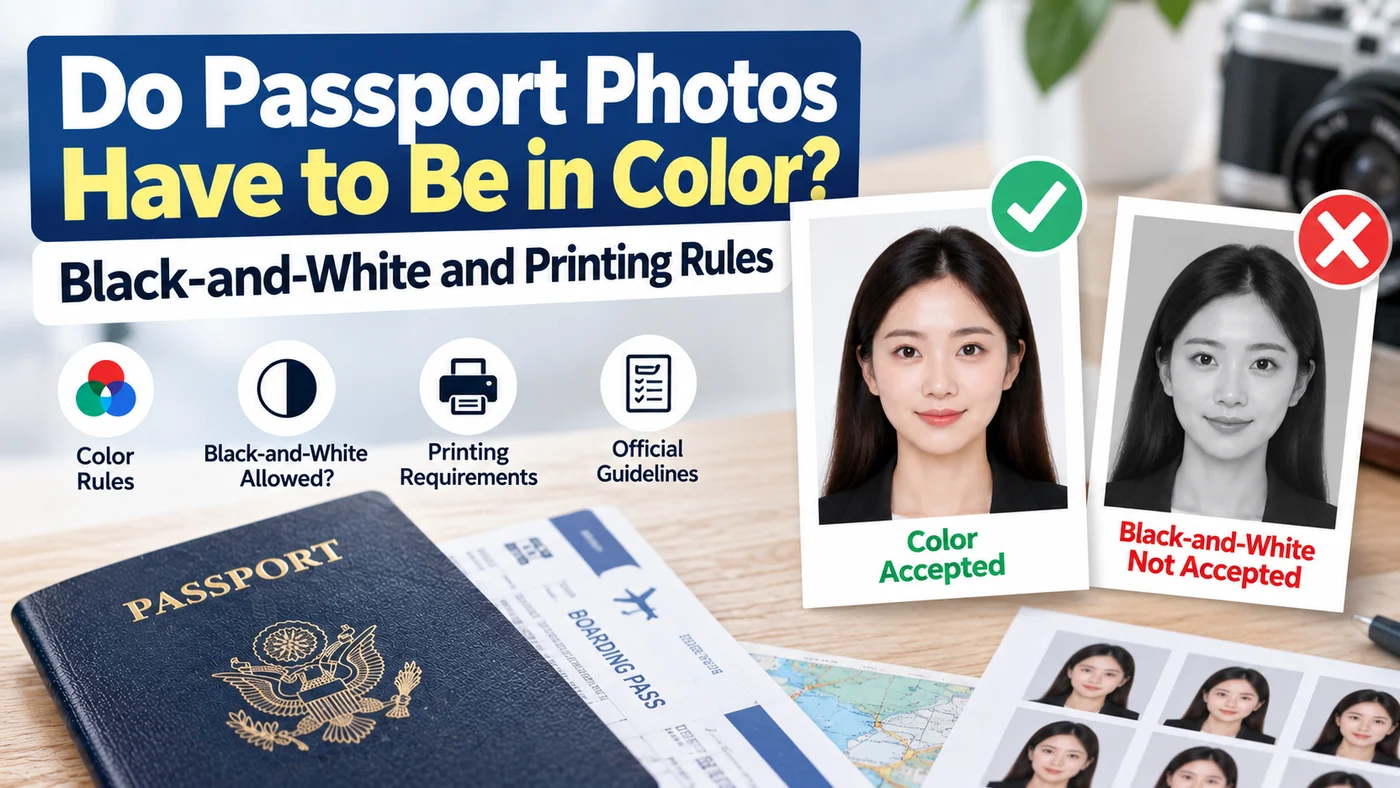
Quick answer: For a U.S. passport, yes — your photo must be in color. Black-and-white photos are explicitly not accepted, and this isn't a recent change; it's been a firm requirement for years. This is actually one of the clearer, more consistent rules across the entire application — unlike expression or background rules, which have some nuance, "must be color" has no exceptions for U.S. passports. That said, this rule genuinely varies by country: Canada and South Africa, for example, explicitly accept both color and black-and-white passport photos, so if you're applying somewhere other than the U.S., don't assume the same rule applies.
Why This Question Keeps Coming Up
Older U.S. government guidance, still findable in some archived and unofficial sources, once stated photos "may be black and white or color" — language from an earlier era of passport processing. That outdated wording still circulates on forums and older blog posts, which is likely why this question persists even though the current rule is unambiguous. The current U.S. Department of State guidance is direct: submit a color photo. If you find a source telling you black-and-white is fine for a U.S. passport, it's either outdated or simply wrong.
The Rule, Country by Country
| Country | Color Required? |
|---|---|
| United States | Yes — color only |
| Canada | Either color or black-and-white accepted |
| South Africa | Color required for passports; color or black-and-white accepted for national ID cards |
| Netherlands | Color required |
| United Kingdom | Color required |
The pattern across most major passport-issuing countries is that color is now the default requirement, with a handful of countries (Canada being the most notable) still explicitly permitting black-and-white as an alternative. If you're applying for a passport anywhere outside the handful of countries that allow both, treat color as mandatory unless you've directly confirmed otherwise.
Why Governments Care About Color at All
This isn't an aesthetic preference. A color photo shows your natural skin tone, hair color, and eye color — details that matter for identity verification and biometric matching. A black-and-white photo strips out information that a border officer or an automated facial recognition system might use to confirm you're the person in the photo. That's also part of why heavily filtered or edited photos (even color ones) get rejected — anything that alters your natural coloring works against the same verification purpose color photos are meant to serve.
What "Color" Actually Requires Beyond Just Not Being Black-and-White
Passing the "is it in color" check is the easy part — most phone cameras shoot color by default. Where people actually run into trouble is a photo that's technically in color but poorly lit or color-corrected in a way that misrepresents skin tone — too warm, too cool, or washed out from an aggressive filter or auto-enhancement setting. Several countries' current guidance specifically calls out filters and "beautify" camera modes as a rejection risk, separate from the black-and-white rule entirely. Turning off any automatic photo enhancement or filter setting on your phone before taking the picture is worth doing regardless of which country you're applying to.
Printing Considerations: Does Paper Finish Matter Alongside Color?
If you're printing your own photo rather than uploading it digitally, the color requirement is separate from — but sometimes confused with — questions about paper finish (matte vs. glossy) and paper weight. Both matte and glossy photo paper are generally accepted as long as the print itself is on genuine photo-quality stock, not standard printer paper, and the photo is undamaged, sharp, and true to color. Printing a color photo on cheap paper won't make it "not color" — but it can make the color rendering poor enough to cause other rejection issues (dullness, incorrect tone, visible print artifacts).
Getting a Correctly Colored Photo Without Guesswork
Since even a color photo can be rejected for inaccurate color rendering — too much filter, poor white balance, a background that isn't a true neutral white — it's worth having the photo checked rather than assuming a phone snapshot is automatically compliant. A tool like PhotoOmni processes an uploaded photo to correct background, cropping, and lighting to the destination country's specific color and format requirements, and flags issues like over-filtering before you submit.
FAQ
Can I submit a black-and-white photo for my U.S. passport if it's a high-quality professional print? No — quality doesn't override the requirement. U.S. passport photos must be in color regardless of how the black-and-white photo was produced.
Is a sepia-toned or vintage-filter photo considered "color"? No — this would likely be rejected on the grounds of misrepresenting natural skin tone and coloring, even though it's technically not black-and-white. Stick to a natural, unfiltered color photo.
Does the color requirement apply to visa photos the same way it applies to passport photos? Generally yes for most countries, though it's worth double-checking the specific visa's photo requirements separately, since visa and passport specs can differ even within the same country.
If my country allows both color and black-and-white, is one more likely to be accepted without issue? Color is generally the safer default even where black-and-white is technically permitted, since it provides more identifying information and is the format most processing systems are built around.
Bottom Line
For a U.S. passport, the color requirement is firm and has no exceptions — outdated advice suggesting black-and-white is acceptable should be ignored. A handful of other countries, Canada among them, do allow black-and-white as an alternative, so check your specific destination rather than assuming either rule applies universally. Whichever country you're applying to, a tool like PhotoOmni can confirm your photo's color, background, and format all meet that country's specific requirements before you submit.