
Indian eVisa Photo Requirements 2026: A Complete Guide by Application Type
Indian eVisa photo requirements for 2026, including JPEG size and upload rules, background standards, application categories, and common mistakes.
Product route and document guidance checked: September 28, 2026
If you're applying for an Indian eVisa, your photo isn't just a formality — it's checked by automated systems before a human ever sees your application, and it's checked again by airline staff at the boarding gate against your passport. Getting it wrong doesn't just risk a rejected application; it can also mean a delayed trip or a denied boarding pass. This guide walks through exactly what the Indian eVisa photo requirements are, how they apply across the different eVisa categories, and where most applicants slip up.
Use the PhotoOmni Indian visa photo tool to prepare a square visa image for the selected application channel. Confirm the current eVisa portal limits before upload, because file-size rules can differ from paper or application-centre submissions.
Quick Answer: Indian eVisa Photo Requirements
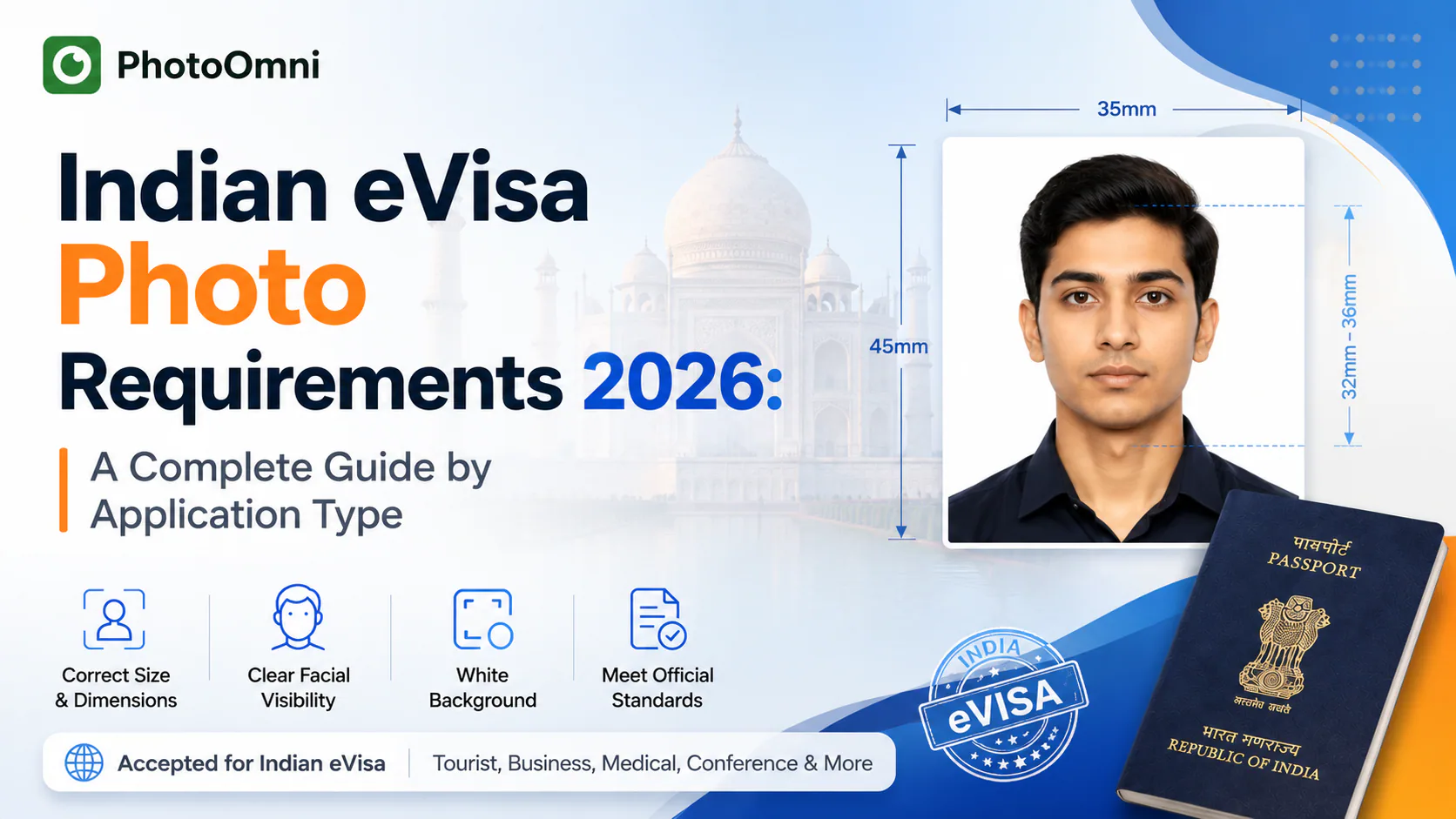
An Indian eVisa photo must be a square JPEG (equal width and height), between 350 x 350 px and 1,000 x 1,000 px, with a file size of 10 KB to 1 MB. It needs a plain white or light-colored background, a recent (within 6 months), unedited, front-facing color photo showing your full face, centered and uncovered. These specs are the same across all five eVisa categories — tourist, business, medical, medical attendant, and conference.
If you prefer to prepare the file online, the Indian photo maker can help check the crop, background, and visa-photo format before submission.
What Is the Indian eVisa, and Who Needs One?
The Indian eVisa is a fully online alternative to visiting a consulate or application center in person. Instead of paper forms and an in-person appointment, eligible travelers upload their documents — including a digital photo — directly through the official portal at indianvisaonline.gov.in. It was introduced to make short-term travel to India faster, and it's now available to nationals of a large number of countries, though the exact list changes periodically as India adjusts eligibility, so it's worth confirming your country's status on the official site before applying.
The Five eVisa Categories — and Why It Matters for Your Photo
The Indian eVisa isn't one single visa; it's a family of five sub-categories, each tied to a different travel purpose:
| eVisa Type | Purpose | Typical Validity |
|---|---|---|
| e-Tourist Visa | Sightseeing, visiting family/friends, short recreational trips | 30 days, 1 year, or 5 years depending on the option chosen |
| e-Business Visa | Business meetings, trade, setting up a venture | Up to 1 year, multiple entries |
| e-Medical Visa | Receiving medical treatment at a recognized hospital in India | Short-term, multiple entries |
| e-Medical Attendant Visa | Accompanying someone traveling on an e-Medical Visa | Matches the patient's visa validity |
| e-Conference Visa | Attending a specific government-approved conference | Short-term, single entry |
Here's the part that surprises a lot of applicants: the photo specifications are identical across all five categories. Whether you're applying for a two-week tourist trip or a multi-entry business visa, the same square photo format, background rules, and file requirements apply. What changes between categories isn't the photo — it's the supporting documents (like a hospital letter for e-Medical or a conference invitation for e-Conference).
Indian eVisa Photo Specifications
| Requirement | Specification |
|---|---|
| Shape | Square, equal width and height (1:1 ratio) |
| Pixel dimensions | 350 x 350 px (minimum) to 1,000 x 1,000 px (maximum) |
| File format | JPEG, in color |
| File size | 10 KB to 1 MB |
| Background | Plain white or light-colored, no patterns, curtains, doors, or decorated walls |
| Face coverage | Full face, front-facing, centered, uncovered, filling most of the frame without being too close or too far |
| Photo age | Taken within the last 6 months |
If you compress the photo too aggressively to hit a small file size, or if you upload a photo that's cropped incorrectly, the eVisa portal's automated check can reject it before a visa officer ever reviews your application — costing you time you may not have if you're applying close to your travel date.
A Indian visa photo maker can apply these dimensions and formatting checks to the uploaded photo.
The Two Photo Uploads People Confuse
One of the most common eVisa mistakes has nothing to do with the photo's dimensions — it's uploading the wrong file to the wrong field. The eVisa application asks for two separate images:
- Your applicant photograph — a current photo of your face, following the square photo specs above.
- A scan of your passport's bio page — a clear, complete scan showing the entire page, including the machine-readable zone (MRZ) at the bottom.
These two uploads have different requirements and different purposes, but applicants sometimes compress both files using the same settings, or accidentally swap them. A blurry, cropped, or low-quality passport bio-page scan can get flagged just as easily as a bad applicant photo, so treat them as two separate tasks rather than one.
Why Automated Verification Makes eVisa Photos Riskier Than Paper Visas
Because the entire eVisa process happens online, Indian immigration systems increasingly rely on automated image verification to screen photos before human review. This means:
- Heavily edited, filtered, or digitally whitened photos are more likely to be flagged than they would be in a manual paper-based review.
- Reused photos from an old passport or a previous visa application are frequently caught by the system, especially if they're more than six months old.
- Off-white, cream, or artificially brightened backgrounds can trigger a technical rejection even if the photo looks fine to the human eye.
In other words, the "it looked fine to me" standard isn't enough for an eVisa photo — it needs to meet the technical spec exactly, because software checks it first.
The Boarding Gate Risk Most Guides Don't Mention
Here's a consequence unique to the eVisa process that most photo-requirement guides skip entirely: your approved eVisa document includes the photo you submitted, and airline staff compare that document against your passport photo and your face at check-in and boarding. If your eVisa photo is noticeably inconsistent with your passport photo, or unclear enough that it doesn't obviously match your appearance, it can lead to questions — or in some cases, boarding complications — even after your eVisa has already been approved. A compliant, clear, recent photo protects you not just during the application stage, but at the airport as well.
How Far in Advance Can You Apply?
Indian eVisas are generally issued for future travel and most categories can be applied for well ahead of a planned trip, though the exact window can vary by category and by updates to government policy. Applying early gives you a buffer to fix and resubmit a photo if it gets rejected, rather than scrambling days before departure.
Common eVisa Photo Mistakes by Category
- e-Tourist applicants: Using vacation photos or selfies with visible backgrounds (beaches, hotel rooms, decorated walls) instead of a plain studio-style shot.
- e-Business applicants: Submitting corporate ID badge photos or LinkedIn headshots that don't meet the square crop or background requirements.
- e-Medical and e-Medical Attendant applicants: Reusing an old photo taken before a medical procedure changed the applicant's appearance, which can cause a mismatch flag.
- e-Conference applicants: Rushing the photo step last-minute since the rest of the application (invitation letters, accreditation) takes priority, then submitting a low-resolution phone screenshot.
Get a Compliant eVisa Photo in Minutes with PhotoOmni
Since every eVisa category shares the same strict photo specification, getting it right once means it works no matter which visa type you're applying for. PhotoOmni lets you upload any photo, automatically crops it to the correct square format, corrects the background to a compliant plain white or light tone, and compresses the file into the required size range — all without the guesswork of manual editing tools. Whether you're applying for a tourist trip, a business visit, or a medical appointment in India, a properly formatted photo through PhotoOmni means one less reason for your eVisa application to be delayed.
This guide is intended for general reference. Always confirm the latest eVisa eligibility, categories, and photo specifications on the official Indian Visa Online portal (indianvisaonline.gov.in) before applying, as requirements and eligible countries can change.
About the Author
Emma Richardson Senior ICAO Photo Compliance Expert, PhotoOmni
Emma Richardson is the Senior ICAO Photo Compliance Expert at PhotoOmni. With 12+ years of experience in passport and visa photo verification, she has helped applicants achieve 820,000+ successful photo approvals across 100+ countries and territories. She specializes in global passport photo requirements, ICAO-compliant photo standards, and biometric image verification.