
U.S. Green Card Photo Requirements 2026
Complete guide to U.S. Green Card photo requirements for 2026. Learn who qualifies, how the USCIS process works, common risks, and how PhotoOmni helps you submit compliant photos.
Applying for a U.S. Green Card is one of the most significant milestones for anyone planning to build a long-term future in the United States. Whether you're joining family, accepting a permanent job offer, investing in a U.S. business, or adjusting your immigration status after years of living in the country, obtaining lawful permanent resident (LPR) status opens the door to living and working in the U.S. indefinitely.
If you prefer to prepare the file online, the US passport photo maker can help check the crop, background, and passport-photo format before submission.
However, many applicants begin their journey with the wrong question:
"What are the Green Card photo requirements?"
While submitting a compliant photo is important, it's only one small part of a much larger immigration process. Before worrying about photo size or background color, applicants should understand whether they qualify for a Green Card, when photographs are required, how USCIS verifies identity, and what mistakes are most likely to delay an application.
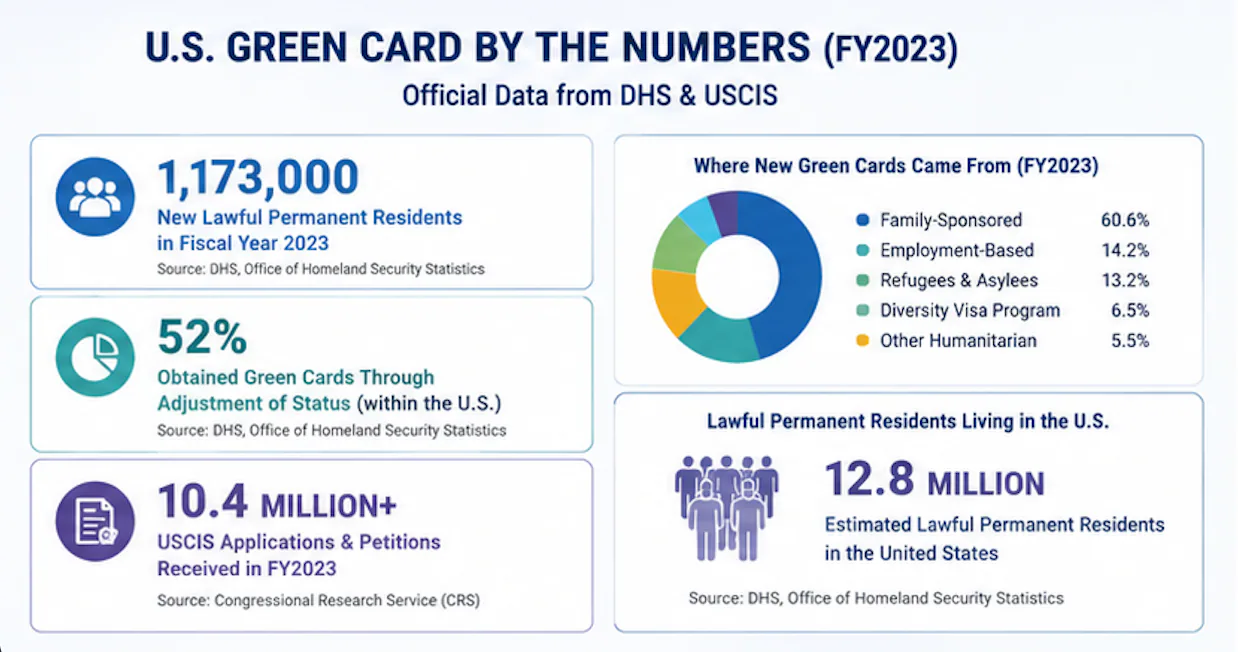
According to the U.S. Department of Homeland Security (DHS), the United States granted lawful permanent resident status to more than 1.17 million people during Fiscal Year (FY) 2023. Approximately 52% of those new Green Cards were issued through Adjustment of Status, meaning applicants were already living in the United States when they applied. The remaining applicants completed Consular Processing from overseas before entering the U.S. as permanent residents.
These numbers highlight an important fact: there isn't a single Green Card application journey. Different applicants follow different pathways, but all must successfully complete identity verification—including submitting compliant photographs whenever required.
In this guide, you'll learn:
- Who actually needs to apply for a Green Card
- The most common Green Card eligibility categories
- Typical applicant profiles and their biggest concerns
- Where photos fit into the USCIS application process
- The most common reasons Green Card applications are delayed or denied
- How PhotoOmni helps applicants reduce avoidable photo-related mistakes before submission
Rather than focusing only on technical photo specifications, this guide explains how Green Card photographs support identity verification throughout the entire immigration process, helping you understand not only what USCIS requires, but why those requirements matter.
Quick Answer
If you're applying for lawful permanent residence in the United States, you may need to submit passport-style photographs as part of your Green Card application, depending on the application type and filing method.
However, the photograph itself is rarely the biggest challenge.
Most Green Card delays occur because of eligibility issues, incomplete documentation, requests for additional evidence, or identity verification—not because applicants don't know the correct photo size.
Here's a simplified overview of the Green Card journey.
| Step | Why It Matters |
|---|---|
| Confirm your eligibility | Determine whether you qualify under a USCIS Green Card category. |
| Prepare your application | Complete the correct forms and gather supporting evidence. |
| Submit photographs (when required) | Provide compliant photos that meet current USCIS standards. |
| Attend biometrics (if scheduled) | USCIS collects fingerprints, a digital photo, and your signature. |
| Complete background checks | Identity and security checks are performed. |
| Receive a decision | USCIS approves, requests additional evidence, or denies the application based on the full case—not the photo alone. |
A compliant photo is important, but it represents just one component of a much broader identity verification process.
What Is a Green Card?
A Green Card, officially called a Permanent Resident Card (Form I-551), allows a foreign national to live and work permanently in the United States.
Green Card holders can:
- Live anywhere in the United States.
- Work for almost any employer without requiring a separate work visa.
- Travel internationally while maintaining permanent resident status (subject to immigration rules).
- Sponsor certain family members for immigration.
- Apply for U.S. citizenship after meeting the applicable residency and legal requirements.
Although people often use the terms "Green Card" and "U.S. permanent residency" interchangeably, receiving a Green Card does not automatically make someone a U.S. citizen.
Who Needs a Green Card?
One of the biggest misconceptions is that anyone living in the United States should apply for a Green Card.
In reality, only individuals who qualify under one of the eligibility categories established by Congress and administered by USCIS can become lawful permanent residents.
Below are the most common applicant groups.
| Applicant Type | Typical Immigration Path | Usually Eligible? |
|---|---|---|
| Spouse of a U.S. citizen | Family-based immigration | ✅ Yes |
| Parent or child of a U.S. citizen | Family-based immigration | ✅ Yes |
| Sponsored by a U.S. employer | Employment-based immigration | ✅ Yes |
| EB-5 investor | Investment immigration | ✅ Yes |
| Refugee or asylee | Humanitarian immigration | ✅ Yes (after meeting eligibility requirements) |
| Diversity Visa winner | Diversity Visa Program | ✅ Yes |
| Tourist (B-1/B-2) | Temporary visit | ❌ No, unless eligible through another pathway |
| International student (F-1) | Study visa | ❌ Not automatically |
| Temporary worker (H-1B, L-1, O-1, etc.) | Nonimmigrant work visa | ⚠️ May qualify later through employer sponsorship or another category |
Understanding your eligibility category is the first—and arguably the most important—step in the Green Card process. Preparing the perfect passport photo won't help if you apply under the wrong immigration category.
Who Applies for Green Cards? Understanding the Typical Applicant
Although millions of people dream of obtaining permanent residency in the United States, most Green Card applicants fall into a relatively small number of categories.
Understanding these applicant profiles helps explain why different people have different concerns throughout the process.
Persona 1: Family-Based Applicants
This is the largest Green Card category in the United States.
Typical applicants include:
- Spouses of U.S. citizens
- Parents of adult U.S. citizens
- Children of permanent residents
- Immediate relatives sponsored by family members
Their biggest concerns usually include:
- Processing times
- Marriage evidence
- Interview preparation
- Supporting documentation
- Ensuring every required document—including photographs—is submitted correctly the first time
Persona 2: Employment-Based Professionals
Many applicants already live and work in the United States under temporary visas before applying for permanent residence.
Common examples include professionals holding:
- H-1B visas
- L-1 visas
- O-1 visas
- EB-2 and EB-3 employment-based petitions
Their priorities are often different from family applicants.
Instead of marriage interviews, they focus on:
- Adjustment of Status (Form I-485)
- Employment authorization
- Biometrics appointments
- Maintaining lawful status while the application is pending
Persona 3: Families Applying Together
Many Green Card applications involve an entire family rather than a single individual.
Parents often need to prepare applications for:
- Themselves
- Their spouse
- One or more children
This creates additional challenges because every family member may need separate photographs, supporting documents, and identity verification records.
For parents with infants or young children, taking compliant immigration photos can be especially difficult, making preparation even more important.
U.S. Green Card Statistics: Why This Process Matters
The scale of the U.S. immigration system explains why USCIS has developed standardized identity verification procedures, including strict photo requirements.
According to the Department of Homeland Security's Office of Homeland Security Statistics (OHSS):
| FY2023 Official Statistics | Figure |
|---|---|
| New Lawful Permanent Residents | 1.173 million |
| Adjustment of Status approvals | Approximately 52% |
| Consular Processing approvals | Approximately 48% |
| Estimated Lawful Permanent Residents living in the U.S. | About 12.8 million |
| USCIS applications and petitions received (FY2023) | More than 10 million |
These figures illustrate why identity verification is such an important part of the Green Card process. Every year, USCIS and its partner agencies process millions of immigration benefits while protecting against identity fraud and ensuring that immigration records accurately match each applicant.
For applicants, this means that accuracy matters at every stage—from choosing the correct eligibility category to submitting complete supporting documents and compliant photographs.
Why Understanding the Process Is More Important Than Memorizing Photo Rules
Many websites focus only on Green Card photo dimensions, but applicants who understand the entire immigration process are better prepared to avoid delays.
A US passport photo maker can apply these dimensions and formatting checks to the uploaded photo.
A compliant photograph is important, yet it is only one piece of a successful application. Eligibility, supporting evidence, identity verification, biometrics, and background checks all work together to determine the outcome of your case.
Understanding the U.S. Green Card Application Process
Once you've confirmed that you're eligible for a Green Card, the next step is understanding how the application process works. This is where many applicants become confused, particularly about when passport-style photos are required and how they differ from the photo taken during a USCIS biometrics appointment.
One of the most common misconceptions is that submitting a compliant photo is the final identity check. In reality, your photo is just one part of a multi-step verification process that combines documentation, biometrics, security screening, and background checks.
The exact process varies depending on your immigration category, but most Green Card applicants follow a similar journey.
Determine Eligibility
          ↓
Submit Petition (if required)
          ↓
File Green Card Application
          ↓
Submit Supporting Documents & Photos
          ↓
USCIS Case Review
          ↓
Biometrics Appointment
          ↓
Background & Security Checks
          ↓
Interview (if required)
          ↓
Final Decision
          ↓
Green Card Production
At several stages of this process, USCIS uses your photograph to verify your identity and ensure that your application records match the correct individual.
When Are Green Card Photos Required?
Contrary to popular belief, not every Green Card applicant submits photos at the same stage.
The timing depends on how you're applying.
| Application Type | When Photos Are Typically Required |
|---|---|
| Adjustment of Status (Form I-485) | Submitted with the application package (unless USCIS instructions state otherwise) |
| Consular Processing | Submitted according to National Visa Center (NVC) or U.S. embassy instructions |
| Green Card Renewal (Form I-90) | Depends on filing method and USCIS instructions |
| Replacement Green Card | May require new photographs depending on the reason for replacement |
| Certain humanitarian applications | Follow the specific form instructions provided by USCIS |
Always follow the latest instructions for the form you're filing, as USCIS occasionally updates document requirements.
One important point is that the passport-style photos submitted with your application are not the same as the digital photograph collected during biometrics.
Many applicants mistakenly believe one replaces the other, but they serve different purposes.
Passport Photos vs. Biometrics Photos
This is one of the most misunderstood parts of the Green Card process.
The passport-style photographs you submit with your application are used during case processing and document production.
Later, if USCIS schedules you for a biometrics appointment, a new digital photograph will usually be taken together with your fingerprints and electronic signature.
These are two separate identity verification steps.
| Submitted Application Photo | Biometrics Appointment Photo |
|---|---|
| Submitted by the applicant | Captured by USCIS |
| Passport-style photograph | Live digital image |
| Supports document processing | Confirms identity in person |
| Included with application materials | Collected together with fingerprints and signature |
Understanding this distinction helps applicants prepare correctly and avoids confusion when USCIS later schedules a biometrics appointment.
What Happens During a USCIS Biometrics Appointment?
Most Adjustment of Status applicants—and many other Green Card applicants—are required to attend a USCIS Application Support Center (ASC) for biometrics.
Although the appointment is relatively short, it plays an important role in verifying your identity.
A typical appointment includes:
| Step | What Happens |
|---|---|
| Identity Check | USCIS verifies your appointment notice and passport or other acceptable identification. |
| Fingerprints | Digital fingerprints are collected electronically. |
| Photograph | A live digital facial image is captured. |
| Electronic Signature | You confirm that the information provided is accurate. |
| Data Transmission | Your biometric information is securely transmitted for background and security screening. |
Most appointments take 15 to 30 minutes, although waiting times vary depending on the location and appointment schedule.
It's important to remember that the biometrics appointment is not an interview. USCIS officers generally do not evaluate your eligibility during this visit; instead, they collect biometric data used to process your application.
Where Does USCIS Use Your Photo?
Many applicants assume their Green Card photo exists only so it can appear on the finished card.
In reality, your photograph supports multiple stages of the immigration process.
Your image may be used for:
- Confirming that your application matches your identity.
- Comparing your appearance with your passport or travel documents.
- Supporting background and security checks.
- Producing your Permanent Resident Card.
- Verifying identity during future USCIS applications.
- Helping prevent identity fraud.
- Supporting employment eligibility verification when appropriate.
Because your photograph becomes part of your immigration record, accuracy is far more important than appearance.
The Biggest Risks During a Green Card Application
Many people worry that an incorrect photo will automatically lead to a Green Card denial.
Fortunately, that's usually not the case.
A photo that doesn't meet USCIS requirements is more likely to result in a request for replacement photographs than an outright denial.
Far more significant risks involve eligibility and supporting evidence.
The table below summarizes common issues.
| Risk Level | Example | Possible Outcome |
|---|---|---|
| 🟢 Low | Photo doesn't meet technical requirements | USCIS may request replacement photos, which can delay processing. |
| 🟡 Moderate | Missing supporting documents or incomplete forms | Request for Evidence (RFE) or additional documentation. |
| 🟠 High | Applicant doesn't qualify under the chosen immigration category | Application may be denied. |
| 🔴 Very High | Fraud, false documents, or material misrepresentation | Denial and potentially serious immigration consequences. |
This distinction is important.
While applicants often spend hours worrying about the exact background color of their photograph, USCIS is generally much more concerned with whether:
- You qualify under immigration law.
- Your supporting evidence is complete.
- Your identity can be verified.
- Your application is truthful and consistent.
A technically imperfect photo is often fixable.
Eligibility problems usually are not.
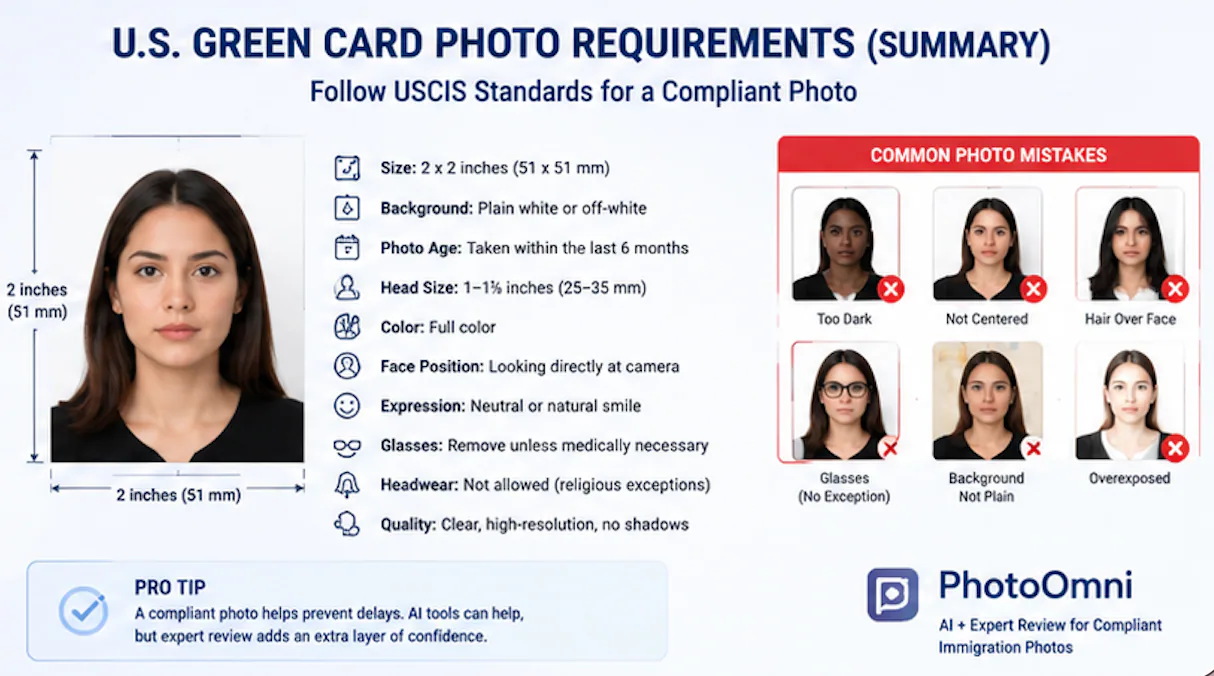
Why Photo Quality Still Matters
Although photographs rarely determine whether a Green Card application is approved, they can still affect how smoothly your case moves through the system.
Common photo-related issues include:
- Incorrect cropping.
- Poor lighting.
- Shadows across the face.
- Low image resolution.
- Backgrounds that don't meet USCIS standards.
- Photos that no longer resemble the applicant.
When these issues are identified, USCIS may request replacement photographs before continuing to process the application.
This creates avoidable delays—especially when applicants are living overseas or working within strict immigration timelines.
How PhotoOmni Helps Reduce Avoidable Photo-Related Delays
Preparing a compliant immigration photo doesn't have to be stressful.
PhotoOmni is designed to help applicants prepare passport and immigration photos that align with current USCIS photo specifications before submission.
Instead of simply removing the background, PhotoOmni combines multiple verification steps to identify common issues that applicants often overlook.
AI Compliance Checks
PhotoOmni automatically evaluates factors such as:
- Background consistency.
- Face positioning.
- Cropping.
- Image resolution.
- Lighting balance.
This helps identify technical issues before you submit your application.
Optional Expert Verification
For applicants who want additional confidence, PhotoOmni also offers an optional expert review.
Before your final download, trained reviewers examine the photo against current USCIS photo requirements and check for issues such as:
- Incorrect head positioning.
- Uneven lighting.
- Visible shadows.
- Improper cropping.
- Background inconsistencies.
While no service can guarantee Green Card approval, an expert review can help reduce the likelihood of photo-related replacement requests or avoidable processing delays, allowing applicants to submit their photos with greater confidence.
Official U.S. Green Card Photo Requirements (What Actually Matters)
After understanding the Green Card application process, it's much easier to see why USCIS asks for passport-style photographs. The goal isn't simply to print your photo on a Permanent Resident Card—it is to establish and verify your identity consistently throughout the immigration process.
Fortunately, the technical photo requirements are relatively straightforward. The key is submitting a recent, clear photograph that accurately represents your current appearance.
| Requirement | USCIS Standard |
|---|---|
| Photo Size | 2 × 2 inches (51 × 51 mm) |
| Background | Plain white or off-white |
| Photo Age | Taken within the last 6 months |
| Color | Full color |
| Face Position | Looking directly at the camera |
| Head Size | Approximately 1–1⅜ inches (25–35 mm) |
| Glasses | Remove unless medically necessary |
| Editing | No beauty filters or facial alterations |
Instead of trying to create the "perfect" photo, focus on meeting these basic USCIS requirements while ensuring the image accurately reflects your current appearance.
Green Card Photo Checklist
Before submitting your application, use this quick checklist.
Identity
✅ The photo was taken within the last six months.
✅ It accurately reflects your current appearance.
✅ Your face is fully visible.
Technical Quality
✅ Plain white background.
✅ Even lighting.
✅ High-resolution image.
✅ No blur.
✅ No shadows.
Appearance
✅ Looking directly at the camera.
✅ Eyes open.
✅ Neutral expression or natural smile.
✅ Hair does not cover your face.
Submission
✅ Following the instructions for your specific USCIS form.
✅ Original digital image retained in case USCIS requests another copy.
Taking a few minutes to review these items before submitting your application can help prevent avoidable requests for replacement photographs.
Frequently Asked Questions
Can a bad photo cause my Green Card application to be denied?
Usually, no.
In most cases, if your photo doesn't meet USCIS requirements, you'll be asked to submit a replacement rather than having your application denied solely because of the photograph.
However, replacing photos can delay processing, particularly if USCIS must pause your case while waiting for new documents.
To avoid this, learn about the most common reasons photos are rejected so you can get it right the first time.
Can I use the same photo as my U.S. passport?
Often, yes.
If the photo:
- Was taken within the last six months,
- Still reflects your current appearance, and
- Meets current USCIS requirements,
it may also be suitable for your Green Card application.
Do children need separate Green Card photos?
Yes.
Every applicant—including infants and young children—must generally provide photographs that meet the applicable USCIS requirements.
Parents should ensure the child's face is fully visible and free from toys, blankets, or other objects that could obscure facial features.
If you're preparing photos for your family, check our guide to taking passport photos at home for tips on photographing children.
Is the photo taken at my biometrics appointment the same as my application photo?
No.
These serve different purposes.
The passport-style photographs submitted with your application support case processing, while the photograph taken during your biometrics appointment is captured directly by USCIS as part of in-person identity verification.
Can I use AI to edit my Green Card photo?
Basic adjustments—such as background removal or cropping—may be acceptable if they do not change your appearance.
However, you should avoid AI features that:
- Smooth skin.
- Change facial shape.
- Remove natural features.
- Alter eye size or facial proportions.
- Apply beauty filters.
Your submitted image should accurately represent how you look today.
What happens if USCIS requests a new photo?
If USCIS determines that your photo doesn't meet the required standards, you'll generally receive instructions explaining what needs to be corrected.
Responding promptly with a compliant replacement photo can help your application continue moving through the review process.
Why More Applicants Are Preparing Photos Online
Over the past few years, more applicants have chosen to prepare immigration photos from home rather than visiting a traditional photo studio.
Several factors have contributed to this shift:
- Modern smartphone cameras capture high-resolution images suitable for immigration applications.
- AI-powered tools can assist with background removal and photo cropping.
- Applicants can review their photos before submission instead of relying on a single studio print.
- Online services make it easier for families applying together to prepare multiple compliant photos.
While convenience is important, accuracy remains the priority. Any online tool should help applicants meet USCIS requirements rather than simply producing a visually appealing image.
Why Choose PhotoOmni?
Preparing a Green Card application already involves enough paperwork. Your photo shouldn't become another source of uncertainty.
PhotoOmni is designed specifically for passport and immigration photos, helping applicants prepare compliant images before submitting them to USCIS.
AI-Powered Photo Preparation
PhotoOmni automatically helps with:
- Background removal.
- Intelligent cropping.
- Face positioning.
- Image quality checks.
- Resolution optimization.
Instead of manually editing photos, applicants can prepare an immigration-ready image in just a few minutes.
Optional Expert Verification
One feature that distinguishes PhotoOmni from many basic photo editors is its optional expert verification.
After the AI completes the initial checks, experienced reviewers can examine your image against current USCIS photo requirements.
The review helps identify common issues such as:
- Uneven lighting.
- Background inconsistencies.
- Incorrect head positioning.
- Improper cropping.
- Low image quality.
This additional review provides another layer of confidence before submission.
It's important to note that no photo service can guarantee Green Card approval. USCIS decisions are based on eligibility, supporting evidence, security screening, and many other factors.
However, submitting a photo that already meets the required standards can reduce the likelihood of photo-related replacement requests and avoidable processing delays, allowing you to focus on the more important parts of your application.
Final Thoughts
Applying for a Green Card is about much more than completing forms or submitting a passport photo. It's a legal process that requires applicants to demonstrate eligibility, provide accurate supporting evidence, complete identity verification, and satisfy USCIS security and background checks.
According to the Department of Homeland Security, more than 1.173 million people became lawful permanent residents during FY2023, and approximately 52% of them obtained their Green Cards through Adjustment of Status while already living in the United States. At the same time, USCIS received more than 10 million immigration benefit requests, illustrating the enormous scale of the U.S. immigration system.
Within this process, your photograph serves an important—but limited—role. A compliant photo won't guarantee approval, just as a minor photo issue usually won't result in an automatic denial. What it can do is help prevent unnecessary delays caused by replacement requests, allowing your application to move forward more efficiently.
If you're preparing your Green Card application from home, PhotoOmni combines AI-powered compliance checks with optional expert verification to help you identify common photo issues before submission. By reducing avoidable photo-related mistakes, you can submit one part of your application with greater confidence and focus your attention on the documents and evidence that matter most.
About the Author
Emma Richardson Senior ICAO Photo Compliance Expert, PhotoOmni
Emma Richardson is the Senior ICAO Photo Compliance Expert at PhotoOmni. With 12+ years of experience in passport and visa photo verification, she has helped applicants achieve 820,000+ successful photo approvals across 100+ countries and territories. She specializes in global passport photo requirements, ICAO-compliant photo standards, and biometric image verification.
Related Articles
- How to Take a Passport Photo at Home (2026 Guide)
- Passport Photo Requirements: The Complete 2026 Guide
- Why Was My Passport Photo Rejected? 15 Common Reasons & Fixes
Data sources: US Department of Homeland Security Office of Homeland Security Statistics (FY2023), USCIS Fiscal Year 2023 statistical reports. Pricing based on publicly listed rates as of July 2026.