
Can You Wear Makeup in a Passport Photo? Foundation, Lipstick, Lashes, Contacts and Retouching
Learn how makeup, lipstick, lashes and contact lenses affect US and UK passport photos, and why face retouching and beauty filters can cause rejection.
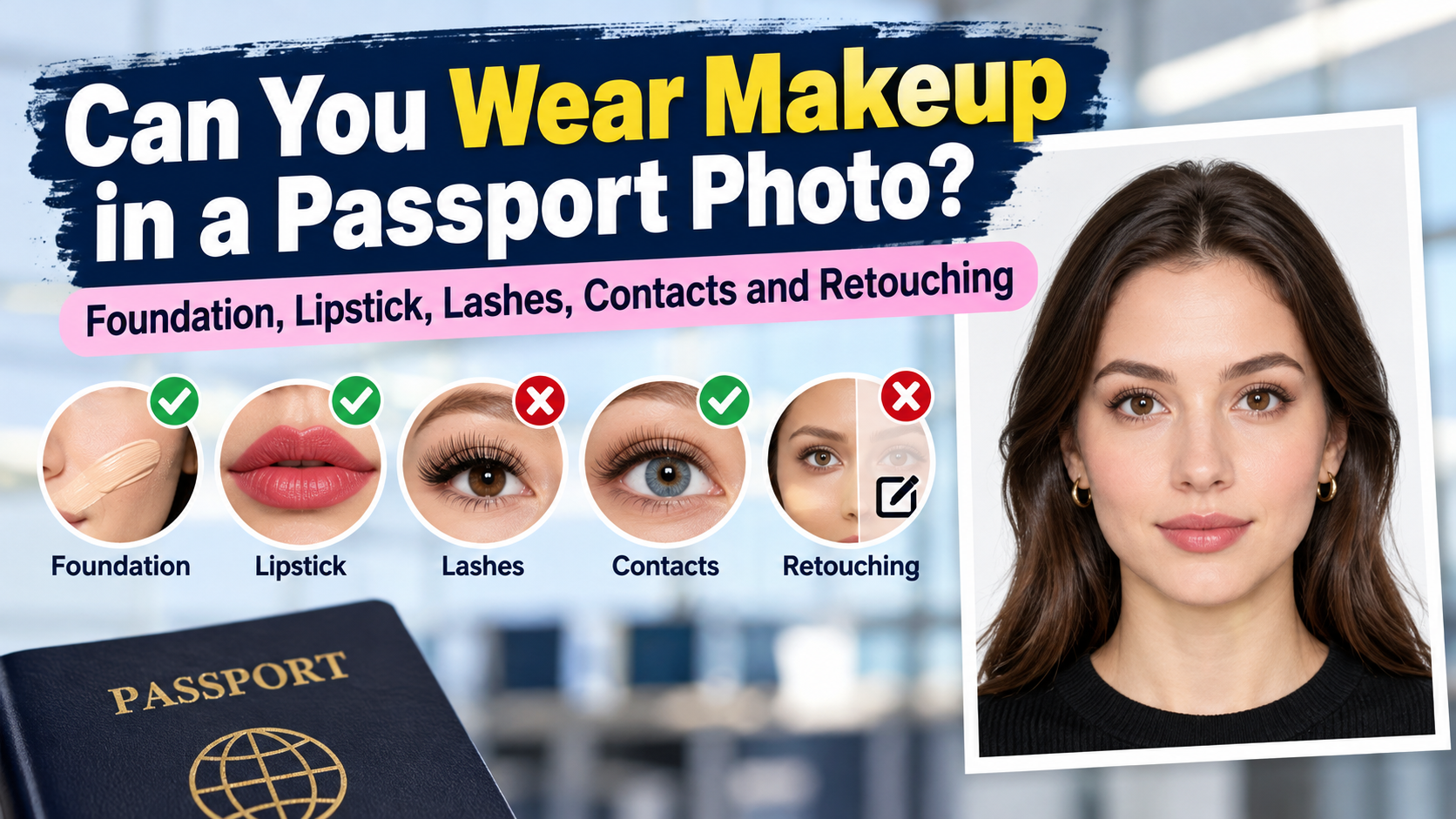
Quick Answer
Yes, you can wear makeup in a passport photo. Neither the US State Department nor the UK's HM Passport Office has a rule that bans it. What they check is whether the photo is a true likeness of you, whether your eyes are open and clearly visible, whether the lighting is even with no reflections or shadows hiding your face, and whether the image is free of digital retouching. Makeup only causes trouble when it breaks one of those tests: shimmer that creates glare, dramatic eye makeup or lashes that change how your eyes look, contouring that reads as shadow, or enlarging cosmetic lenses.
Which applications does this cover? The rules below are for US and UK passport photos. Visa and ID photos follow the same likeness principle, but always check the instructions for your specific document and country.
The biggest trap isn't makeup, it's editing. Both countries reject retouched faces. Covering a blemish with concealer is fine. Removing it in a photo app is not.
1. Why Guides Give Such Different Answers
Search this question and you will find advice that contradicts itself. Here is why.
There is no official makeup rule to quote. The US passport photo policy never sets a makeup standard. Its only mention of makeup is a note that permanent tattoos do not have to be covered with clothing or makeup. HM Passport Office's published examiner standards do not mention makeup either. So guides fill the gap with "unwritten rules" and personal opinion.
Guides disagree on false lashes and coloured contacts because nothing official names them. Some say "never", others call it a grey area. On contacts, a common claim is that coloured lenses are banned, but the US policy says the opposite: clear lenses are acceptable, and so are tinted and novelty lenses that do not obscure the eye, meaning they do not make the iris appear larger or smaller.
Makeup and retouching get mixed together. They are treated very differently. Makeup is part of how you actually look. Digital retouching changes the image, and both the US and UK rules reject it.
US and UK wording differs. The US policy says the expression should be natural and allows normal, unexaggerated smiles. The UK asks for a plain expression with the mouth closed, rejecting wide smiles, pouting or frowning. Lip colour and expression interact, so it matters which country you are applying to.
"Natural" does not mean "bare." Nobody requires a bare face. The standard is that the photo looks like you on an ordinary day.
2. What the Rules Actually Require, and How Makeup Can Trip Them
The tests that matter
| What is checked | Source | How makeup can interfere |
|---|---|---|
| Good likeness / true likeness of you | US: 22 CFR 51.26 via 8 FAM 402.1; UK: HMPO standards | A look so different from daily life that the photo no longer matches you |
| Natural skin tones reproduced accurately | US policy (about photo exposure and colour) | Indirect only: a foundation or tint far from your real skin tone can make the photo look unlike you |
| Uniform lighting, no reflections on the face | US policy | Shimmer, glitter, glossy highlighter, oily shine |
| No shadows hiding facial features | US and UK | Heavy contouring and thick lashes casting shadow over the eye |
| Both eyes open and clearly visible | UK: HMPO standards | Eye makeup or lashes that obscure the eye |
| No retouching, no beauty filters | US policy; UK standards | Smoothing, blemish removal, face reshaping in an app |
Item by item, with examples
| Makeup item | Verdict | Why | Example |
|---|---|---|---|
| Foundation and concealer | Fine, keep it matte | Your skin tone should read naturally and not shine | Your usual matte foundation: fine. A dewy, high-shine finish under a ceiling light: risks reflections on the cheeks and forehead |
| Powder | Fine | Helps control shine, which the lighting rule is about | Light setting powder on the T-zone: helpful |
| Contour, bronzer and blush | Keep it light | Heavy contouring creates tonal shadows that can read as shadow on the face and change how your features look | Soft blush: fine. Sculpted cheekbone contour you would never wear on a work day: skip it |
| Highlighter and shimmer | Skip it | Reflections on the face are what the US lighting rule warns against | Shimmer on cheekbones and the nose bridge, catching the light |
| Eyeshadow, eyeliner, mascara and brows | Fine if your eyes stay clearly visible | The test is visible, open eyes and a true likeness | Neutral shadow, thin liner and mascara: fine. Heavy smoky eyes or a long dramatic wing that changes the apparent eye shape: risky |
| Glitter shadow or face gems | Skip it | Reflections and distraction. The US policy rejects one-time facial decorations, and the UK rejects a temporary bindi made from a jewel or sticker | A stick-on gem at the corner of the eye |
| False lashes | Judgement call; skip dramatic ones | No official text names them. The risk is shadow over the eye or a look unlike your daily one | Everyday natural lashes: low risk. Long strip lashes casting shadow on the iris: skip |
| Lipstick and gloss | Fine, prefer matte | Nothing official bans colour. Gloss can reflect light, and expression rules apply | A natural or bold matte shade: fine. A high-shine gloss under direct light: can create glare |
| Coloured contacts | Depends on the lens | US: acceptable if they do not make the iris appear larger or smaller. Cosmetic lens wearers should list their natural eye colour on the form. UK: not addressed by name, but it asks for a true likeness and clearly visible eyes | Subtle tint: acceptable in the US. Enlarging "circle" lenses: not acceptable |
| Tattoos and permanent marks | Leave as they are | The US policy says there is no requirement to cover tattoos with makeup or clothing, and the UK accepts permanent tattoos | A neck or cheek tattoo: do not cover it |
The three example looks
Example A: everyday look. Matte foundation, neutral lip colour, mascara, light brow fill, soft blush. Even lighting, mouth relaxed, eyes open. This matches what you look like day to day. Low risk.
Example B: night-out look. Shimmer highlighter, long strip lashes, a sharp winged liner, heavy contour and bold gloss. Each piece is allowed in isolation. Together they create reflections, shadow over the eyes and a face that looks different from how you normally look. High risk of a likeness or lighting problem.
Example C: circle lenses plus beauty mode. Enlarging lenses make the iris appear bigger, which the US policy does not accept, and beauty mode retouches the face, which both countries reject. Two separate problems.
Contacts: what is and is not acceptable
- Clear contact lenses are acceptable (US policy).
- Tinted and novelty lenses are acceptable in the US if they do not obscure the eye, meaning they do not make the iris look larger or smaller.
- Even if you wear cosmetic lenses every day, the US policy says to list your natural eye colour on the application forms.
- The UK guidance does not name cosmetic lenses. Because it requires a true likeness and eyes that are clearly visible, a dramatic colour or size change is a risk.
Retouching and filters: where the hard line is
| US | UK | |
|---|---|---|
| Face retouching and beauty filters | Not acceptable | Digitally enhanced facial images are rejected, for example removing blemishes or making features larger or smaller |
| Filters | Social-media style filters not acceptable | Brightness and contrast adjustments accepted. Filters that add textures or effects, or make you look younger or older, are not |
| Background clean-up | Plain light background required | Examiner guidance says edits such as removing background shadows can be accepted if they do not affect the image of you. GOV.UK's public instructions still say the photo must be unaltered, so follow those |
Concealer versus retouching, as an example. You cover a spot with concealer, take the photo, and it is accepted as you look today. Or you take the photo, then erase the spot in an app: that is retouching, and it is rejected. The outcome on screen looks similar, but one is how you appear and the other is an edited image.
Phone cameras often apply retouching automatically. On many Android phones, for example, scene optimisers and face-retouching modes are on by default. PhotoOmni's Android passport photo guide shows how to switch them off.
3. How to Prepare a Compliant Photo When You Wear Makeup
- Do your normal everyday makeup. Not a new look. If a friend would not recognise you in it, change it.
- Go matte where it counts. Set the T-zone with powder, skip shimmer, and avoid gloss on lips and lids.
- Check your eyes. Keep lashes and liner so that both eyes are clearly open and visible, with no shadow across the iris.
- Take a few test shots in even, soft light. Daylight from a window works well. Avoid overhead lights and flash.
- Switch off beauty mode, portrait mode and any filters before you shoot.
- Review the photo zoomed in on a larger screen. Look for shine on cheeks and forehead, lash shadow, and a skin tone that looks natural.
- Compare with how you look in the mirror and on your ID. The photo should look like you.
- Do not edit the face. No smoothing, no blemish removal, no reshaping.
- Check against the official requirements for your country and, where available, the official online checker before submitting.
4. Time and Cost of Getting It Right
Makeup itself adds little. What costs time and money is a retake.
| Route | Cost | Time | Notes |
|---|---|---|---|
| Max Spielmann booth (UK) | £10 | Under 3 minutes | Self-service, automatic capture, no human check |
| Max Spielmann shop (UK) | £12.99 | About 5 minutes | A colleague checks the photo, with free retakes |
| Phone photo at home | Free | A few minutes | You are responsible for lighting and checking |
| PhotoOmni | One-time $5.99 | About 3 to 15 minutes | AI pre-check plus expert review before delivery |
A rejected photo delays your application, so spending a few extra minutes on lighting and checks is the cheapest fix.
5. Common Mistakes, With Examples
- Shimmer under overhead lighting. A highlighter that looks subtle in person can become two bright reflective patches in a photo. The US lighting rule asks for no reflections on the face.
- Lash shadow. Thick lashes lit from above can throw shadow over the eye, which conflicts with the requirement that eyes be clearly visible.
- Enlarging lenses. In the US they are not acceptable if they make the iris appear larger.
- Beauty mode left on. Skin smoothing and reshaping are retouching, and both countries reject it.
- Editing after the shot. Removing spots, whitening or reshaping features in an app is not allowed.
- Foundation that does not match your skin. No rule names this, but a shade that clearly differs from your neck or real colour makes the photo look less like you, which is the likeness test.
- Wide smile or pouting in the UK. Lip makeup invites expression, but the UK asks for a plain expression and mouth closed.
- Covering tattoos with makeup. Not needed; the US policy says tattoos need not be covered.
If your photo is rejected: read the reason given, fix that specific problem, and retake rather than editing the old file. Our guide to why passport photos get rejected covers the common causes, and our good vs bad passport photo examples show accepted and rejected patterns including hair, makeup and earrings.
6. PhotoOmni vs Other Ways to Get Your Photo
| Method | Best for | Watch out for |
|---|---|---|
| Booth or photo shop | Quick, in person, with a retailer check in some shops | Booths are automatic with no human review. Shops may offer retakes |
| Taking it yourself | Free, full control | Easy to miss shine, lash shadow or a filter you did not turn off |
| PhotoOmni US passport photo or UK passport photo | Preparing from home with an AI pre-check and expert review | It checks technical compliance. The final decision rests with the passport authority |
PhotoOmni is built for passport, visa and ID photos, and says its goal is to produce an image that accurately represents you rather than to enhance your appearance. That fits this topic: it checks things like lighting, shadows, background, framing and sharpness, and it cannot and should not make your face look different. Its pages list a one-time $5.99 fee and a refund guarantee for photo-related rejection, so check the refund policy for the terms. For a broader walkthrough, see our guides to taking a passport photo at home and the passport photo requirements.
7. Checklist Before You Submit
- I look like I do on an ordinary day
- Foundation is matte, with no shimmer, glitter or high-shine gloss
- Both eyes are open and clearly visible, with no lash or liner shadow across the iris
- No contour or highlight that reads as shadow or reflection
- No stick-on gems, stickers or one-time face decorations
- Contacts are clear, or tinted without making the iris look larger or smaller
- Natural eye colour listed on US forms if I wear cosmetic lenses
- Beauty mode, portrait mode and filters are off
- No retouching or blemish removal in any app
- Lighting is even, with no flash and no shadows on my face
- Expression matches my country's rule: natural in the US, plain with mouth closed in the UK
- Photo is recent and meets the size and format rules for my country
8. FAQ
Can you wear makeup in a US passport photo? Yes. The State Department's policy does not set a makeup rule. It requires a good likeness, natural skin tones, even lighting without reflections, and no retouching.
Can you wear makeup in a UK passport photo? Yes. HM Passport Office's published standards do not name makeup. They require a true likeness, eyes open and clearly visible, no shadows hiding the face, and no digital enhancement of the face.
Can you wear false eyelashes? No official text names them. The practical risk is shadow over the eye or a look very different from your daily one. If you wear modest lashes every day, the risk is lower. Dramatic strip lashes are best skipped.
Can you wear coloured contacts? In the US, yes if they do not obscure the eye, meaning they do not make the iris appear larger or smaller. List your natural eye colour on the forms. UK guidance does not name cosmetic lenses, so avoid dramatic changes.
Can I wear lipstick or a bold lip colour? Yes. No rule bans colour. Prefer a matte finish to avoid glare, and keep your expression within your country's rule.
Can I cover a spot with concealer? Yes. That is makeup. Removing it digitally is retouching and is rejected.
Are beauty filters allowed? No. The US policy rejects beauty filters and retouching. The UK rejects enhanced facial images, and filters that add effects or change apparent age.
Do I have to cover my tattoos with makeup? No. The US policy says permanent tattoos need not be covered with clothing or makeup, and the UK accepts permanent tattoos.
Should I wear less makeup than usual? Not necessarily. Aim for how you normally look. Just avoid shine, heavy shadow and anything that obscures your eyes.
Do these rules apply to visas and ID cards? The likeness principle is similar, but each document has its own instructions, so check the one for your application.
Final Take
Wear the makeup you normally wear, keep it matte, keep your eyes clearly visible, and never edit the face. If you want a second pair of eyes before you submit, PhotoOmni can check your photo for lighting, shadow, framing and other technical problems first, while the authority makes the final call.